Friday, January 28, 2011

Happy feast of St Thomas!


FAITH - REJECTING ONE ARTICLE OF


"To reject any article of the faith is to reject the faith itself. This is like pulling one stone out of an arch; it is like putting one hole in the hull of a ship. The whole arch tumbles down; the whole ship sinks. A man who has the faith, accepts God's word. Now, God's word has set up the Church as man's infallible teacher and guide. If a man, therefore, rejects one article of the faith, and says that he believes all the other articles, he believes these by his own choice and opinion, not by faith. Rejecting one article of the faith, he rejects the whole authority of the Church, and he rejects the authority of God who has set up and authorized the Church to teach truth. Hence, it is entirely incorrect to say that am man may have lifeless or formless faith in some article of the Creed while he rejects others; such a man has not the faith at all, living or lifeless." Thomas Aquinas, Summa IIa IIae Q5


Sorry, I lost the source of the above quote, which is based on the Summa, as opposed to IN the Summa.

Thursday, January 27, 2011

From "Bad Vestments" blog

I fount this image at the site "Bad Vestments" which is so like a train wreck where you don't want to see the carnage but can't help but look.

anyway, this had me in stitches...


Bad Vestments post can be found here

Link between liturgical and sexual abuse?

Anita (V-for Victory) found an article which we’d read a few years ago and lost the link to, and so I’m posting the link again so that I won’t loose it.

In this article, the author, Fr. Farfaglia, makes the provocative suggestion that sexual impurity is perhaps at the heart of liturgical abuse. Following is the section of the article; I suggest you read the whole thing at Renew America.

Another cause of the present state of emergency with regard to the liturgy could be the underlying cause of the entire mess we're in. Having taught the Catechism of the Catholic Church to a large number of parishioners, I have found the following insight of the Catechism to be quite amazing. When discussing the Ninth Commandment, the Catechism states:

'The sixth beatitude proclaims, 'Blessed are the pure in heart, for they shall see God.' Pure in heart refers to those who have attuned their intellects and wills to the demands of God's holiness, chiefly in three areas: charity; chastity or sexual rectitude; love of the truth and orthodoxy of faith. There is a connection between purity of heart, of body, and of faith' (#2518).

It is interesting to note, based upon a lifetime of observation, that those priests who habitually carry on with women, or those active homosexual priests who carry on with their proclivities, are guilty of the most obtrusive and bizarre liturgical abuses. There is a connection between purity of heart, of body, and of faith.

Fr James Farfaglia, “State of Emergency, The Present Situation of the Catholic Liturgy in America, in Renew America, 2007 (link)

Where there’s smoke, there’s fire?

Additionally, at Chiesa Online, Sandro Magister recently quoted from Cardinal Biffi’s book, Memories of an Italian Cardinal. He has an interesting thing to say on The Ideology of Homosexuality:

Regarding the problem of homosexuality that is emerging today, the Christian conception tells us that one must always distinguish the respect due to persons, which involves rejecting any marginalization of them in society and politics (except for the unalterable nature of marriage and the family), from the rejection of any exalted "ideology of homosexuality," which is obligatory.

The word of God, as we know it in a page of the letter to the Romans by the apostle Paul, offers us on the contrary a theological interpretation of the rampant cultural aberration in this matter: such an aberration – the sacred text affirms – is at the same time the proof and the result of the exclusion of God from the collective attention and from social life, and of the refusal to give him the glory that he is due (cf. Romans 1:21).

The exclusion of the Creator determines a universal derailing of reason: "They became vain in their reasoning, and their senseless minds were darkened. While claiming to be wise, they became fools" (Romans 1:21-22). The result of this intellectual blindness was a fall, in both theory and practice, into the most complete dissoluteness: "Therefore, God handed them over to impurity through the lusts of their hearts for the mutual degradation of their bodies" (Romans 1:24).

And to prevent any misunderstanding and any accommodating interpretation, the apostle proceeds with a startling analysis, formulated in perfectly explicit terms:

"Therefore, God handed them over to degrading passions. Their females exchanged natural relations for unnatural, and the males likewise gave up natural relations with females and burned with lust for one another. Males did shameful things with males and thus received in their own persons the due penalty for their perversity. And since they did not see fit to acknowledge God, God handed them over to their undiscerning mind to do what is improper" (Romans 1:26-28).

Finally, Paul takes pains to observe that the greatest abjection takes place when "the authors of these things . . . not only do them but give approval to those who practice them" (cf. Romans 1:32).

It is a page of the inspired book, which no earthly authority can force us to censor. Nor are we permitted, if we want to be faithful to the word of God, the pusillanimity of passing over it in silence out of concern not to appear "politically incorrect."

We must on the contrary point out the singular interest for our days of this teaching of Revelation: what St. Paul revealed as taking place in the Greco-Roman world is shown to correspond prophetically to what has taken place in Western culture in these last centuries. The exclusion of the Creator – to the point of proclaiming grotesquely, a few decades ago, the "death of God" – has had the result (almost like an intrinsic punishment) of the spread of an aberrant view of sexuality, unknown (in its arrogance) to previous eras.

The ideology of homosexuality – as often happens to ideologies when they become aggressive and end up being politically triumphant – becomes a threat to our legitimate autonomy of thought: those who do not share it risk condemnation to a kind of cultural and social marginalization.

The attacks on freedom of thought start with language. Those who do not resign themselves to accept "homophilia" (the theoretical appreciation of homosexual relations) are charged with "homophobia" (etymologically, the "fear of homosexuality"). This must be very clear: those who are made strong by the inspired word and live in the "fear of God" are not afraid of anything, except perhaps the stupidity toward which, Bonhoeffer said, we are defenseless. We are now even charged sometimes with the incredibly arbitrary accusation of "racism": a word that, among other things, has nothing to do with this issue, and in any case is completely extraneous to our doctrine and our history.

The essential problem that presents itself is this: is it still permitted in our days to be faithful and consistent disciples of the teaching of Christ (which for millennia has inspired and enriched the whole of Western civilization), or must we prepare ourselves for a new form of persecution, promoted by homosexual activists, by their ideological accomplices, and even by those whose task it should be to defend the intellectual freedom of all, including Christians?

There is one question that we ask in particular of the theologians, biblicists, and pastoralists. Why on earth, in this climate of almost obsessive exaltation of Sacred Scripture, is the Pauline passage of Romans 1:21-32 never cited by anyone? Why on earth is there not a little more concern to make it known to believers and nonbelievers, in spite of its evident timeliness?

Giacomo Biffi, "Memorie e digressioni di un italiano cardinale," Translation by Matthew Sherry for Sandro Magister, Chiesa Online (Link)


To make it even more interesting, Athanasius Schneider, the Auxiliary Bishop of Kazakhstan has issued a call for clarification – (will the real Vatican II please stand up!) in the form of a Syllabus of errors:

[. . .] For a correct interpretation of Vatican Council II, it is necessary to keep in mind the intention manifested in the conciliar documents themselves and in the specific words of the popes who convened and presided over it, John XXIII and Paul VI.

Moreover, it is necessary to discover the common thread of the entire work of the Council, meaning its pastoral intention, which is the "salus animarum," the salvation of souls. This, in turn, depends on and is subordinate to the promotion of divine worship and of the glory of God, it depends on the primacy of God.

This primacy of God in life and in all the activity of the Church is manifested unequivocally by the fact that the constitution on the liturgy occupies, conceptually and chronologically, the first place in the vast work of the Council. [. . .]

*

The characteristic of the rupture in the interpretation of the conciliar texts is manifested in a more stereotypical and widespread way in the thesis of an anthropocentric, secularist, or naturalistic shift of Vatican Council II with respect to the previous ecclesial tradition.

One of the best-known manifestations of such a mistaken interpretation has been, for example, so-called liberation theology and the subsequent devastating pastoral practice. What contrast there is between this liberation theology and its practice and the Council appears evident from the following conciliar teaching: "Christ, to be sure, gave His Church no proper mission in the political, economic or social order. The purpose which He set before her is a religious one" (cf. "Gaudium et Spes," 42). [. . .]

One interpretation of rupture of lighter doctrinal weight has been manifested in the pastoral-liturgical field. One might mention in this regard the decline of the sacred and sublime character of the liturgy, and the introduction of more anthropocentric elements of expression.

This phenomenon can be seen in three liturgical practices that are fairly well known and widespread in almost all the parishes of the Catholic sphere: the almost complete disappearance of the use of the Latin language, the reception of the Eucharistic body of Christ directly in the hand while standing, and the celebration of the Eucharistic sacrifice in the modality of a closed circle in which priest and people are constantly looking at each other.

This way of praying – without everyone facing the same direction, which is a more natural corporal and symbolic expression with respect to the truth of everyone being oriented toward God in public worship – contradicts the practice that Jesus himself and his apostles observed in public prayer, both in the temple and in the synagogue. It also contradicts the unanimous testimony of the Fathers and of all the subsequent tradition of the Eastern and Western Church.

These three pastoral and liturgical practices glaringly at odds with the law of prayer maintained by generations of the Catholic faithful for at least one millennium find no support in the conciliar texts, and even contradict both a specific text of the Council (on the Latin language: cf. "Sacrosanctum Concilium," 36 and 54) and the "mens," the true intention of the conciliar Fathers, as can be seen in the proceedings of the Council.

*

In the hermeneutical uproar of the contrasting interpretations, and in the confusion of pastoral and liturgical applications, what appears as the only authentic interpreter of the conciliar texts is the Council itself, together with the pope.

One could make a comparison with the confused hermeneutical climate of the first centuries of the Church, caused by arbitrary biblical and doctrinal interpretations on the part of heterodox groups. In his famous work "De Praescriptione Haereticorum," Tertullian was able to counter the heretics of various tendencies with the fact that only the Church possesses the "praescriptio," meaning only the Church is the legitimate proprietor of the faith, of the word of God and of the tradition. The Church can use this to fend off the heretics in disputes over true interpretation. Only the Church can say, according to Tertullian, "Ego sum heres Apostolorum," I am the heir of the apostles. By way of analogy, only the supreme magisterium of the pope or of a future ecumenical council will be able to say: "Ego sum heres Concilii Vaticani II."

In recent decades there existed, and still exist today, groupings within the Church that are perpetrating an enormous abuse of the pastoral character of the Council and its texts, written according to this pastoral intention, since the Council did not want to present its own definitive or unalterable teachings. From the same pastoral nature of the texts of the Council, it can be seen that its texts are in principle open to supplementation and to further doctrinal clarifications. Keeping in mind the now decades-long experience of interpretations that are doctrinally and pastorally mistaken and contrary to the bimillennial continuity of the doctrine and prayer of the faith, there thus arises the necessity and urgency of a specific and authoritative intervention of the pontifical magisterium for an authentic interpretation of the conciliar texts, with supplementation and doctrinal clarifications; a sort of "Syllabus" of the errors in the interpretation of Vatican Council II.

There is the need for a new Syllabus, this time directed not so much against the errors coming from outside of the Church, but against the errors circulated within the Church by supporters of the thesis of discontinuity and rupture, with its doctrinal, liturgical, and pastoral application.

Such a Syllabus should consist of two parts: the part that points out the errors, and the positive part with proposals for clarification, completion, and doctrinal clarification.

*

Two groupings stand out for their support of the theory of rupture. One of these groupings tries to "Protestantize" the life of the Church doctrinally, liturgically, and pastorally. On the opposite side are those traditional groups which, in the name of tradition, reject the Council and exempt themselves from submission to the supreme living magisterium of the Church, from the visible head of the Church, the vicar of Christ on earth, submitting meanwhile only to the invisible head of the Church, waiting for better times. [. . .]

In essence, there have been two impediments preventing the true intention of the Council and its magisterium from bearing abundant and lasting fruit.

One was found outside of the Church, in the violent process of cultural and social revolution during the 1960's, which like every powerful social phenomenon penetrated inside the Church, infecting with its spirit of rupture vast segments of persons and institutions.

The other impediment was manifested in the lack of wise and at the same time intrepid pastors of the Church who might be quick to defend the purity and integrity of the faith and of liturgical and pastoral life, not allowing themselves to be influenced by flattery or fear.

The Council of Trent had already affirmed in one of its last decrees on the general reform of the Church: "The holy synod, shaken by the many extremely serious evils that afflict the Church, cannot do other than recall that the thing most necessary for the Church of God is to select excellent and suitable pastors; all the more in that our Lord Jesus Christ will ask for an account of the blood of those sheep that should perish because of the bad governance of negligent pastors unmindful of their duty" (Session XXIV, Decree "de reformatione," can. 1).

The Council continued: "As for all those who for any reason have been authorized by the Holy See to intervene in the promotion of future prelates or those who take part in this in another way, the holy Council exhorts and admonishes them to remember above all that they can do nothing more useful for the glory of God and the salvation of the people than to devote themselves to choosing good and suitable pastors to govern the Church."

So there is truly a need for a Syllabus on the Council with doctrinal value, and moreover there is a need for an increase in the number of holy, courageous pastors deeply rooted in the tradition of the Church, free from any sort of mentality of rupture, both in the doctrinal field and in the liturgical field.

These two elements constitute the indispensable condition so that doctrinal, liturgical, and pastoral confusion may diminish significantly, and so that the pastoral work of Vatican Council II may bear much lasting fruit in the spirit of the tradition, which connects us to the spirit that has reigned in every time, everywhere and in all true children of the Catholic Church, which is the only and the true Church of God on earth.


As reported by Sandro Magister, Chiesa Online (link)


Five years have passed since the Holy Father Benedict XVI spoke of the clash between the right and wrong interpretation of Vatican II, the conflict between the hermeneutic of rupture versus the hermeneutic of reform, presented to the Roman Curia in his Christmas message of Dec 22, 2005:

[] it all depends on the correct interpretation of the Council or - as we would say today - on its proper hermeneutics, the correct key to its interpretation and application. The problems in its implementation arose from the fact that two contrary hermeneutics came face to face and quarrelled with each other. One caused confusion, the other, silently but more and more visibly, bore and is bearing fruit.

On the one hand, there is an interpretation that I would call "a hermeneutic of discontinuity and rupture"; it has frequently availed itself of the sympathies of the mass media, and also one trend of modern theology. On the other, there is the "hermeneutic of reform", of renewal in the continuity of the one subject-Church which the Lord has given to us. She is a subject which increases in time and develops, yet always remaining the same, the one subject of the journeying People of God.

The hermeneutic of discontinuity risks ending in a split between the pre-conciliar Church and the post-conciliar Church. It asserts that the texts of the Council as such do not yet express the true spirit of the Council. It claims that they are the result of compromises in which, to reach unanimity, it was found necessary to keep and reconfirm many old things that are now pointless. However, the true spirit of the Council is not to be found in these compromises but instead in the impulses toward the new that are contained in the texts.

These innovations alone were supposed to represent the true spirit of the Council, and starting from and in conformity with them, it would be possible to move ahead. Precisely because the texts would only imperfectly reflect the true spirit of the Council and its newness, it would be necessary to go courageously beyond the texts and make room for the newness in which the Council's deepest intention would be expressed, even if it were still vague.

In a word: it would be necessary not to follow the texts of the Council but its spirit. In this way, obviously, a vast margin was left open for the question on how this spirit should subsequently be defined and room was consequently made for every whim.

The nature of a Council as such is therefore basically misunderstood. In this way, it is considered as a sort of constituent that eliminates an old constitution and creates a new one. However, the Constituent Assembly needs a mandator and then confirmation by the mandator, in other words, the people the constitution must serve. The Fathers had no such mandate and no one had ever given them one; nor could anyone have given them one because the essential constitution of the Church comes from the Lord and was given to us so that we might attain eternal life and, starting from this perspective, be able to illuminate life in time and time itself.

Through the Sacrament they have received, Bishops are stewards of the Lord's gift. They are "stewards of the mysteries of God" (I Cor 4: 1); as such, they must be found to be "faithful" and "wise" (cf. Lk 12: 41-48). This requires them to administer the Lord's gift in the right way, so that it is not left concealed in some hiding place but bears fruit, and the Lord may end by saying to the administrator: "Since you were dependable in a small matter I will put you in charge of larger affairs" (cf. Mt 25: 14-30; Lk 19: 11-27).

These Gospel parables express the dynamic of fidelity required in the Lord's service; and through them it becomes clear that, as in a Council, the dynamic and fidelity must converge.

The hermeneutic of discontinuity is countered by the hermeneutic of reform, as it was presented first by Pope John XXIII in his Speech inaugurating the Council on 11 October 1962 and later by Pope Paul VI in his Discourse for the Council's conclusion on 7 December 1965.

Here I shall cite only John XXIII's well-known words, which unequivocally express this hermeneutic when he says that the Council wishes "to transmit the doctrine, pure and integral, without any attenuation or distortion". And he continues: "Our duty is not only to guard this precious treasure, as if we were concerned only with antiquity, but to dedicate ourselves with an earnest will and without fear to that work which our era demands of us...". It is necessary that "adherence to all the teaching of the Church in its entirety and preciseness..." be presented in "faithful and perfect conformity to the authentic doctrine, which, however, should be studied and expounded through the methods of research and through the literary forms of modern thought. The substance of the ancient doctrine of the deposit of faith is one thing, and the way in which it is presented is another...", retaining the same meaning and message (The Documents of Vatican II, Walter M. Abbott, S.J., p. 715).

It is clear that this commitment to expressing a specific truth in a new way demands new thinking on this truth and a new and vital relationship with it; it is also clear that new words can only develop if they come from an informed understanding of the truth expressed, and on the other hand, that a reflection on faith also requires that this faith be lived. In this regard, the programme that Pope John XXIII proposed was extremely demanding, indeed, just as the synthesis of fidelity and dynamic is demanding.

However, wherever this interpretation guided the implementation of the Council, new life developed and new fruit ripened. Forty years after the Council, we can show that the positive is far greater and livelier than it appeared to be in the turbulent years around 1968. Today, we see that although the good seed developed slowly, it is nonetheless growing; and our deep gratitude for the work done by the Council is likewise growing.

(Link)


with special thanks to Matt Abott at Renew America for Fr. Farfaglia's article, and to Sandro Magister for the articles by Cardinal Biffi and Bishop Athanasius Schneider.

Thursday, January 13, 2011

New Provincial elected


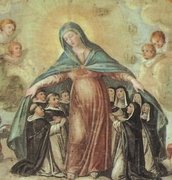
The members of the Blessed Margaret of Castello Chapter would like to congratulate Fr. Mark Padrez, OP on his election to Prior Provincial of the Province of the Holy Name of Jesus (Western Dominican Province).

hat tip to Fr. Pius Pietrzyk OP of the Eastern Province for the news on the Friar's Blog

Thursday, January 06, 2011

We Three Kings - Epiphany reflection

The following is from eLumen, the Newsletter of the Lay Fraternities of St. Dominic, Province of St. Joseph, U.S.A.


From the Provincial Promoter’s Desk

We three kings of orient are
bearing gifts we traverse afar
Field and fountain, moor and mountain
following yonder star.

In our popular carol about the Wise Men, we quickly pass over their journey with all its fields and moors, fountains and mountains. In the usual Christmas spirit, this allows us to focus on the most important part—the presents! Each gift is given a whole verse to itself: gold for Jesus the King, incense for Jesus who is God, and myrrh for Jesus who is to be a sacrifice. Yet, for the Magi,the journey to Jerusalem and then on to Bethlehem to find Jesus was a significant trip. We don’t know exactly who they were or from where they came. Many traditions hold they came from Persia, Arabia, or Indian. Typical nativity scenes show the magi representing three ancient gentile races: Greeks, Ethiopians, and Chinese. A journey from any of these places would be incredibly long, over a thousand miles. We modern Americans have no idea what it meant to travel that kind of distances. We complain if we have to cross to the other side of town or spend a few hours in an airport. For the magi this journey would have taken months, perhaps half a year, doing nothing but traveling. Even for those with wealth and power, such a journey was not easy or safe. And certainly, camels have never struck me as being particularly ergonomic.

These Wise Men spent months traveling thousands of miles following a star. They were searching not for the Seven Cities of Gold or the fountain of youth. They gained no glory or power or fame. They didn’t even get to appear on “Amazing Star Following” on CBS. In the end, all they found is a baby boy, born in a stable, who was too young to remember or even recognize them. And so, after months of travel, they turned around and went home. Only, they were forced to sneak back “by a different way” because paranoid King Herod was trying to kill them to cover the whole thing up. They undertook an incredible journey of risk and sacrifice which brought them...absolutely nothing. They didn’t get anything out of it.

This realization is crucial to understand what the Wise Men were about. For the Wise Men didn’t make their journey to get anything. They made that journey to give. Certainly, they gave their famous gifts of gold, frankincense, and myrrh. However, more importantly, they went to give the gift of worship. When they found the child with Mary his mother, “they fell down and worshiped him.” They were willing to travel so far and risk so much, because they found someone worthy of their worship, someone whom they could adore. This was the point of their thousand mile journey, and this is the point of the journey of each of our lives. We are made to seek someone to worship, someone worthy of our adoration.

There is a strange temptation in the world today to see religion in terms of what we get out of it. We are supposed to find the religion or the church that gives us the best service, the most for our money. I’m sure we have all heard people complain, “I don’t get anything out of Mass.” Perhaps when we’ve been frustrated with the music or preaching at our parish, we’ve even shared that sentiment ourselves. Yet, when we gather to celebrate Mass, we do not come to get to hear beautiful music, to get insightful instruction from the priest, or to get to share in our community of faith. All these things are good, but we come not to get them but to give—to give our worship to God.

We are sometimes tempted to imagine a god who doesn’t want to be worshiped, a god who is much more egalitarian, a regular Joe just like us. But in imaging such a god, we imagine something that is not God. Worshiping doesn’t fit well into our American culture as we have managed to obliterate so many signs of respect and honor from ordinary life. This makes it hard for us to see anything as worthy of honor. It also leads us to forget that man’s greatest attribute is being made in the image and likeness of God. Our fellow men and women deserve to be respected and honored because each one is like God. God Himself deserves not just to be respected and honored but to be worshiped and adored because he is God.

The new translation of the Mass that we will start using next Advent intentionally highlights this aspect of the Mass. It uses loftier language and sometime even big words—words that were chosen not because they were the easiest options for us but because they were the most worthy options for God. Those who fret that average Americans won’t be able to understand these words not only insult average Americans but also forget who is being addressed throughout most of the Mass—not us but God. The language used at Mass will be a bit different from the language we use for other activities, but that is because what we do at Mass is different from any other activity.

The effort we spend to prepare and celebrate Mass is not so we or others can get more out of it, but it’s so we can give more honor to God. The art and beauty of our Churches is not meant for our eyes or ears but is a sacrifice rising up to God. We come to Mass to give—to give everything to God. Like the Magi, in giving, we will find our greatest joy. We will discover a God who is not only a source for grace and enlightenment but one who is Emmanuel, God with us. God dwells with us giving us his very flesh and blood so that we can receive him and adore him.

Fr. Darren Pierre, O.P.
Provincial Promoter

Tuesday, January 04, 2011

Duty to die

From the Irish prolife site, Family and Life:

Belgian Court Decides Disabled Child Denied “Right” to be Aborted
A Belgian court has ruled that a disabled child was denied his “right” to be aborted. Belgian journal, Revue Générale des Assurances et Responsabilités, has just published a decision rendered by the Brussels Court of Appeal on 21 September 2010 in a case of a child born disabled after an erroneous prenatal diagnosis. The Court ruled that the child, represented by his parents, could claim damages from physicians for the injury of being born disabled. "Certainly, the misdiagnosis did not cause the child's disability, which existed before the error and which could not be remedied," the Court considered. "However, the injury which must be compensated is not the disability itself, but the fact of being born with such disabilities." For the Court, the child would have had "right" to an abortion if the disability had been...
Details: http://www.familyandlife.org/Abortion-and-Embryo/2050/9/13.html

Monday, December 27, 2010

Turkey-free Christmas dinner

This year for Christmas the kids decided to go "sans turkey" and rather than the Brazillian fejoida of the last 25+ years, we decided to make a paella instead. Less than two hours to prepare, compared to the all day excercise that fejoida can be! No muscles or clams, but we used chorizo, shrimp, snapper, and lobster. it was a real hit.


good thing I had a gigantic electric skillet!

I hope your Christmas day was wonderful. don't forget, NOW it's Christmas; Advent is over, the Christmas season has started! let the celebration begin and continue to it's proper conclusion at the Baptism of the Lord on January 9!

Wednesday, December 22, 2010

Christmas note from Dominican Mission in Mexicali, Mexico

I received a Christmas note from Br. Corwin Low OP, and reproduce it here. Some of you might recognize Fr. Bart!


Christmas 2010
Dear Friends and Family,

Believe it or not, I'm in my 5th year as a Dominican. In this year of formation ( out of 8) we suspend our studies in order to get "real world" experience. Although I do not discount the value of academic work, from my years in corporate America I have always recognized that theory is one thing but reality is quite another-and yet we live in the real world. I was surprised at my assignment however. While I have been studying Spanish over the last year, I didn't think it was sufficient to warrant a year working in a parish in Mexico; but my superiors thought to the contrary.

As a Type-A perfectionist it hasn't been an easy transition. For one thing, it's difficUlt to express your opinion if you lack the ability to speak. But at the same time I've seen and experienced so many things that I woUld never have if I had been dropped into a safe, familiar (and therefore easy) situation. Had I not yielded to the wisdom of my superiors I woUld have never understood it.

One of my ministries is to visit the parish neighborhood called Villa Zapata (picture with a portion of the community is attached). It is far from the center of Mexicali and is remote enough that it lacks basic necessities. Electricity is only now being installed; and there is no water. When I arrived there was no shelter from the heat of more than 120° Fahrenheit (49° Celsius). But now in the winter it has dropped to 35° (4°) at night. While that might not seem overly cold to you, it is to the people here because their houses are made from little more than discarded factory palettes and no insUlation. Lately we've been distributing blankets and warm clothing to help get people through the nights, particUlarly with the vicious winds of the desert. One particUlarly heart-wrenching case is a house (actuallya shack) of 6 children. The eldest is 13. They lost their mother last summer and their father abandoned them long ago. Neighbors take turns keeping an eye on them, but it isn't really sufficient. There are cases similar to this throughout the community, though this is perhaps the worst. It is gratifying to see their smiling faces when we show up.

Because I don't have papers to write or hundreds of pages to read, I actually do have time to work on some web sites. This keeps me a little more hands-on with technology in a place where technology up to the point I got here was little more than a typewriter and a photocopier. How's that for cUlture shock? I've been keeping a web log (address below) and I've been generating content for our mission website (http://mexicali.opwest.org). I woUld very much enjoy it if you take a look. I am eager to get feedback on them and I am continually updating them. So keep coming back!

So in a nutshell, Mexicali has been good work and good for me. I especially enjoy assisting at bringing the sacraments to the people. They truly desire it them. I've only now just started preaching in Spanish, but the early feedback has been positive-a good sign from a people who are usually reserved with such things. And, bey eve it or not, I'm still singing. ..

Br Corwin Low, OP
http://www.cantateop.org

Tuesday, December 07, 2010

Serialized book of note

The Dominican Friars of the Eastern Province are serializing one of Fr. William Hinnebusch's books, "Dominican Spirituality", 1965. This is an excellent book and a project worth following (much better than a mindless TV show)!

The first three chapter have been posted:

Chapter I - A General View of Dominican Life
http://www.op-stjoseph.org/blog/dominican_spirituality_i

Chapter II - The Dominican Life is the Image of St. Dominic
http://www.op-stjoseph.org/blog/dominican_spirituality_ii

Chapter III - Dominican Life is Contemplative
http://www.op-stjoseph.org/blog/dominican_spirituality_iii


Thanks to Fr. Benedict Croell, O.P., who is posting these!

Monday, November 29, 2010

"The Mystery of Advent"

some excellent Advent posts over at the Friar's Blog; I'm only about half way through the first one, but thought I'd post the links.

The Mystery of Advent
by Fr. Pius Pietrzyk, O.P.


In 2007, some of the priests and brothers at the Dominican House of Studies prepared a series of reflections on the four weeks of Advent. As the Church begins the new liturgical Year of Grace with the season of Advent, we present again these reflections.


Mystery of Advent, Week One
Mystery of Advent, Week Two
Mystery of Advent, Week Three
Mystery of Advent, Week Four

Friday, November 19, 2010

New book

A new book on Bl. Margaret of Castello is out.

Well, actually more of a pamphlet... It's from the Catholic Truth Society


From the back cover:
Patroness of the disabled and marginalized Margaret's story shows how God has a purpose for even the most unfortunate and disadvantaged; that his gifts may shine strongly in any of us, whatever our situation in this life. Young, small, blind, lame, unattractive, a hunchback who was rejected by her parents, in today's world she would certainly have been another victim of abortion. Yet, despite her severe disadvantages, 'Little Margaret' emerged as an exemplary model of selfless love. In recognition of this she was beatified, and now the cause for her canonization is recognized in Rome. Invoked as the patroness of the disabled and unwanted, there are shrines to her in America where she is revered as patron of the disabled and the marginalized.


Alan Frost has authored other titles for CTS, including St Louis-Marie de Montfort.

Old Book - "From Luther to Hitler"

My next read came in - "From Luther to Hitler, The History of Fascist-Nazi Political Philosophy", 1941, by William McGovern.

I found this in the references pages of "Philosophies at War", 1943, by Fulton J Sheen, and decided to check it out!

Thursday, November 18, 2010

Dominican Sisters on Oprah, Nov 23

Dear Friends,

The Dominican Sisters of Mary will be featured on the Oprah Winfrey Show on Tuesday, November 23rd.


This is a new show that includes interviews with Mother Assumpta, Sr. Joseph Andrew, Sr. Mary Samuel, Sr. John Dominic and other Sisters; as well as on-site filming of the First and Final Profession Masses and this year’s Entrance Day, during which we welcomed 22 Aspirants.


The show will feature the experience of a Sister entering religious life and the meaning of religious profession as being ‘married’ to Christ.


You may recall that Oprah first reached out to our community on February 9th of this year due to an interest in the hidden aspects of religious life. Click here to watch an excerpt from that program.


The response from the first show was so positive that the Sisters were asked if we would be open to another opportunity to share our life. We have accepted this invitation in the hopes of reaching an audience we might not otherwise reach with the witness of our life and the Gospel. Please join us in praying that the show will be for the good of souls and the honor of God.


As we approach the Thanksgiving holiday, let us give thanks to God for His bountiful goodness. May God bless you and your families during this holiday season.


In Jesus and Mary,

The Dominican Sisters of Mary, Mother of the Eucharist


p.s. To learn more about supporting the Sisters’ ongoing formation and education, click here.


4597 Warren Rd.
Ann Arbor, MI 48105
(734) 930-4222
http://www.sistersofmary.org/


Tuesday, November 16, 2010

Book plug!

Zaccheus Press is pleased to announce the release of two new titles by Abbot Vonier: The Human Soul and The Life of the World to Come.

See below for our special sale offer.

Abbot Vonier was a bestselling author in England of the 1920s. After decades of neglect, Vonier is today recognized as a masterful spiritual writer whose work "is as inspiring and fresh as ever." Zaccheus Press is bringing his finest books back into print for a new generation of Catholic readers.

The Human Soul: In the eyes of God the human soul is a jewel of infinite worth, of more value than the whole world with all its glory and treasure. But what do we think of the soul so highly prized by God? What do we know of our own soul?

Abbot Vonier's first and most popular book, The Human Soul was written to open the eyes of readers to the tremendous frontiers of their true country: the immortal soul. Written with "a youthful freshness and vigor," it is a work of rare inspiration, "such as to make one hold one's breath at the beauty and grandeur of what we so lightly, without thought, call our soul."

The Human Soul features a Foreword by Ralph McInerny.

The Human Soul by Abbot Vonier
240 pages . $14.95 (paperback)

The Life of the World to Come: We all want to go to Heaven - but what will Heaven actually be like? Drawing on sacred Scripture and Catholic doctrine, The Life of the World to Come pulls back the veil to give us a closer look at the dazzling joys, the reality of eternal life. With simplicity and good humor, this "marvelous little book" achieves the goal Abbot Vonier set for all his works - to open the eyes of men and women to the splendors of the Catholic faith.

The Life of the World to Come features a Foreword by Edward T. Oakes, SJ.

The Life of the World to Come by Abbot Vonier
128 pages . $11.95 (paperback)

Special Introductory Offer: The Human Soul for only $12.95 (regular price: $14.95), and The Life of the World to Come for only $9.95 (regular price: $11.95). Sale ends December 31.

Early-Bird Special: Order one or both titles by Tuesday, November 23 and receive free shipping!

Please note: The Human Soul and The Life of the World to Come will ship on or about November 24.

Sorry, we can only offer free shipping to customers in the United States. Orders are shipped via USPS Media Mail, and will usually arrive within 7 business days, but please allow up to 21 business days for delivery. As we get closer to the Christmas season, longer than usual delivery times can be expected. Please plan ahead and place your order accordingly.

HOW TO ORDER
Place your order for The Human Soul at our webpage here.

The Life of the World to Come may be ordered here.

If you have trouble with the embedded links, please copy and paste the following into your web browser, one at a time:
http://tinyurl.com/Vonier-Soul [The Human Soul]

http://tinyurl.com/Vonier-Life [The Life of the World to Come]

You will automatically receive free shipping on orders placed by November 23.

Our secure webpage now accepts PayPal, as well as all major credit cards.

You can also phone in your credit card order. Call 970-416-6672. Orders may be placed Monday-Friday, 9 am - 5:00 pm, mountain standard time.

To arrange expedited shipping, please call 970-416-6672, Monday-Friday, 9 am - 5 pm, mountain standard time.
For Canadian orders, please call 970-416-6672, Monday-Friday, 9 am - 5 pm, mountain standard time, or email: comments@zaccheuspress.com

Other Christmas Sale Offers
This Christmas season we are offering special sale prices on all of our previously released titles. Please see our webpage for details.

In addition to the sale prices on individual titles, we offer free shipping on orders of any combination of 3 books or more (not including The Human Soul or The Life of the World to Come until after the early-bird free shipping offer ends on November 23).

Our books make wonderful Christmas gifts. Please go to the Zaccheus Press home page for details, and place your order today!

Praise for Abbot Vonier
"Those seeking spiritual wisdom will find it here. Vonier was a master, and his work is as inspiring and fresh as ever."
-Matthew Levering, author Christ and the Catholic Priesthood

"Abbot Vonier has a serious right to be considered one of the great Catholic theologians of the 20th century. Here is the theology of St. Thomas translated into a contemplative idiom and communicated with a wonderful clarity and simplicity of expression. These new editions of his works, after decades of neglect, are warmly to be welcomed."
-Fr. John Saward, author Cradle of Redeeming Love

"Turning new lights on old truths and making application of revelation to life, Abbot Vonier 'digs down into the meaning of Catholic dogma.' His thought is so simple, clear, and practical that no formal theological training is needed to follow him with profit and delight."
-Fr. C.C. Martindale, SJ, quoted in Commonweal

"Gifted in his capacity to write of sublime things in terms that all could understand."
-The American Benedictine Review

"Abbot Vonier was the most gifted dogmatic theologian writing in England during his lifetime. The Vonier revival is a highly encouraging sign of the return of classical doctrine in the Church."
-Aidan Nichols, OP, author The Shape of Catholic Theology

____________________________________________________
Forward this Sale Offer
¯¯¯¯¯¯¯¯¯¯¯¯¯¯¯¯¯¯¯¯¯¯¯¯¯¯¯¯¯¯¯¯¯¯¯¯¯¯¯¯¯¯¯¯¯¯¯¯¯¯¯¯
Please forward this message to friends and acquaintances who
may be interested.
____________________________________________________


This email was sent by:
Zaccheus Press
1331 Red Cedar Circle
Fort Collins, CO 80524 USA

Tuesday, November 09, 2010

This is from an inlaw's inlaw:


From: Stanley
Sent: Monday, November 08, 2010 7:47 PM
Subject: Coho


Dear Friends and Acquaintances,

There are few things in this world that encourage me more than the annual Coho Salmon run here in the South Umpqua Elk Creek watershed. It seems to simply wash away the deep concerns of life when I see those giant flashes of red going against the tide of the stream. They are relentless and unwavering in their determination to keep the cycle of life going. The return of the salmon is an ancient reminder that so much is going on in this world that is not under our control. A reminder that greater things than us mold our existence.

So rejoice with me at this years very early run of Coho in Elk Creek!

high regards,

Stan

--
~~~~~~~~~~~~~~~~~~~~~~~~~~~~~~~~~~~~~~~~~~~~~~~
O O O 0 0 0 o o o . . . >< )))(*>
_______________________________________________
Stanley Petrowski
President/Director
South Umpqua Rural Community Partnership (SURCP)
Tiller, Oregon


Saturday, November 06, 2010

More on recent travels

Time to catch up a bit on traveling - a reflective moment after arriving in Bantry, Ireland. Germany... remember Germany?


A week before we'd attended the Cannstatter Volksfest in Stuttgart, Germany. Here's a view from the giant ferris wheel:

The "beer tents" are at the very far upper left in this picture; you really can't get a sense of their immense size, reputedly they hold 5000 each! here's a view which shows the size:


Yes, there are three of them shown. "Tent" is a stretch, although the roofs are actually canvas. Inside there is some serious pouring going on!


Which means, better get some food under it. marvelous at that!


The Germans there seem to be very friendly...


Although there was one dick-head:


Generally, a happy and enthusiastic crowd enjoying the live music.


and as the evening wore on (we arrived around 4), folks got even livelier, moving from the floors to the tabletops!


Live music from Tina Turner!  Oh wait, thats... well, a really good impersonator by voice if not looks


As the evening wore on, my young photographers seem to have lost something in their photography skills as they gained something in beer consumption! oh wait, did I take that picture? hummm. Second-hand alcohol at work here! Yeah, that's it!


All things considered, not a bad vacation day, considering that 24 hours before Emily had been in Kampala, Uganda...


Thank you Stuttgart, Dorothy, Tina Turner...

Friday, November 05, 2010

Truth Be Told issue #13 - Newsletter of the Laity of the Province of the Most Holy Name of Jesus

The thirteenth issue of "Truth Be Told," the newsletter of the Laity of the Province of the Holy Name of Jesus has been posted to the web.

The newsletter is available for download at the provincial web page here:
http://laydominicanswest.org/newsletter/

Wednesday, November 03, 2010

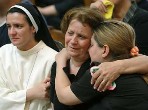
Bombing of Cathedral in Baghdad


Church bombings in Iraq since 2004

from Google translate:

Statement issued by Prince El Hassan about the terrorist attack on the Church of Our Lady of the Annunciation in Baghdad

Amman - Npras News - His Royal Highness Prince El Hassan bin Talal, a statement Wednesday night about the terrorist attack on the Church of Our Lady of the Annunciation in Baghdad.

And, consequently, the text of the statement:

What is the guilt of the resort to the house of God to seek tranquility and peace of mind and to communicate with his Creator ... What harm even thrown in hell is no longer a worldly known range, shape, or from any point of burning fire?!

What is sin even destroy the houses of God and claim the lives of command within Creator to Nsunha and to protect and make ourselves in order to respect the sanctity of life?!

Did this manipulation of religion to reduce the affect upon the Almighty in the houses of worship from churches and mosques, and a terrible disregard for His creation, who assumed they were safe all the security in those houses?!

The recent terrorist attack on the Church of Our Lady of the Annunciation in Baghdad, which has killed Muslims and Christians, and other previous terrorist acts against mosques and other churches, is a serious indicator of the degree to which he arrived thinking exclusionary and mobilization blind ideologies politicized is not a religion at all, and not of our heritage for anything.

The sanctity of human life are hung on the gallows industry, hatred, ill-treatment is the ugliest pictures every day and means the most bloody.

"We sent thee but as a mercy to the worlds." What kind of mercy in the killing of worshipers were Inajon Lord, and raising their hands to pray?! Any mercy in the destruction of places of worship, which is supposed to be no shelter of refuge for him, but not a place to fight over, conflict and settle political scores and sectarianism?!

The Mercy truth exists in our history and our heritage in the teachings of our Islam and the teachings of Christitna. I was born Christian, and Islam was born among us and in Arab lands. And spread both in the world from our churches and mosques. Muslims and Christians are brothers and sisters in this part of the universe throughout history. Together they built a civilization still bright effects even today in various fields of life.

This is a cry of every human soul Distressed what happened: Where is the mercy, love and rationality in this bloody scene. Where is the mercy, love and rationality in our view of our family members as the historical one, Bchristiera and Muslims?

Go back to Allah and fear Him in worship and in His creation, "and equipped themselves with the best provision is piety."

بيان صادر عن الأمير الحسن حول الهجوم الإرهابي على كنيسة سيدة البشارة ببغداد


عمان - نبراس نيوز- اصدر صاحب السمو الملكي الأمير الحسن بن طلال بيانا مساء الاربعاء حول الهجوم الإرهابي على كنيسة سيدة البشارة في بغداد .

وتاليا نص البيان :

ما ذنب من يلجأ إلى بيت من بيوت الله طلباً للسكينة والطمأنينة والتواصل مع خالقه... ما ذنبه حتى يزج به في جهنّم دنيوية لم يعد أحد يعرف مداها أو شكلها أو من أي جهة تشتعل نيرانها؟!

ما ذنب بيوت الله حتى تدمّر وتزهق داخلها أرواحٌ أمر الخالق أن نصونها وأن نحميها وأن نبذل أنفسنا في سبيل احترام قدسية حياتها؟!

هل وصل التلاعبُ بالدين إلى هذا الحدّ من تطاولٍ عليه سبحانه وتعالى في بيوت عبادته من كنائس ومساجد، ومن استخفاف فظيع بخلقه الذين يُفترض أنهم آمنون كلّ الأمان في تلك البيوت؟!

إن الهجوم الإرهابي الأخير على كنيسة سيدة البشارة في بغداد، والذي ذهب ضحيته مسلمون ومسيحيون، وغيره من أعمال إرهابية سابقة ضد مساجد وكنائس أخرى، لهو مؤشر خطير على الدرجة التي وصل إليها التفكير الإقصائي والتجييش الأعمى لأيديولوجيات مسيّسة ليست من الدين في شيء، وليست من إرثنا في شيء.

إن قدسية الحياة البشرية أصبحت معلقة على مشانق صناعة الكراهية، ويتم التنكيل بها كل يوم بأبشع الصور والوسائل وأكثرها دموية.

"وما أرسلناك إلا رحمةً للعالمين". فأيّ رحمةٍ في قتل مصلّين كانوا يناجون ربهم ويرفعون أيديهم إليه بالدعاء؟! وأي رحمةٍ في تخريب أماكن عبادته التي يفترض أنها ملجأ من لا ملجأ له، وليست مكاناً للاحتراب والنزاع وتصفية الحسابات السياسية والطائفية؟!

إن الرحمة الحقيقة موجودة في تاريخنا وفي تراثنا وفي تعاليم إسلامنا كما في تعاليم مسيحيتنا. لقد ولدت المسيحية، كما ولد الإسلام، بيننا وفي أرضنا العربية. وانتشر كلاهما في العالم انطلاقاً من كنائسنا ومساجدنا. والمسلمون والمسيحيون أخوة وأخوات في هذا الجزء من الكون عبر التاريخ. بنوا معاً حضارة مشرقةً لا تزال تأثيراتها حتى اليوم في مختلف ميادين الحياة.

هذه صرخة من روح إنسانية يؤلمها كل ما حدث: أين الرحمة والعقلانية والمحبة في هذا المشهد الدموي. أين الرحمة والعقلانية والمحبة في نظرتنا إلى أفراد أسرتنا التاريخية الواحدة، بمسيحييها ومسلميها؟

عودوا إلى الله واتقوه في عباده وفي خلقه، "وتَزوّدوا فإِنّ خيْر الزّاد التّقوى".

http://www.nebrasnews.com/index.php?option=com_content&task=view&id=20352&Itemid=45
Hat tip to Abouna Imad Twal
http://www.cics-ar.org/

Monday, November 01, 2010

For All Saints

The Dies Irae

My attempts at Irish Soda Bread

humm... breadmaking trial; not nearly ready for prime-time.


I have a long way to go!

Friday, October 29, 2010

May Truth and right reason influence your vote

The Holy Father's address to the bishops of Brazil:

BRAZIL: CHURCH TEACHES MAN HIS DIGNITY AS CHILD OF GOD

VATICAN CITY, 28 OCT 2010 (VIS) - Prelates from the National Conference of Bishops of Brazil (Northeast region 5) who have just complete their five- yearly "ad limina" visit were received this morning by the Holy Father.

"I wish to speak to you today", the Pope told them, "about how the Church's mission to serve as the leavening of human society through the Gospel teaches human beings their dignity as children of God, and their vocation to the unity of all mankind, whence derive the need for justice and social peace in accordance with divine wisdom".

"First, the duty of direct action to ensure a just ordering of society falls to the lay faithful who, as free and responsible citizens, strive to contribute to the just configuration of social life, while respecting legitimate autonomy and natural moral law", the Holy Father explained. "Your duty as bishops, together with your clergy, is indirect because you must contribute to the purification of reason, and to the moral awakening of the forces necessary to build a just and fraternal society. Nonetheless, when required by the fundamental rights of the person or the salvation of souls, pastors have the binding duty to emit moral judgments, even on political themes".

"When forming these judgements, pastors must bear in mind the absolute value of those ... precepts which make it morally unacceptable to chose a particular action which is intrinsically evil and incompatible with human dignity. This decision cannot be justified by the merit of some specific goal, intention, consequence or circumstance, Thus it would be completely false and illusory to defend, political, economic or social rights which do not comprehend a vigorous defence of the right to life from conception to natural end. When it comes to defending the weakest, who is more defenceless than an unborn child or a patient in a vegetative or comatose state?"

"When political projects openly or covertly contemplate the depenalisation of abortion or euthanasia, the democratic ideal (which is truly democratic when it recognises and protects the dignity of all human beings) is betrayed at its very foundations. For this reason, dear brothers in the episcopate, when defending life we must not fear hostility or unpopularity, rejecting all compromise and ambiguity which would conform us to the mentality of this world".

In order to help lay people live their Christian, social and political commitments in a unified and coherent fashion it is necessary, said the Holy Father, to ensure appropriate "social catechesis and an adequate formulation of Church Social Doctrine. ... This also means that on some occasions, pastors must reminds all citizens of the right, which is also a duty, freely to use their vote to promote the common good".

"At this point politics and faith come together", he went on. "The specific nature of faith certainly lies in the meeting with the living God, Who opens new horizons far beyond the sphere of reason. ... Only by respecting, promoting and indefatigably teaching the transcendent nature of the human being can a just society be built. ... 'God has a place in the public realm, specifically in regard to its cultural, social, economic, and particularly its political dimensions'", said the Holy Father quoting his Encyclical "Caritas in veritate".

Benedict XVI concluded his discourse by joining the Brazilian bishops' appeal for religious education and, "more specifically, for the pluralistic and confessional education of religion in State schools". He also indicated that "the presence of religious symbols in public life is both a recollection of man's transcendence and a guarantee of its respect. They have particular value in the case of Brazil where the Catholic religion is a component part of the country's history".
AL/VIS 20101028 (630)
http://press.catholica.va/news_services/press/vis/dinamiche/d0_en.htm

Monday, October 25, 2010

which one must die?

A worried woman went to her gynecologist and said:

'Doctor, I have a serious problem and desperately need your help! My baby is not even 1 year old and I'm pregnant again. I don't want kids so close together.

So the doctor said: 'Ok and what do you want me to do?'

She said: 'I want you to end my pregnancy, and I'm counting on your help with this.'

The doctor thought for a little, and after some silence he said to the lady: 'I think I have a better solution for your problem. It's less dangerous for you too.' She smiled, thinking that the doctor was going to accept her request. Then he continued: 'You see, in order for you not to have to take care 2 babies at the same time, let's kill the one in your arms. This way, you could rest some before the other one is born. If we're going to kill one of them, it doesn't matter which one it is. There would be no risk for your body if you chose the one in your arms.

The lady was horrified and said: 'No doctor! How terrible! It's a crime to kill a child!

'I agree', the doctor replied. 'But you seemed to be OK with it, so I thought maybe that was the best solution.

The doctor smiled, realizing that he had made his point. He convinced the mom that there is no difference in killing a child that's already been born and one that's still in the womb. The crime is the same!

Hat tip to Doc Nuenschwander

Saturday, October 23, 2010

Back from trip... Sort of

From ages 3 to 17 I lived within 50 miles of San Francisco, yet I never lost my heart there. Ireland? Well, that's another story.  How to return from a place like Ireland? In the picture below is Slea Head, which is on the Dingle Peninsula, one of the western most points in south west Ireland, we find the North Atlantic greeted by:


And, as it turns out, the North Atlantic which comes here is mild, bringing the Gulf Current from Florida, with mild weather capable of supporting palm trees, and a lovely October day on the beach at Inch.


In Dingle we stayed at the delightful Murphy's pub/B&B; a nice quiet family dorm room en suite (as they call it when you have a private bath), and a lively pub with excellent food and plenty of "Guiness, for strength" as well as Murphy's and Smithicks; fine brews which did not seem to upset the stomach like the sludge we have in the states.

Then how to describe the "new" (1829) St Finbarr parish church in Bantry, in West Cork?


What a lovely Church!

And contrary to all the reports of empty churches in Europe, it was full on Sunday morning. St Finbarr was an early Christian in Ireland, and the founder of the city of Cork in the 7th century.  Here is his original 7th century monastic establishment in West Cork (the openings are the cells).


While dad was in another reality, with the kids he of course enjoyed the food, the people, and the hospitality of the Irish pubs...


...and Octoberfest. Did I mention Octoberfest? Oh yeah, Germany too... I will continue later...

Friday, October 22, 2010

The Scandal of Disobedience to the Magisterium

The Scandal of Disobedience to the Magisterium
By Archbishop Raymond Burke

Recognizing the responsibility of Christians and of all men of good will to enunciate and uphold the natural moral law, we also recognize the scandal which is given when Christians fail to uphold the moral law in public life. When those who profess to be Christian, at the same time, favor and promote policies and laws which permit the destruction of innocent and defenseless human life, and which violate the integrity of marriage and the family, then citizens, in general, are confused and led into error about the basic tenets of the moral law. In our time, there is a great hesitation to speak about scandal, as if, in some way, it is only a phenomenon among persons of small or unenlightened mind, and, therefore, a tool of such persons to condemn others rashly and wrongly.

Certainly, there is such a thing as pharisaical scandal, that is, a malicious interpretation of the morally good or, at least, morally indifferent actions of another. The term comes from the supposed scandal which Our Lord Jesus caused to the Pharisees by, for instance, healing the man born blind on the Sabbath (cf. Jn 9:13-34).

But there is also true scandal, that is, the leading of others, by our words, actions and failures to act, into confusion and error, and, therefore, into sin. Our Lord was unequivocal in his condemnation of those who would confuse or lead others into sin by their actions and their failures to act. In teaching His disciples about temptations, He declared: "Temptations to sin are sure to come; but woe to him by whom they come! It would be better for him if a millstone were hung round his neck and he were cast into the sea, than that he should cause one of these little ones to sin (Lk 17:1-2).

It is clear that Our Lord taught as a primary responsibility, with the gravest of consequences, the avoidance of scandal, namely, of any act or failure to act which could lead another into sin. Our Lord’s words are nothing less than vehement.

To ignore the fact that Catholics in public life, for example, who persistently violate the moral law regarding the inviolability of innocent human life or the integrity of the marital union, lead many into confusion or even error regarding the most fundamental teachings of the moral law, in fact, contributes to the confusion and error, redounding to the gravest harm to our brothers and sisters, and, therefore, to the whole nation. The perennial discipline of the Church, for that reason among other reasons, has prohibited the giving of Holy Communion and the granting of a Church funeral to those who persist, after admonition, in the grave violation of the moral law (Code of Canon Law, cann. 915; and 1184, § 1, 31).

It is said that these disciplines which the Church has consistently observed down the centuries presume to pass a judgment on the eternal salvation of a soul, which judgment belongs to God alone, and, therefore, they should be abandoned. On the contrary, these disciplines are not a judgment on the eternal salvation of the soul in question. They are simply the acknowledgment of an objective truth, namely, that the public actions of the soul are in grave violation of the moral law, to his own grave harm and to the grave harm of all who are confused or led into error by his actions. The Church confides every soul to the mercy of God, which is great beyond all our imagining, but that does not excuse her from proclaiming the truth of the moral law, also by applying her age-old disciplines, for the sake of the salvation of all.

When a person has publicly espoused and cooperated in gravely sinful acts, leading many into confusion and error about fundamental questions of respect for human life and the integrity of marriage and the family, his repentance of such actions must also be public. The person in question bears a heavy responsibility for the grave scandal which he has caused. The responsibility is especially heavy for political leaders. The repair of such scandal begins with the public acknowledgment of his own error and the public declaration of his adherence to the moral law. The soul which recognizes the gravity of what he has done will, in fact, understand immediately the need to make public reparation.

If there has always been the danger of giving scandal to others by public and seriously sinful actions or failures to act, that danger is heightened in our own time. Because of the confusion about the moral law, which is found in public discourse, in general, and is even embodied in laws and judicial pronouncements, the Christian is held to an even higher standard of clarity in enunciating and upholding the moral law.

It is particularly insidious that our society which is so profoundly confused about the most basic goods also believes that scandal is a thing of the past. One sees the hand of the Father of Lies at work in the disregard for the situation of scandal or in the ridicule and even censure of those who experience scandal. Teaching about the relationship of human ecology to environmental ecology, Pope Benedict XVI underscores a contradiction in "the overall moral tenor of society," which leads us and especially our youth into serious confusion and error: "If there is a lack of respect for the right to life and to a natural death, if human conception, gestation and birth are made artificial, if human embryos are sacrificed to research, the conscience of society ends up losing the concept of human ecology and, along with it, that of environmental ecology. It is contradictory to insist that future generations respect the natural environment when our educational systems and laws do not help them to respect themselves. The book of nature is one and indivisible: it takes in not only the environment but also life, sexuality, marriage, the family, social relations: in a word, integral human development. Our duties towards the environment are linked to our duties towards the human person, considered in himself and in relation to others. It would be wrong to uphold one set of duties while trampling on the other (Caritas in veritate, no. 51).

One of the ironies of the present situation is that the person who experiences scandal at the gravely sinful public actions of a fellow Catholic is accused of a lack of charity and of causing division within the unity of the Church. In a society whose thinking is governed by the "dictatorship of relativism" and in which political correctness and human respect are the ultimate criteria of what is to be done and what is to be avoided, the notion of leading someone into moral error makes little sense. What causes wonderment in such a society is the fact that someone fails to observe political correctness and, thereby, seems to be disruptive of the so-called peace of society.

Lying or failing to tell the truth, however, is never a sign of charity. A unity which is not founded on the truth of the moral law is not the unity of the Church. The Church's unity is founded on speaking the truth with love. The person who experiences scandal at public actions of Catholics, which are gravely contrary to the moral law, not only does not destroy unity but invites the Church to repair what is clearly a serious breach in Her life.

Were he not to experience scandal at the public support of attacks on human life and the family, his conscience would be uninformed or dulled about the most sacred realities.


+ Raymond Leo Burke
Archbishop Emeritus of Saint Louis
Prefect of the Supreme Tribunal of the
Apostolic Signatura
WORLD PRAYER CONGRESS FOR LIFE
ISTITUTO PATRISTICO «AUGUSTINIANUM»
Via Paolo VI, 25, 00193 ROMA
October 9, 2010


The above is only part of the address, which was distributed by Robert Moynihan, "The Moynihan Report"

Wednesday, October 20, 2010

NY Bishops speak on voting

NEW YORK STATE CATHOLIC CONFERENCE
465 State Street Albany, NY 12203-1004 Phone (518) 434-6195 Fax (518) 434-9796
www.nyscatholic.org e-mail:info@nyscatholic.org

Our Cherished Right, Our Solemn Duty
By the Catholic Bishops of New York State


We Catholics are called to look at politics as we are called to look at everything – through the lens of our faith. While we are free to join any political party that we choose or none at all, we must be cautious when we vote not to be guided solely by party loyalty or by self interest. Rather, we should be guided in evaluating the important issues facing our state and nation by the Gospel of Jesus Christ and the teachings of His Church.

Our national and state elected officials have profound influence on countless matters of great importance, such as the right to life, issues of war and peace, the education of children and how we treat the poor and vulnerable. We must look at all of these issues as we form our consciences in preparation for Election Day.

Unfortunately, it is the rare candidate who will agree with the Church on every issue. But as the U.S. Bishops’ most recent document Forming Consciences for Faithful Citizenship (www.faithfulcitizenship.org) makes clear, not every issue is of equal moral gravity. The inalienable right to life of every innocent human person outweighs other concerns where Catholics may use prudential judgment, such as how best to meet the needs of the poor or to increase access to health care for all.

The right to life is the right through which all others flow. To the extent candidates reject this fundamental right by supporting an objective evil, such as legal abortion, euthanasia or embryonic stem cell research, Catholics should consider them less acceptable for public office. As Faithful Citizenship teaches, “Those who knowingly, willingly, and directly support public policies or legislation that undermine fundamental moral principles cooperate with evil.”

These are complex times, so our task is not light. It is often difficult to get a good grasp on the positions of incumbent congressional representatives and state legislators, not to mention their challengers. News accounts of positions are hard to come by, and voting records on important issues are often lacking. So the task of doing due diligence can be truly challenging. Yet our state is facing many critical issues which are of vital concern to faithful Catholics. Thus it is absolutely necessary for good citizens to take a careful look at every candidate and to vote accordingly for the better candidates. You can find all of the candidates for elected office at the New York State Catholic Conference Web site (www.nyscatholic.org).

Many of the most compelling moral issues of the day play out at the state level. Commonsense restrictions on abortion, whether or not to employ the death penalty, issues related to same-sex “marriage” and civil unions, parental rights in education, programs to serve the poor, access to health insurance – all of these debates occur in the halls of our state Capitol in Albany.

We set forth below potential questions for candidates on a variety of critical issues, and we urge you to learn where all the candidates for every office stand with each critical issue. This list is by no means exhaustive, but our hope is that it serves as a valuable tool in forming your consciences as you make your decisions in the voting booth as Catholic faithful citizens.

While we as the Bishops of New York State cannot and do not endorse candidates for office, we encourage you to properly form your conscience by reflecting on the moral and social teachings of our Church and we strongly urge you to vote on Election Day. For when you vote, you are exercising your cherished right and your solemn duty as Americans and as Catholics.

Important Questions for Political Candidates

The Right to Life

Do you agree with the need to overturn the U.S. Supreme Court’s decision in Roe v. Wade, which struck down all state laws criminalizing abortion and established a woman’s “right” to abort her unborn child in the womb?

Do you oppose the state’s “Reproductive Health Act” or the federal “Freedom of Choice Act” which both go beyond Roe v. Wade, guaranteeing a fundamental right to abortion with no restrictions or regulations?

Do you support a ban on physician-assisted suicide?

Do you oppose government funding for human embryonic stem cell research?

Do you oppose the death penalty?

Do you oppose using taxpayer money to fund abortions?

Parental Rights in Education

Do you support the right of all parents – especially poor parents – to be provided with the means (such as education tax credits) to choose the most appropriate school for their child, including a religious or independent school?

Do you support restoring full state reimbursement on mandates in religious and independent schools?

Protecting Marriage

Do you support maintaining the historic understanding of marriage as only between a man and a woman?

Immigration Reform

Do you support immigration reform that regularizes the situation for undocumented immigrants already in this country?

Do you oppose punishing charitable organizations that provide social services to undocumented persons?

Access to Health Care

Do you support legislative action to provide access to health care for needy New Yorkers?

Protecting the Poor

Do you support the Farmworkers Fair Labor Practices Act that would grant farm workers certain rights available to all other New York workers, such as the right to overtime pay, collective bargaining and a day of rest?

Do you support an increase in the Earned Income Tax Credit and the Child Tax Credit, available as refunds to families with the greatest need?

Religious Liberty

Do you support the right of faith-based health and human service providers to offer services to the community in accord with their religious beliefs?

Do you support the right of faith-based health and human service providers to make employment and employee benefits decisions in accord with their religious beliefs?


A Time to Act

As religious leaders, we urge you to exercise your right and solemn duty to vote on Election Day.

+Timothy M. Dolan, Archbishop of New York
+Howard J. Hubbard, Bishop of Albany
+Nicholas DiMarzio, Bishop of Brooklyn
+Edward U. Kmiec, Bishop of Buffalo
+Terry R. LaValley, Bishop of Ogdensburg
+Robert J. Cunningham, Bishop of Syracuse
+Matthew H. Clark, Bishop of Rochester
+William F. Murphy, Bishop of Rockville Centre

(original is here)