On Sunday Fr Carmona made the insightful comment that the Lazarus' in our lives are usually much closer to us than we want to deal with; we'd rather do 'works of charity' at a distance, rather than live live the charity which God has prudentially given us opportunity to exercise; usually in the form of family and aquaintances. It is here that we are called most clearly to share the abundance of our table, more often spiritually than carnally. What is that abundance? duh, Jesus in the Eucharist!
OK, I will have to say that in 17 years of being a Catholic, I have never heard a homily on this reading that echos St Augustin's explanation. Before Jesus fed the 5000 with 5 loaves, he said "they are like sheep without a shepherd." So the "rich man" is the Hebrew priesthood and educated caste, who posess evertything essential for salvation because they are the guardians of the Word of God. Lazarus represents the sheep without a shepherd, those who don't know God and are mired in their sins because they have not heard what they need to hear for their salvation.
And pastors today? We have this reading immediately following the long series in the Divine Office from St Augustin's Sermon on Pastors where he excoriates those pastors who feed on their sheep instead of shepherding their flock.
And we who are laymen; we are also members of the Royal Priesthood; our [priestly] sacrifice is a broken heart, a contrite spirit, but we are also surrounded by sheep without shepherds, Lazarus who is seeking God's assistance but starved for even a scrap, a drop of cold water. Remember those springs of living water that are supposed to well up in us?
Oh yeah, dogs licking Lazarus' sores. To a first century Hebrew, this final insult by an unclean animal would not be comforting, as it is easy for today's pet-saturated culture to imagine; rather this insult would probably be like you having an open wound and watching flies land on it and not being able to to anything about it; shudder! We may not have an appreciation of ancient Hebrew ritual cleanliness, but we understand that sort of physical uncleanliness!
Being a Dominican, it is hard to resist the temptation to assign to the dog the identity of bad or heretical preachers; their 'ministrations' to Lazarus are not only of no assistance, they drive him further from being saved.
Showing posts with label Spiritual reflections. Show all posts
Showing posts with label Spiritual reflections. Show all posts
Monday, September 30, 2013


Friday, September 27, 2013
Thoughts on Pope Francis' Big Interview
"We cannot insist only on issues related to abortion, gay marriage and the use of contraceptive methods. This is not possible. I have not spoken much about these things, and I was reprimanded for that. But when we speak about these issues, we have to talk about them in a context. The teaching of the church, for that matter, is clear and I am a son of the church, but it is not necessary to talk about these issues all the time." - Pope Francis, Sept 30, interview in America Magazine with Antonio Spadaro SJ (Link)
Many of us have wondered where this church is that is so insistent only on these issues. We'd like to go there. Seriously, how many priests, parishes, how many statements of the USCCB or any other bishop’s conference, can be accused of this with a straight face? Yes, a few no doubt, but to color the entire Church by that? It strains credulity. So, what is Pope Francis telling us?
Perhaps the answer lies in not linking this paragraph to the one above, but rather, reading "we" in a different light than we are wont to.
Given this pope's persona of "humility" it is unlikely that he has used the term in the royal sense, as have so many popes in the past. No, we naturally jump to a reading where "we" becomes associated with the body of Christ, the Church. Passing beyond the "We believe" in the previous translation of the Credo to the current "I believe" for the collective voice of The Church, I propose that the context of "we" in this paragraph is the Holy Father and the members of the Media.
Where else, but the main stream media, can you look to find a shrill and insistent voice speaking endlessly about abortion, gay marriage, and contraception? This is the (un)holy trinity of the secular culture, and their evangelists, the members of the media, are mercilessly ramming it down our throats.
So when the Holy Father complains that this subject needs to be spoken of in context, what does the media immediately do, but quote (and misquote) him out of context!
So perhaps this strains your credulity as a way of reading this in the context of the interview. Yet, as successor of Peter, I think it not unreasonable to read his comments in this light.
Caiaphas, who was high priest that year, said to them, "You know nothing, nor do you consider that it is better for you that one man should die instead of the people, so that the whole nation may not perish." He did not say this on his own, but since he was high priest for that year, he prophesied that Jesus was going to die for the nation, and not only for the nation, but also to gather into one the dispersed children of God. (John 11:49-52 )
Many of us have wondered where this church is that is so insistent only on these issues. We'd like to go there. Seriously, how many priests, parishes, how many statements of the USCCB or any other bishop’s conference, can be accused of this with a straight face? Yes, a few no doubt, but to color the entire Church by that? It strains credulity. So, what is Pope Francis telling us?
Perhaps the answer lies in not linking this paragraph to the one above, but rather, reading "we" in a different light than we are wont to.
Given this pope's persona of "humility" it is unlikely that he has used the term in the royal sense, as have so many popes in the past. No, we naturally jump to a reading where "we" becomes associated with the body of Christ, the Church. Passing beyond the "We believe" in the previous translation of the Credo to the current "I believe" for the collective voice of The Church, I propose that the context of "we" in this paragraph is the Holy Father and the members of the Media.
Where else, but the main stream media, can you look to find a shrill and insistent voice speaking endlessly about abortion, gay marriage, and contraception? This is the (un)holy trinity of the secular culture, and their evangelists, the members of the media, are mercilessly ramming it down our throats.
So when the Holy Father complains that this subject needs to be spoken of in context, what does the media immediately do, but quote (and misquote) him out of context!
So perhaps this strains your credulity as a way of reading this in the context of the interview. Yet, as successor of Peter, I think it not unreasonable to read his comments in this light.
Caiaphas, who was high priest that year, said to them, "You know nothing, nor do you consider that it is better for you that one man should die instead of the people, so that the whole nation may not perish." He did not say this on his own, but since he was high priest for that year, he prophesied that Jesus was going to die for the nation, and not only for the nation, but also to gather into one the dispersed children of God. (John 11:49-52 )
Monday, January 14, 2013
Interior life of Elisabeth Leseur
From The Secret Diary of Elisabeth Leseur, The woman whose goodness changed her husband from atheist to priest
Sept 13, 1904
I am going to take advantage of a rare day of calm in my increasingly troubled and scattered life to make a serious examination of conscience and meditation. And first I want to write a little in this journal; it will do me good, for I feel a great solitude in my soul, humanly speaking, and a word of faith or of charity, falling from human lips, would bring warmth to my heart.
It is God’s will that, until my most intense wish is granted, I should walk alone in the path of suffering that He has shown us, and that He has made quite rough for me lately. And yet He is more than ever close to me and supporting me.
From the human point of view, no light is visible. Sadness in the present, anxiety for the future, frequent impediments in everything through my illness, the privation of all that could have transformed my life: good and fruitful work, reading – and this because of more immediate and humble duties. Absence of the consolation that contact with people of intelligence, faith, and truly Christian love always brings; physical discomfort – all these at present make a dull, sad atmosphere in my soul.
Today in recollection and humble prayer I will implore the divine aid I need so much, and plan out my life for this winter, such as it presents itself to me. First, I must firmly renounce the concrete visible good I would so much have liked to do; my duty to my dear invalids comes before all, and since I believe in the Communion of Saints, I will as God to apply to those I love and to souls the sacrifice of this inaction. I must learn to use stray moments to write and work. I must not neglect to meditate daily, for that is so necessary to me, and I will do it when and how I can.
To return to greater serenity, inner and outer; to struggle against absorption in beloved one’s suffering; to avoid speaking of my miseries, which is harmful to inner concentration. To be serene with myself and to try and acquire more indulgence for others.
Not to dwell upon the little wounds that my feelings and convictions perpetually suffer, but to offer them “manfully” to God. Not to give way to discouragement and a type of moral lassitude as a result of emotional sadness and bodily trials, but to keep alive in myself supernatural joy and the will to act, without any care to know the result of my action and efforts.
Sept 13, 1904
I am going to take advantage of a rare day of calm in my increasingly troubled and scattered life to make a serious examination of conscience and meditation. And first I want to write a little in this journal; it will do me good, for I feel a great solitude in my soul, humanly speaking, and a word of faith or of charity, falling from human lips, would bring warmth to my heart.
It is God’s will that, until my most intense wish is granted, I should walk alone in the path of suffering that He has shown us, and that He has made quite rough for me lately. And yet He is more than ever close to me and supporting me.
From the human point of view, no light is visible. Sadness in the present, anxiety for the future, frequent impediments in everything through my illness, the privation of all that could have transformed my life: good and fruitful work, reading – and this because of more immediate and humble duties. Absence of the consolation that contact with people of intelligence, faith, and truly Christian love always brings; physical discomfort – all these at present make a dull, sad atmosphere in my soul.
Today in recollection and humble prayer I will implore the divine aid I need so much, and plan out my life for this winter, such as it presents itself to me. First, I must firmly renounce the concrete visible good I would so much have liked to do; my duty to my dear invalids comes before all, and since I believe in the Communion of Saints, I will as God to apply to those I love and to souls the sacrifice of this inaction. I must learn to use stray moments to write and work. I must not neglect to meditate daily, for that is so necessary to me, and I will do it when and how I can.
To return to greater serenity, inner and outer; to struggle against absorption in beloved one’s suffering; to avoid speaking of my miseries, which is harmful to inner concentration. To be serene with myself and to try and acquire more indulgence for others.
Not to dwell upon the little wounds that my feelings and convictions perpetually suffer, but to offer them “manfully” to God. Not to give way to discouragement and a type of moral lassitude as a result of emotional sadness and bodily trials, but to keep alive in myself supernatural joy and the will to act, without any care to know the result of my action and efforts.
Monday, December 12, 2011
St Albert, peace, and Dominicans
The following quote is from "St Albert the Great" by Kevin Vost:
This reflects a thought I have long harbored, and I think brings out what I believe to be the serious error espoused by those Dominicans who seek political solutions through political means, neglecting and even denigrating the preaching mission, which some have even called "useless" (in personal communications).
I will even offer this additional thought; the lack of peace the ends in war is the terminal symptom of the failure to preach; because of our fallen nature we will not fall far from the nature family tree (Cain) but will fall far from our adopted family tree (of Life).

St Albert well understood that men journeying together towards heaven live in a harmony not found amoung men journeying any other direction.
Albert was a consummate peacemaker among men because peace, like joy, is an effect that flows from charity, an infused virtue with which Albert was abundantly blessed. Peace is a concordance or harmony of desires among persons. When those persons’ desires are not fully just and their thoughts are not focused on good and honorable ends, peace will not last long. [Albert] knew well that true peace was only possible among good men, and that is why his greatest peacemaking efforts were performed not in the settlement of sundry disputes but through his teaching and preaching: by making men good .
This reflects a thought I have long harbored, and I think brings out what I believe to be the serious error espoused by those Dominicans who seek political solutions through political means, neglecting and even denigrating the preaching mission, which some have even called "useless" (in personal communications).
I will even offer this additional thought; the lack of peace the ends in war is the terminal symptom of the failure to preach; because of our fallen nature we will not fall far from the nature family tree (Cain) but will fall far from our adopted family tree (of Life).
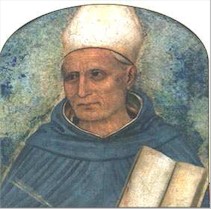
St Albert well understood that men journeying together towards heaven live in a harmony not found amoung men journeying any other direction.
Wednesday, November 23, 2011
First Sunday of Advent
From the Fr Pius Pietrzyk OP of the Eastern Dominican Province, posting on Preacher's Sketchbook for First Sunday of Advent:
The above is a well written reminder that the Lord who came amoung us a Bethlehem and died for our salvation on the cross, has kept his promise to "be with us always". Now is the time to make friends with Him. When He comes in judgment, that time will be past.
Dom Prosper Gueranger, The Liturgical Year
We find that this mystery of the coming, or Advent, of Jesus is at once simple and threefold. It is simple, for it is the one same Son of God that is coining; it is threefold, because He comes at three different times and in three different ways. ‘In the first coming,’ says St. Bernard, ‘He comes in the flesh and in weakness; in the second, He comes in spirit and in power; in the third, He comes in glory and in majesty; and the second coming is the means whereby we pass from the first to the third.’
This, then, is the mystery of Advent. Let us now listen to the explanation of this threefold visit of Christ, given to us by Peter of Blois, in his third Sermon de Adventu: ‘There are three comings of our Lord; the first in the flesh, the second in the soul, the third at the judgement. The first was at midnight, according to those words of the Gospel: At midnight there was a cry made, Lo the Bridegroom cometh! But this first coming is long since past, for Christ has been seen on the earth and has conversed among men. We are now in the second coming, provided only we are such as that He may thus come to us; for He has said that if we love him, He will come unto us and will take up His abode with us. So that this second coming is full of uncertainty to us; for who, save the Spirit of God, knows them that are of God? They that are raised out of themselves by the desire of heavenly things, know indeed when He comes; but whence He cometh, or whither He goeth, they know not. As for the third coming, it is most certain that it will be, most uncertain when it will be; for nothing is more sure than death, and nothing less sure than the hour of death. When they shall say, peace and security, says the apostle, then shall sudden destruction come upon them, as the pains upon her that is with child, and they shall not escape. So that the first coming was humble and hidden, the second is mysterious and full of love, the third will be majestic and terrible. In His first coming, Christ was judged by men unjustly; in His second, He renders us just by His grace; in His third, He will judge all things with justice. In His first, a lamb; in His last, a lion; in the one between the two, the tenderest of friends.’
The above is a well written reminder that the Lord who came amoung us a Bethlehem and died for our salvation on the cross, has kept his promise to "be with us always". Now is the time to make friends with Him. When He comes in judgment, that time will be past.
Saturday, October 29, 2011
Pontifical Council for Justice and Peace: recommendation of a global financial authority
A couple days ago the Pontifical Council for Justice and Peace issued a position paper recommending, as a solution to the world's financial problems, what some would attribute as "more of the cause." The Document, titled: "TOWARDS REFORMING THE INTERNATIONAL FINANCIAL AND MONETARY SYSTEMS IN THE CONTEXT OF GLOBAL PUBLIC AUTHORITY", can be read here.
The paper, which doesn't seem to have an attribution of authorship, and certainly does not bear the imprimatur of the church, much less the Holy Father, has been written about by more competent authors than me, so I'll let you find those articles on your own and form your own opinions. What strikes me as a layman, is that the Vatican, with it's scandal-plagued Vatican Bank, would offer suggestions of this nature when it has clearly demonstrated deficiency in this department; a department that it seems lies outside the competence of the Church. From a moral standpoint, if the world had embraced Christ and lived a devout faith, there would be no financial crisis, right? given fallen human nature, there will always be crisis of one sort or another, as man seeks to assert his will over his fellow man, rather than serve his neighbor as one created in the image of God.
So it seems to this financially-challenged mind, that a document that suggests that to make things right, the world needs to live as though the fruits of charity were present and could be counted upon, without ever mentioning the name of Jesus, from whom all charity flows, has missed the mission statement:
"Go, therefore, and make disciples of all nations, baptizing them in the name of the Father, and of the Son, and of the holy Spirit, 20 teaching them to observe all that I have commanded you. And behold, I am with you always, until the end of the age.” [Mt 28:18ff]
The paper, which doesn't seem to have an attribution of authorship, and certainly does not bear the imprimatur of the church, much less the Holy Father, has been written about by more competent authors than me, so I'll let you find those articles on your own and form your own opinions. What strikes me as a layman, is that the Vatican, with it's scandal-plagued Vatican Bank, would offer suggestions of this nature when it has clearly demonstrated deficiency in this department; a department that it seems lies outside the competence of the Church. From a moral standpoint, if the world had embraced Christ and lived a devout faith, there would be no financial crisis, right? given fallen human nature, there will always be crisis of one sort or another, as man seeks to assert his will over his fellow man, rather than serve his neighbor as one created in the image of God.
So it seems to this financially-challenged mind, that a document that suggests that to make things right, the world needs to live as though the fruits of charity were present and could be counted upon, without ever mentioning the name of Jesus, from whom all charity flows, has missed the mission statement:
"Go, therefore, and make disciples of all nations, baptizing them in the name of the Father, and of the Son, and of the holy Spirit, 20 teaching them to observe all that I have commanded you. And behold, I am with you always, until the end of the age.” [Mt 28:18ff]
Monday, June 13, 2011
Living in the moment
A gem from "All Men Have a Special Vocation" in "Spiritual Conferences" by Fr. Frederick William Faber
But the surest method of arriving at a knowledge of God's eternal purposes about us is to be found in the right use of the present moment. We must esteem our present grace, and rest in it, and with tranquil assiduity correspond to it. Our present grace is the most infallible will of God. It is a revelation from God, which almost always brings its own authoritative interpretation along with it. What we want for our sanctification is not merely grace, but the right grace, the right grace at the right time and in the right place. God's will does not come to us in the whole, but in fragments, and generally in small fragments. It is our business to piece it together, and to live it into one orderly vocation. Like a lantern in the night, grace gives light around our feet, a circle of light just wide enough to prevent our stumbling. But then we must look at our feet. If we strain our eyes into the gloom ahead of us, we shall stumble in spite of the lantern: nay sometimes we shall even stumble because of it, its shadows move so suddenly, and with such unwieldy strides. Our present grace is also the one least beset with delusions, and we can act safely upon it, although perhaps not comfortably, even when we do not see how it matches with what has just gone before, or how it can fit into any conceivable future which our circumstances will allow. The hours are like slaves which follow each other, bringing fuel to the furnace. Each hour comes with some little (censored) of God's will fastened upon its back. If we thus esteem our present grace, we shall begin to understand God's purposes. It seems an easy thing to do, and yet it cannot really be easy because so few do it. One man is always pulling the past to pieces, while another man is marching with his head erect into the uncertain future, disdainful of the present. Strange to say, intentions are more exciting than actions, and therefore more attractive. For safety and for swiftness, for clear light and successful labour, there is nothing like the present. Practically speaking, the moment that is flying holds more eternity than all our past, and the future holds none at all, and only becomes capable of holding any, as it is manufactured piecemeal into the present. The spiritual direction of multitudes of men consists of nothing but keeping them to this; and it is one of those unlikely works which has the misfortune of being seldom successful, even though it is indispensable, and on the whole least successful, where most indispensable.
Tuesday, May 24, 2011
Jesus and Barabbas

Although I'll return to work tomorrow, and my reading will slow down as a result (I'm about half way through the book), there have been a couple delightful insights which I was pleased to discover. The first was the Holy Father's heavy use of Jacob Neusner's A Rabbi Talks with Jesus, in order to place the Sermon on the Mount in the deep context of Jewish faith, as the expression of the New Law from the New Moses on the new Sinai. So, there's another book for my reading backlog [I just ordered one].
The second is a little linguistic surprise which was so obvious yet I'd never read or heard it before. Let's go back to the Praetorium, where Pontius Pilate is asking the mob who to release, Jesus, your king, or Barabbas, robber & murderer (sometimes rendered "revolutionary"). Turns out "robber" in the context of 1st century Greek is infused with the meaning of a "resistance fighter" and it was in this context that Barrabas had committed murder. It is even stated that historical evidence shows he was the leader of yet another resistance movement intent on driving out the Romans, a secular "messiah" who will save Israel and restore the kingdom.

With that, look at the name: Bar Abbas = Son of the Father. Add to this an observation from Origen that prior to the third century, approximately half of the codexes in circulation name him "Jesus Barabbas."
The choice before the mob, was a savior who promised to drive out the Romans and restore the kingdom, and a Savior who promised suffering and claimed the Kingdom was already present. The Holy Father brings up Barabbas in the context of the third temptation of Jesus; "bow to me, and I will give you all the kingdoms..." This temptation remains with us today, doesn't it? In this light, I am more inclined to be understanding and join our Lord in saying "forgive them Father, they know not what they do."
It is good to reflect on which Jesus we are asking for...
Tuesday, April 12, 2011
Suffering

How many times do we hear (or pose) a variant the question “If there is a God who loves us, why does he allow suffering?” or more to the point, “If God loves me, why does he allow me to suffer?
As we approach Passion Sunday, the question again bears some reflection. In order to do this, let us first cease to think of ourselves first, and think about love in its highest form, the love of the Holy Trinity. For, as it is said, the Father loves the Son, and the Son loves the Father, and this love is so perfect it is a Person, the Holy Spirit. Now there is no greater love than this, and this is the love that human life was created to enter into. So as we look at Jesus, in all he has done, his agony in the garden, his death on a cross, we see that the Father who loves the Son permits His Son to endure the most unspeakable suffering which man can inflict and endure. And the Son does this out of love for the Father, and for us, for also there is no greater love than to lay down one’s life for one’s friend.
We are confronted with the reality that there is something so much more valuable in the eyes of God than our mere comfort, and that in attaining this something, somehow suffering is a part.
If we turn our thoughts back to Lazarus, we see a bit of that Trinitarian love of Father and Son mirrored in the love of friends, Jesus and Lazarus. For Lazarus was one of Jesus’ best friends, yet Jesus allowed him to suffer and die, before taking action at the request of other friends, and raising him from the dead. To be a friend of God is to embrace the suffering which will come our way, which it will. And Lazarus means “Friend of God.”
According to Aquinas, the suffering of hell by the reprobate spirits is that they will other than what is or what is not (as explained by Abbot Vonier in “The Human Soul”). Thus, our suffering is compounded when we will against that which is or is not; when we align our will with God’s permissive will, in the sense of accepting what has been permitted, then do we find we have entered the way where the peace which passes all understanding is to be found.
I don’t really expect those who repose in the question which I began will really understand this if they don’t already, but it helps me to put these thoughts together in order to recall and focus on the source and destination of Life, before whom with St Paul we learn to say “I count all things as loss”. For those to whom this makes no sense, I can only suggest: "Ask, and it shall be given to you; seek, and ye shall find; knock, and it shall be opened." - Sound advice, I read it in a good book.
Wednesday, March 30, 2011
Feeding Sheep or Amusing Goats?
A friend sent this essay, written by a the British Baptist Charles Spurgeon in 1890. It ought to ring some bells, especially in light of the new tell-all book by Dale Fuschek, defrocked founder of the "Life Teen" program. (Catholic-hostile news report here)
Saint Michael, the Archangel, defend us in battle; be our protection against the wickedness and snares of the devil. May God rebuke him, we humbly pray, and do thou, O prince of the heavenly host, by the power of God, thrust into Hell, Satan and all the other evil spirits, who prowl throughout the world, seeking the ruin of souls. Amen.
Feeding Sheep or Amusing Goats?With good reason Leo XIII ordered the St Michael prayer be said at the end of mass.
attributed to Charles H. Spurgeon, 1834-1892 (edited)
________________________________________
An evil is in the professed camp of the Lord, so gross in its impudence, that the most shortsighted can hardly fail to notice it. During the past few years it has developed at an abnormal rate, even for evil. It has worked like leaven until the whole lump ferments. The devil has seldom done a cleverer thing, than hinting to the Church that part of their mission is to provide entertainment for the people, with a view to winning them. From speaking out as the Puritans did, the Church has gradually toned down her testimony, then winked at and excused the frivolities of the day. Then she tolerated them in her borders. Now she has adopted them under the plea of reaching the masses.
My first contention is that providing amusement for the people is nowhere spoken of in the Scriptures as a function of the Church - if it is a Christian work why did not Christ speak of it? 'Go ye into all the world and preach the gospel to every creature'. That is clear enough, so it would have been if He had added, 'and provide amusement for those who do not relish the gospel'. No such words, however, are to he found. It did not seem to occur to Him. Then again, 'He gave some apostles, some prophets, some pastors and teachers, for the work of the ministry'. Where do entertainers come in? The Holy Spirit is silent concerning them. Were the prophets persecuted because they amused the people or because they refused? The concert has no martyr roll.
Again, providing amusement is in direct antagonism to the teaching and life of Christ and all His apostles. What was the attitude of the Church to the world? 'Ye are the salt', not the sugar candy - something the world will spit out, not swallow. Short and sharp was the utterance 'Let the dead bury their dead'. He was in awful earnestness!
Had he introduced more of the bright and pleasant elements into His mission, He would have been more popular when they went back, because of the searching nature of His teaching. I do not hear Him say, 'Run after these people, Peter, and tell them we will have a different style of service tomorrow - something short and attractive with little preaching - we will have a pleasant evening for the people. Tell them they will be sure to enjoy it. Be quick, Peter, we must get the people somehow!' Jesus pitied sinners, sighed and wept over them, but never sought to amuse them. In vain will the epistles be searched to find any trace of the gospel of amusement. Their message is. 'Come out, keep out, keep clean out' - anything approaching fooling is conspicuous by its absence. They had boundless confidence in the gospel and employed no other weapon.
After Peter and John were locked up for preaching, the Church had a prayer meeting, but they did not pray, 'Lord, grant unto thy servants that by a wise and discriminating use of innocent recreation we may show these people how happy we are'. If they ceased not for preaching Christ, they had not time for arranging entertainments - scattered by persecution they went everywhere preaching the gospel. They turned the world upside down, that is the only difference! Lord, clear the Church of all the rot and rubbish the devil has imposed on her and bring us back to apostolic methods.
Lastly, the mission of amusement fails to effect the end desired. It works among young converts. Let the careless and scoffers, who thank God because the Church met them half way, speak and testify. Let the heavy laden who found peace through the concert not keep silent! Let the drunkard to whom the dramatic entertainment had been God's link in the chain of their conversion, stand up! There are none to answer! The mission of amusement produces no converts.
The need of the hour for today's ministry is believing scholarship, joined with earnest spirituality, the one springing from the other as fruit from the root. The need is Biblical doctrine, so understood and felt, that it sets men on fire.
Saint Michael, the Archangel, defend us in battle; be our protection against the wickedness and snares of the devil. May God rebuke him, we humbly pray, and do thou, O prince of the heavenly host, by the power of God, thrust into Hell, Satan and all the other evil spirits, who prowl throughout the world, seeking the ruin of souls. Amen.
Tuesday, March 08, 2011
Professor Edward Feser and the Thomas Aquinas Anselm “straw-man”
I went to Bend for the weekend, but sometimes I "go around the bend" so to speak. One of my hobbies is trying to understand the writings of Thomas Aquinas; which, without a formal training in philosophy, is not an easy task. Yet, one of the popes (Pius X I think) wrote that you cannot understand Catholic dogmatic theology if you do not understand Aquinas. I consider the gauntlet thrown, and have nibbled around the edges of Aquinas’ works for some years.
Some years ago I encountered a list of books which should be read as primers to Aquinas; so I purchased all the books. I did not make it past GK Chesterton’s “The Dumb Ox.” Was Chesterton by this title having a spot of fun at the expense of his readers, the title referring to readers like me?
Some years ago I purchased a reprint of Etienne Gilson’s “The Philosophy of Thomas Aquinas” on a $1 markdown shelf. At the time I did not make it past the first chapter, and each time I’ve tried to read it, I’ve gotten a little further. Last time I tried, about five years ago, I made it as far as the fourth “proof,” but I’d plowed that far on sheer will to continue, without gaining much understanding from the read. I think this is because he writes close to his subject, not just his style. I derived tremendous benefit from Gilson’s book on the social justice encyclicals of Leo XIII, “The Church Speaks to the Modern World”, and his book “God and Philosophy”.
I have read and will heartily recommend Fr Walter Farrell OP’s “Summa Companion”, which is on the internet and extremely readable; a delightful work. One of his excellent quotes even appears on the sidebar of this blog. The delightful little book, “My Daily Life”, based on the Summa, is also excellent and readable. Yet, after reading these, when I return to the source, Thomas in the Summa, I am more often than not befuddled.
All of this is a lead in to my most recent attempt to “crack” the Aquinas Gordian knot; Professor Edward Feser’s “Aquinas,” published in the “Beginners Guides” series by Oneworld Publications, Oxford (2009). The author is Assistant Professor of Philosophy at Pasadena City College, California. I actually found first him and then the book through a social justice web forum, and was encouraged to try one more time. The book contains the following endorsement on the back cover:
All of which leads to the subject of this particular meditation; Aquinas and Anselm’s Ontological Proof. At the end Chapter 3 (Natural Theology), Feser writes:
I remember in the early days of the US Space Program, would-be astronauts were trained in the experience of working in a weightless environment. How? They were put in an airplane which flew in an arc to the maximum altitude and then curved back to earth. This provided a few brief minutes where the trainees and their equipment were completely free of the earth’s gravity, which at that point had the plane along with the contents of the plane, resulting in zero net gravity. We used to enjoy watching the news clips of floating men trying to work with wrenches and doing weightless acrobatics in the belly of the plane. From a physical standpoint, if you fly high enough, at the stall point gravity takes the plane but inside the plane all the contents are falling at the same rate, so that the net effect to the passenger is that of no gravity at all; for a moment, one can slip the bonds of earthly bondage to gravity without actually going into space.
And this is the key, I propose, to understanding what Anslem desired us to know. For if you begin a chain of conceiving of things and their “greater than,” you will, in contrast to regressing to infinite causes or movers, expend your efforts considering God as greater than what God has ever been conceived of, one at a time from statue upwards; and finally, like that airplane, slip for a moment beyond your ability to conceive of a thing at all. In this momentary “weightless state,” the tool which we have used all our life is no longer functional, and it is here in this moment that our limited intellect can encounter God. And granted that this “proof” of the existence of God is not one of rigorous logic, such as those of Thomas’s five, but rather one of direct experience, and experience of the sort that inclines one to say “all else is but as straw.”
Be that as it may, straw is good, very good. I continue to seek to understand Thomas, and I thank Professor Feser for some of the best assistance I have yet found. I will also concede that it is entirely possible that I have misunderstood Anselm and have done little more than stumble through a contemplative crack in the philosophical matrix, which the thick fog of my mind is too dense to penetrate. Either way, “seek ye first the kingdom of God, and His righteousness; and all these things shall be added unto you." [Mt 6:33]
I hope to go 'round the bend again soon.
Some years ago I encountered a list of books which should be read as primers to Aquinas; so I purchased all the books. I did not make it past GK Chesterton’s “The Dumb Ox.” Was Chesterton by this title having a spot of fun at the expense of his readers, the title referring to readers like me?
Some years ago I purchased a reprint of Etienne Gilson’s “The Philosophy of Thomas Aquinas” on a $1 markdown shelf. At the time I did not make it past the first chapter, and each time I’ve tried to read it, I’ve gotten a little further. Last time I tried, about five years ago, I made it as far as the fourth “proof,” but I’d plowed that far on sheer will to continue, without gaining much understanding from the read. I think this is because he writes close to his subject, not just his style. I derived tremendous benefit from Gilson’s book on the social justice encyclicals of Leo XIII, “The Church Speaks to the Modern World”, and his book “God and Philosophy”.
I have read and will heartily recommend Fr Walter Farrell OP’s “Summa Companion”, which is on the internet and extremely readable; a delightful work. One of his excellent quotes even appears on the sidebar of this blog. The delightful little book, “My Daily Life”, based on the Summa, is also excellent and readable. Yet, after reading these, when I return to the source, Thomas in the Summa, I am more often than not befuddled.
All of this is a lead in to my most recent attempt to “crack” the Aquinas Gordian knot; Professor Edward Feser’s “Aquinas,” published in the “Beginners Guides” series by Oneworld Publications, Oxford (2009). The author is Assistant Professor of Philosophy at Pasadena City College, California. I actually found first him and then the book through a social justice web forum, and was encouraged to try one more time. The book contains the following endorsement on the back cover:
“At last. A concise, accessible and compelling introduction to Aquinas’ thought. Feser shows that Aquinas’s philosophy is still a live option for thinkers today.” – Kelly James Clark, Professor of Philosophy, Calvin College.I am making an effort to go through this book, taking my time, and trying to understand. Sometimes it works, sometimes it doesn’t. Nothing substitutes for the rigor of training the mind! I will say that I have gained a deeper appreciation for Thomas’ “proofs,” the objections against them and the refutation of said same objections.
All of which leads to the subject of this particular meditation; Aquinas and Anselm’s Ontological Proof. At the end Chapter 3 (Natural Theology), Feser writes:
“Much more could be said about Aquinas's account of the divine attributes, but this much suffices to show that there is no basis whatsoever for the widespread assumption that Aquinas never justifies the claim that the being whose existence he argues for in the Five Ways is the God of traditional theism. It also gives a sense of how much Aquinas thinks we can know about God through purely philosophical reasoning. But there is also a sense in which Aquinas thinks that we ultimately cannot know the essence of God, at least not as it is in itself. For in the strict sense knowledge of the essence of a thing requires the ability to define it in terms of its genus and difference, and as we have seen, there is for Aquinas no distinction in God between genus and difference, and thus no way to define him (CT 26). It is in this sense that Aquinas holds that "we cannot know what God is, but rather what He is not" (ST 1.3). And this is why the famous ontological argument associated with St. Anselm is not considered by Aquinas to be one of the ways in which we might prove the existence of God. For Anselm, God is by definition the greatest conceivable being, and it is (Anselm holds) greater to exist than not to exist. Hence if God did not exist it would follow, absurdly, that there could be something conceivably greater than the greatest being. Anselm's argument thus begins with a definition of God's essence and attempts to show that given knowledge of that essence, we can know also that there must be something in reality corresponding to it, and thus that God exists. Since Aquinas holds that God's essence and existence are identical, he agrees that if we could have knowledge of God's essence we could see that he must exist. But since in fact we cannot, in his view, have knowledge of that essence, we cannot know the starting point of the ontological argument (ST 1.2.1). Our knowledge of God must therefore be a posteriori, based on observation of his effects. But that, as we have seen, affords us in Aquinas's view with ample grounds indeed for affirming God's existence and predicating of him the traditional divine attributes.First, I will say that I do not know if I am writing about Aquinas’s view of Feser’s view of Aquinas, so please keep that in mind. So let’s look at Anselm’s proposition: “God is that which a greater-than cannot be conceived.” In response to this, Feser says that Anselm’s proof states that God is “the greatest conceivable being” (see quote above). This is a derived conclusion (the conceivability of God) which I do not think is justified nor even intended by Anselm. I believe Anselm, had he been able to sit at table with Aquinas, would have agreed that this knowledge is beyond our conception, and complete agreement would be attained, at least on that point. I will attempt to explain what I think Anselm has in mind by way of an analogy.
Edward Feser, Aquinas for Beginners, Ch 3, p 130
I remember in the early days of the US Space Program, would-be astronauts were trained in the experience of working in a weightless environment. How? They were put in an airplane which flew in an arc to the maximum altitude and then curved back to earth. This provided a few brief minutes where the trainees and their equipment were completely free of the earth’s gravity, which at that point had the plane along with the contents of the plane, resulting in zero net gravity. We used to enjoy watching the news clips of floating men trying to work with wrenches and doing weightless acrobatics in the belly of the plane. From a physical standpoint, if you fly high enough, at the stall point gravity takes the plane but inside the plane all the contents are falling at the same rate, so that the net effect to the passenger is that of no gravity at all; for a moment, one can slip the bonds of earthly bondage to gravity without actually going into space.
And this is the key, I propose, to understanding what Anslem desired us to know. For if you begin a chain of conceiving of things and their “greater than,” you will, in contrast to regressing to infinite causes or movers, expend your efforts considering God as greater than what God has ever been conceived of, one at a time from statue upwards; and finally, like that airplane, slip for a moment beyond your ability to conceive of a thing at all. In this momentary “weightless state,” the tool which we have used all our life is no longer functional, and it is here in this moment that our limited intellect can encounter God. And granted that this “proof” of the existence of God is not one of rigorous logic, such as those of Thomas’s five, but rather one of direct experience, and experience of the sort that inclines one to say “all else is but as straw.”
Be that as it may, straw is good, very good. I continue to seek to understand Thomas, and I thank Professor Feser for some of the best assistance I have yet found. I will also concede that it is entirely possible that I have misunderstood Anselm and have done little more than stumble through a contemplative crack in the philosophical matrix, which the thick fog of my mind is too dense to penetrate. Either way, “seek ye first the kingdom of God, and His righteousness; and all these things shall be added unto you." [Mt 6:33]
I hope to go 'round the bend again soon.
Monday, November 29, 2010
"The Mystery of Advent"
some excellent Advent posts over at the Friar's Blog; I'm only about half way through the first one, but thought I'd post the links.
The Mystery of Advent
by Fr. Pius Pietrzyk, O.P.
In 2007, some of the priests and brothers at the Dominican House of Studies prepared a series of reflections on the four weeks of Advent. As the Church begins the new liturgical Year of Grace with the season of Advent, we present again these reflections.
Mystery of Advent, Week One
Mystery of Advent, Week Two
Mystery of Advent, Week Three
Mystery of Advent, Week Four

Wednesday, September 01, 2010
Duc in altum
From: Luke 5:1-11
The Miraculous Catch of Fish and the Calling of the First Disciples
While the people pressed upon Him (Jesus) to hear the word of God, He was standing by the Lake of Gennesaret. And He saw two boats by the lake, but the fishermen had gone out of them and were washing their nets. Getting into one of the boats, which was Simon's, He asked him to put out a little from the land. And He sat down and taught the people from the boat. And when He had ceased speaking, He said to Simon, "Put out into the deep and let down your nets for a catch." And Simon answered, "Master, we toiled all night and took nothing! But at your word I will let down the nets." And when they had done this, they enclosed a great shoal of fish; and as their nets were breaking, they beckoned to their partners in the other boat to come and help them. And they came and filled both the boats, so that they began to sink. But when Simon Peter saw it, he fell down at Jesus' knees, saying, "Depart from me, for I am a sinful man, O Lord." For he was astonished, and all that were with Him, at the catch of fish which they had taken; And so also were James and John, sons of Zebedee, who were partners with Simon. And Jesus said to Simon, "Do not be afraid; henceforth you will be catching men." And when they had brought their boats to land, they left everything and followed Him.
I have been told again and again by Catholics, even Dominicans, that the path to peace is not through preaching the Gospel of Jesus Christ, the Prince of Peace, but through the world’s political organs and processes. And with this, we wonder why we do not obtain peace. We do not produce a catch because we are fishing in the wrong waters! Those who put their trust in the political systems of men, have forgotten that man is a fallen creature, that no system, no matter how perfect, will produce the just society because in the end society is but the fellowship of men. Bring men to grace, on the other hand, and regardless of the system, their society will increasingly reflect the justice of God. Thus, we produce no catch because we are fishing in the dark of night. Fish in the light, the Light of Christ, and the catch will surprise you.
The Miraculous Catch of Fish and the Calling of the First Disciples
While the people pressed upon Him (Jesus) to hear the word of God, He was standing by the Lake of Gennesaret. And He saw two boats by the lake, but the fishermen had gone out of them and were washing their nets. Getting into one of the boats, which was Simon's, He asked him to put out a little from the land. And He sat down and taught the people from the boat. And when He had ceased speaking, He said to Simon, "Put out into the deep and let down your nets for a catch." And Simon answered, "Master, we toiled all night and took nothing! But at your word I will let down the nets." And when they had done this, they enclosed a great shoal of fish; and as their nets were breaking, they beckoned to their partners in the other boat to come and help them. And they came and filled both the boats, so that they began to sink. But when Simon Peter saw it, he fell down at Jesus' knees, saying, "Depart from me, for I am a sinful man, O Lord." For he was astonished, and all that were with Him, at the catch of fish which they had taken; And so also were James and John, sons of Zebedee, who were partners with Simon. And Jesus said to Simon, "Do not be afraid; henceforth you will be catching men." And when they had brought their boats to land, they left everything and followed Him.
I have been told again and again by Catholics, even Dominicans, that the path to peace is not through preaching the Gospel of Jesus Christ, the Prince of Peace, but through the world’s political organs and processes. And with this, we wonder why we do not obtain peace. We do not produce a catch because we are fishing in the wrong waters! Those who put their trust in the political systems of men, have forgotten that man is a fallen creature, that no system, no matter how perfect, will produce the just society because in the end society is but the fellowship of men. Bring men to grace, on the other hand, and regardless of the system, their society will increasingly reflect the justice of God. Thus, we produce no catch because we are fishing in the dark of night. Fish in the light, the Light of Christ, and the catch will surprise you.
Thursday, July 08, 2010
The body of Christ
The following is from Monday of the 14th Week of Ordinary Time, Office of Readings:
This reading seemed very appropriate as I head out tomorrow for our Dominican Lay Provincial Council meeting! What, you thought we were paragons of charity with one another? Well, I suppose it might look that way...
From a letter to the Corinthians by Saint Clement, pope
Seek the good of all, not personal advantageThe command has been written: Cling to the saints, for those who cling to them will be sanctified. There is a passage in Scripture as well which states: With the innocent man you will be innocent, and with the chosen one you will be chosen also; likewise with the perverse you will deal perversely. Devote yourselves, then, to the innocent and the just; they are God’s chosen ones. Why are there strife and passion, schisms and even war among you? Do we not possess the same Spirit of grace which was given to us and the same calling in Christ? Why do we tear apart and divide the body of Christ? Why do we revolt against our own body? Why do we reach such a degree of insanity that we forget that we are members of one another? Do not forget the words of Jesus our Lord: Woe to that man; it would be better for him if he had not been born rather than scandalise one of my chosen ones. Indeed it would be better for him to have a great millstone round his neck and to be drowned in the sea than that he lead astray one of my chosen ones. Your division has led many astray, has made many doubt, has made many despair, and has brought grief upon us all. And still your rebellion continues.
Pick up the letter of blessed Paul the apostle. What did he write to you at the beginning of his ministry? Even then you had developed factions. So Paul, inspired by the Holy Spirit, wrote to you concerning himself and Cephas and Apollos. But that division involved you in less sin because you were supporting apostles of high reputation and a person approved by them.
We should put an end to this division immediately. Let us fall down before our master and implore his mercy with our tears. Then he will be reconciled to us and restore us to the practice of brotherly love that befits us. For this is the gate of justice that leads to life, as it is written: Open to me the gates of justice. When I have entered there, I shall praise the Lord. This is the gate of the Lord; the just shall enter through it. There are many gates which stand open, but the gate of justice is the gateway of Christ. All who enter through this gate are blessed, pursuing their way in holiness and justice, performing all their tasks without discord. A person may be faithful; he may have the power to utter hidden mysteries; he may be discriminating in the evaluation of what is said and pure in his actions. But the greater he seems to be, the more humbly he ought to act, and the more zealous he should be for the common good rather than his own interest.
This reading seemed very appropriate as I head out tomorrow for our Dominican Lay Provincial Council meeting! What, you thought we were paragons of charity with one another? Well, I suppose it might look that way...
Monday, June 28, 2010
Don't be narrow minded!
the following quote is from the Holy Father, addressing questions from priests on May 10 before the closing of the year of the priest. The following excerpt is from a question pertaining to theological formation in seminary; or perhaps I should say "deformation." From the article: The Pope "Rethinks" Clerical Celibacy. In Order to Reinforce It as reported by Sandro Magister at Chiesa Online.
Here the Holy Father points to an important truth; the majority of the faithful always hold the truth, but the majority of the faithful have gone ahead of us! for our minds to be broad and open, we must listen attentively to the Apostles, the Fathers, the Saints in heaven!
The world's notion of being 'open minded' is just the opposite; the trite saying "A mind is like a parachute, it doesn't work unless it's open" summarizes it. Some of you know my thoughts in that regard, which can be summarized by "an open mind (in the world's sense) is not like a parachute, but more like an unlocked one of these..."

yeah. it gets full of unpleasant stuff.
And I would say to theologians in general: "Do not be afraid of this phantasm of the scientific!" I have been following theology since 1946; I began to study theology in January of 1946, and so I have seen almost three generations of theologians, and I can say: the hypotheses that at that time and then in the 1960's and '80's were the most new, absolutely scientific, absolutely almost dogmatic, in the meantime have become outdated and no longer apply! Many of them appear almost ridiculous. So have the courage to resist what is apparently scientific, not to submit to all the hypotheses of the moment, but really to think on the basis of the great faith of the Church, which is present in all times and gives us access to the truth. Above all, also, do not think that positivistic reason, which excludes the transcendent – which cannot be accessible – is true reason! This weak form of reason, which presents only things that can be experienced, is really an insufficient reason. We theologians must use the greater form of reason, which is open to the greatness of God. We must have the courage to go beyond positivism to the question of the roots of being.
This seems of great importance to me. So, it is necessary to have the courage for grand, broad reason, to have the humility not to submit to all the hypotheses of the moment, to live by the great faith of the Church of all times. There is no majority versus the majority of the saints: the true majority is the saints in the Church, and we must orient ourselves by the saints!
Here the Holy Father points to an important truth; the majority of the faithful always hold the truth, but the majority of the faithful have gone ahead of us! for our minds to be broad and open, we must listen attentively to the Apostles, the Fathers, the Saints in heaven!
The world's notion of being 'open minded' is just the opposite; the trite saying "A mind is like a parachute, it doesn't work unless it's open" summarizes it. Some of you know my thoughts in that regard, which can be summarized by "an open mind (in the world's sense) is not like a parachute, but more like an unlocked one of these..."

yeah. it gets full of unpleasant stuff.
Wednesday, June 23, 2010
Fulton Sheen
The following quote is from the chapter titled The Only Thing that Matters in Moods and Truths by Fulton Sheen (1932).
This essay anticipates the difficulties of attempting to bring the so-called "Social Justice Promoters" back to the faith...
The Church believes [] that a holy hour spent before the Blessed Sacrament does more good for the well-being of the world than whole days spent in talking about Progress to the utter forgetfulness of the fact that the only true Progress consists in the diminution of the traces of original sin; she believes that a penitent returning to God is of far more consequence than the return of Alsace-Lorraine to France; that an increase of sanctifying grace in a soul is of far more value than the increase of international credit; that a group of cloistered nuns in prayer are more effective in preserving world peace than a group of world politicians discussing peace to the forgetfulness of the Prince of Peace; that all the beauties of nature do not compare in the smallest degree with the beauty of a soul in the state of grace; that the profoundest of scientific discoveries is as naught compared with the superior intellectual intuitions of a child at its first Communion; that the soul of a Bowery derelict is more precious in the sight of God than the success of any world policy; that it really does not matter very much whether children ever confuse Aristides with Aristotle, but it does matter if they confuse Buddha with Christ; that the fact that millions listen to a preacher over the radio is of no importance whatever, compared with a visit of a single soul to hear the sweet whisperings of Jesus from the tabernacle; that poverty is not the greatest curse; that physical infirmity is not the greatest ill; that the loss of a member of a family is not so serious as the loss of faith; that all the kingdoms of earth are as the least grain in the balance compared to the kingdom of a human heart in which Mary is Queen and Christ is King.
Is this excessive? Is this a loss of a sense of proportion? Is this foolishness? If it is, it is the foolishness of Our Lord: “For what shall it profit a man, if he gain the whole world, and suffer the loss of his soul?”
Every devotion to a heavenly ideal must seem foolish to a world the ideals of which are of the earth earthly. To some minds it must have seemed foolish for Our Lord on the Mount of Temptation to have repulsed Satan, when Satan, in a wild orgy of triumphant pride, revealed in all their fugitive splendor the great procession of the kingdoms of earth, and promised them to the Lord if only falling down He would adore him.
The foolishness of the Divine Founder has been the foolishness of the Divine Church. She, too, is set high on the mountaintop of the world. To that mountain, as to the Mount of Temptation, the specter of False Progress, New Freedom and Worldly Success come to her, and in vision reminds her of all the churches which would join her communion, all the individuals who would join her ranks, and of all the opposition, and persecution of the world that would cease if only falling down she would adore worldly success, be a little less interested in the spiritual education of the young, a little less emphatic about the sanctity of marriage, and a little less concerned with the salvation of souls.
With the quickness of a lightening flash the Church, conscious of fellowship with her Divine Master, echoes back the words of her Master, the charter cry of spiritual freedom: “Seek ye first the kingdom of God, and His Justice.”
And as the specter of Error and Worldly Success makes its way down the mountaintop, it finds at its base all the little kingdoms of passing theories and ephemeral faiths prostrate in sickening adoration before it, and in contrast to the great kingdom set high upon the mountain, the Specter of Worldly Success, like the specter of Satin, begins to realize and understand that the greatness of the world never tempts the Great – but only the small!
Fulton Sheen, “The Only Thing That Matters, in Moods and Truths, 1932
This essay anticipates the difficulties of attempting to bring the so-called "Social Justice Promoters" back to the faith...
Saturday, June 12, 2010
Immaculate Heart of Mary
Today is the memorial of the Immaculate Heart of Mary. In today's Office of Readings, by St. Lawrence Justinian, we find:
"God places more value on good will in all we do than on the works themselves. Therefore, whether we give ourselves to God in the work of contemplation or whether we serve the needs of our neighbor by good works, we accomplish these things because the love of Christ urges us on. The acceptable offering of the spiritual purification is accomplished not in a man-made temple but in the recesses of the heart where the Lord Jesus freely enters."
There is an important key contained here, which GK Chesterton alluede to in "Platituded Undone," where he said (in so many words) "It is said that 'If it is worth doing, it is worth doing well.' Whereas actually, if it is worth doing, it is worth doing badly!"
Faith hope, and charity; the theological, supernatural virtues. Faith and hope will pass away, but charity endures forever. Charity is an act of the will. Thus, "will to love", be it in the execution of the duties of our state, which is justice, or in those things which go beyond our duties. Worry not about the results, those are in His hands.
These thoughts are helpful in climbing the ladders of our faith; we crawl before we walk and run, we drink milk before we eat meat; stay the course and do not be discouraged, for the Way is none other than Jesus our Lord...
"God places more value on good will in all we do than on the works themselves. Therefore, whether we give ourselves to God in the work of contemplation or whether we serve the needs of our neighbor by good works, we accomplish these things because the love of Christ urges us on. The acceptable offering of the spiritual purification is accomplished not in a man-made temple but in the recesses of the heart where the Lord Jesus freely enters."
There is an important key contained here, which GK Chesterton alluede to in "Platituded Undone," where he said (in so many words) "It is said that 'If it is worth doing, it is worth doing well.' Whereas actually, if it is worth doing, it is worth doing badly!"
Faith hope, and charity; the theological, supernatural virtues. Faith and hope will pass away, but charity endures forever. Charity is an act of the will. Thus, "will to love", be it in the execution of the duties of our state, which is justice, or in those things which go beyond our duties. Worry not about the results, those are in His hands.
These thoughts are helpful in climbing the ladders of our faith; we crawl before we walk and run, we drink milk before we eat meat; stay the course and do not be discouraged, for the Way is none other than Jesus our Lord...
Thursday, April 01, 2010
Holy Thursday meditation
the following is from the Eastern Dominican Province:
Judas was a traitor/betrayer, but he was hidden; Jesus practiced that traditional Catholic discipline of not exposing the sins of one which are not publicly known. There is no record of Judas preaching against Jesus, rather his sins were hidden moral failings.
Try as I might I cannot think of a case in scripture where the Apostle or Prophet is an open and declared enemy of God that is as clear as this. Perhaps we can consider this in the case of Saul and the "guild prophets" - their pretention and demise are plain enough, their false leadership as well. Perhaps there is a connection between David and Saul and Jesus and Judas; but Elijah certainly takes down one bunch of bad guild prophets!
It is clear to me that charity is owed to all, including all the Judases and false prophets; a charity perhaps too generously shown to priests who abused and hid, a charity which does not impell one to wash the feet of a false prophet, so to speak.
Wishing you blessing this Triduum, and the recognition that the cross of Christ is the way; be not afraid.
A meditation from Fr. Joseph Torchia, O.P.The above meditation contains a reference to Judas in the 2nd to the last paragraph that bears thought.
Throughout Holy Week, we have reflected on the days before Jesus’ passion and crucifixion. We have followed Him into Jerusalem on Palm Sunday and heard of all the events leading to His betrayal, arrest, trial, and death on the Cross. As we gather together at the Mass of the Lord’s Supper, we call to mind the most profound mystery of our Christian faith. What we commemorate this evening puts everything which happened on the first Good Friday into proper perspective. On that first Holy Thursday, Christ accomplished something that would shape the lives of Christians for all time. But how can we begin to grasp the full significance of the Last Supper? We have heard this account so often we can easily become anesthetized to its meaning, or think of it as something that occurred in the distant past. But we know that what Jesus did on that night and over the next two days are not merely past events. They continue in our lives; their impact reverberates across the centuries. Jesus is present to us here and now, just as He was present to His closest disciples in the upper room. What makes Him present is the Holy Eucharist and the ordained priesthood that brings the Eucharist to God’s people.
When Jesus gave His disciples His Body to eat and His Blood to drink (I Cor. 11:23-26), He prefigured the complete sacrifice He would make on Calvary in less than twenty-four hours: the offering of His Body and Blood on the Cross for our redemption. What binds us together as Catholics lies in our belief that the same Body that was broken and the same Blood that He shed are with us tonight. As we confront this mystery of Christ’s Real Presence in the Eucharist, we know that He is with us in the most intimate way; He enters the very marrow of our being; He gives a share in His own Divine life. In this Sacred Banquet of the altar, Christ provides the nourishment that sustains us in body and spirit. And we need this sustenance if we are to live out the Gospel message from one challenging day to the next, and remain faithful to our Christian vocation. This is why Christ gave us this Sacrament in the most familiar of all human encounters. He chose the simple experience of eating and drinking together as the means of making Himself present to us for all time. As our first reading reminds us (Ex. 12:1-8,11-14), Jesus instituted the Eucharist in the context of a traditional Passover Supper, with the breaking of bread, and the blessing over a cup of wine. But when He consecrated the bread and wine, He initiated a new Exodus, a liberation of humanity from the bondage of sin and death. And Jesus Himself became the sacrificial Lamb Who offered Himself up for us. That’s the heart of the mystery. Because the Eucharist could only be possible for us now by virtue of the sacrifice that Jesus would make the next day on the Cross.
In dying for us, Christ gave us the means to eternal life. But how are we to live in the present, in the context of our daily lives? Our Gospel provides the answer. Jesus shows us how Christians should live when He washes the feet of His disciples, including the one about to betray Him (Jn. 13:1-15). Over these past Lenten weeks, many of us have been concerned about what we should give up in a penitential way. But this merely sets the stage for something more important. How are we imitating what Jesus did at the Last Supper? To imitate Him in our own lives means that we follow His example and heed the command He gave His disciples (Jn. 13:34-35): Love one another as I have loved you. This means that we must accept His invitation to serve, in the way He was willing to serve, with all we have to give.
As we reenact Christ’s washing of the disciples’ feet this evening, let us mediate on the meaning and demands of Christian discipleship. He shows us what we must do (Jn. 13:15): I have given you a model to follow, so that as I have done for you, you should also do. This is the model of service, which finds its fullest expression in the ministerial priesthood, patterned after the example of Christ Himself. The priest (acting in persona Christi) thus becomes a model of service for all the faithful in making Jesus present to the Church, the Body of Christ on earth. And the faithful, in turn, become “ambassadors of Christ” (II Cor. 5:20), witnessing to the truth of the Gospel in word and deed. Let us begin this great Triduum in that same spirit of service to God and each other: the kind of service that allows us to enter into the mystery of Christ’s suffering and death, and then, set the world ablaze with the fire of His love.
Fr. Joseph Torchia, O.P., currently serves as a professor of Philosophy at Providence College in Rhode Island. He is also the Editor of The Thomist, a quarterly review that seeks to promote original and penetrating inquiry into the full range of contemporary philosophical and theological questions.

Judas was a traitor/betrayer, but he was hidden; Jesus practiced that traditional Catholic discipline of not exposing the sins of one which are not publicly known. There is no record of Judas preaching against Jesus, rather his sins were hidden moral failings.
Try as I might I cannot think of a case in scripture where the Apostle or Prophet is an open and declared enemy of God that is as clear as this. Perhaps we can consider this in the case of Saul and the "guild prophets" - their pretention and demise are plain enough, their false leadership as well. Perhaps there is a connection between David and Saul and Jesus and Judas; but Elijah certainly takes down one bunch of bad guild prophets!
It is clear to me that charity is owed to all, including all the Judases and false prophets; a charity perhaps too generously shown to priests who abused and hid, a charity which does not impell one to wash the feet of a false prophet, so to speak.
Wishing you blessing this Triduum, and the recognition that the cross of Christ is the way; be not afraid.
Saturday, March 27, 2010
But I don't understand Latin...
I've been meditating for a while on the experience of serving a low mass in the extraordinary form, in addition to complaints regarding use of Latin responses and music in the ordinary form. So I'm not surprised to learn that the Angelic Doctor has something to say:
"It is not necessary that prayer be attentive to words." (Summa, Part II-II, Q83 a13)
as quoted in "Saint Thomas Aquinas, Orthodoxy, and Neo-Modernism in the Church" by Renée Casin
"It is not necessary that prayer be attentive to words." (Summa, Part II-II, Q83 a13)
as quoted in "Saint Thomas Aquinas, Orthodoxy, and Neo-Modernism in the Church" by Renée Casin
Wednesday, March 24, 2010
Thy Will be done - turn to the Lord
Do I indeed derive any pleasure from the death of the wicked? says the Lord GOD. Do I not rather rejoice when he turns from his evil way that he may live? [Ez 18:23]
Subscribe to:
Posts (Atom)