9:01am: The US Supreme Court has upheld a ban on partial birth abortions - outlawing the practice
KTVB news report
Supreme Court to Consider Partial-Birth Abortion Ban (Fox News)
Supreme Court Upholds Partial Birth Abortion Ban (CBS news, Dallas)
Partial Birth Abortion Ban Upheld by U.S. Supreme Court - A Pro-Life Legacy for Bush Established (Lifesite News)
ACLJ APPLAUDS SUPREME COURT DECISION OUTLAWING PARTIAL-BIRTH ABORTION (CR Newswire)
GONZALES, ATTORNEY GENERAL v. CARHART
et al.
certiorari to the united states court of appeals for the eighth circuit
No. 05-380. Argued November 8, 2006--Decided April 18, 2007*
Respondents have not demonstrated that the Act, as a facial matter, is void for vagueness, or that it imposes an undue burden on a woman's right to abortion based on its overbreadth or lack of a health exception. For these reasons the judgments of the Courts of Appeals for the Eighth and Ninth Circuits are reversed.
It is so ordered.
Justice Thomas, with whom Justice Scalia joins, concurring.
I join the Court's opinion because it accurately applies current jurisprudence, including Planned Parenthood of Southeastern Pa. v. Casey, 505 U. S. 833 (1992). I write separately to reiterate my view that the Court's abortion jurisprudence, including Casey and Roe v. Wade, 410 U. S. 113 (1973), has no basis in the Constitution. See Casey, supra, at 979 (Scalia, J., concurring in judgment in part and dissenting in part); Stenberg v. Carhart, 530 U. S. 914, 980-983 (2000) (Thomas, J., dissenting). I also note that whether the Act constitutes a permissible exercise of Congress' power under the Commerce Clause is not before the Court. The parties did not raise or brief that issue; it is outside the question presented; and the lower courts did not address it. See Cutter v. Wilkinson, 544 U. S. 709, 727, n. 2 (2005) (Thomas, J., concurring).
Justice Ginsburg, with whom Justice Stevens, Justice Souter, and Justice Breyer join, dissenting.
I dissent from the Court's disposition. Retreating from prior rulings that abortion restrictions cannot be imposed absent an exception safeguarding a woman's health, the Court upholds an Act that surely would not survive under the close scrutiny that previously attended state-decreed limitations on a woman's reproductive choices.
now, can we move from a recognition that we should not kill our children in a particular way, to we should not kill our children???
Wednesday, April 18, 2007


Tuesday, April 17, 2007
Robert Parsons' Ave Maria

Listen to Robert Parsons' Ave Maria. According to Catholic Church Music (Richard Perry, 1907), perhaps the pinacle achievement of polyphonic music (surpassing even Palestrina, in the authors estimation).
More recordings and scores from Robert Parsons here. Most of Parsons' works are lost, destroyed by the forces set into play by Henry VIII. listen with awe and wonder, and grieve what is lost.
While listening, click the image to see a slide show of the English Dominican Novitiate's visit to Salamanca.

thanks again to The New Liturgical Movement - and their efforts on behalf of the truth that the church was not born with nor did she die with Vatican II, but is the same, yesterday, today, and tomorrow.
Monday, April 16, 2007
Thomas is our eyes
Since yesterday I've been struck with the profound difference between the belief of faith and the belief of knowledge. Thomas is so like us, he wants to withold his belief until he sees, and when he sees, he leaps beyond what is seen to what is unseen, MY LORD AND MY GOD!
We are, I suspect, by nature drawn to want to believe in what we know, which is really not belief at all, but knowledge. But we use the expression "I believe" because we have given assent to something as fact, because we have received it, tested it, and judged it to be so; otherwise, we would not believe it.
Now, Thomas, who said he would not believe unless he saw, saw, and believed. But, believed what? He accepted the fact of Jesus' ressurection, this is not belief, but knowledge, pure and simple. His stated belief was the divinity of Jesus, as God Himself. In this, what fact did he judge and come to knowledge of? None whatsovever; rather, the testimony of Jesus regarding his divinity was now accepted; the evidence of things unseen (Heb 11:1, right?).
but us, yes, we want to see. How many saw Jesus and did not believe, and yet we think this would help? The reason the world does not know us is that it did not know him. (1 Jn 3:1) Those who saw Him did not believe Him, just as those who see His appointed apostles do not believe them.
St. Paul reminds us that we are members, one of another, in the body of Christ, a body that is one, a mystery so profound. This body is each of us by ourselves, but all of us united with Christ, the head, who has proceeded us into heaven. This "all of us" includes those who have gone before us, the ultimate democracy that overturns the tyranny of the living, as GKC put it with such delightful wit and charm. as we share the goods of the body, we can say, as St. Augustine taught, that yes, I speak in all the tongues of men, because the Church spread to the ends of the earth speaks all the languages of men. Likewise, Thomas is our eyes, he has spoken for us, it is enough; it is the evidence of things unseen.
Thomas, years later in India, stood on the beach where today the Santhome Cathedral stands, and drove a log into the sand of the beach and said "The waters will not pass here!" When the Tsunami hit Asia, the wall of water parted at the steps of the cathedral where the staff is commemorated, and swept away on both sides for miles, but touched none of the thousands inside.
the Santhome Cathedral Basilica is built on Thomas' tomb.
Here's the Jan 4 2005 article from The Indian Catholic; it bears reading.
How Tsunami Waves Did Not Touch Santhome Cathedral
I've strayed a bit, but the point of this is that there is the belief which is natural, and the faith which is supernatural. The latter is an infused gift of baptism, which, however, we can sin against. We do so, whenever we place our assent at the service of our own judgement, not in simply receiving it from God's appointed messenger.
without faith it is impossible to please God. (Heb 11:6)
We are, I suspect, by nature drawn to want to believe in what we know, which is really not belief at all, but knowledge. But we use the expression "I believe" because we have given assent to something as fact, because we have received it, tested it, and judged it to be so; otherwise, we would not believe it.
Now, Thomas, who said he would not believe unless he saw, saw, and believed. But, believed what? He accepted the fact of Jesus' ressurection, this is not belief, but knowledge, pure and simple. His stated belief was the divinity of Jesus, as God Himself. In this, what fact did he judge and come to knowledge of? None whatsovever; rather, the testimony of Jesus regarding his divinity was now accepted; the evidence of things unseen (Heb 11:1, right?).
but us, yes, we want to see. How many saw Jesus and did not believe, and yet we think this would help? The reason the world does not know us is that it did not know him. (1 Jn 3:1) Those who saw Him did not believe Him, just as those who see His appointed apostles do not believe them.
St. Paul reminds us that we are members, one of another, in the body of Christ, a body that is one, a mystery so profound. This body is each of us by ourselves, but all of us united with Christ, the head, who has proceeded us into heaven. This "all of us" includes those who have gone before us, the ultimate democracy that overturns the tyranny of the living, as GKC put it with such delightful wit and charm. as we share the goods of the body, we can say, as St. Augustine taught, that yes, I speak in all the tongues of men, because the Church spread to the ends of the earth speaks all the languages of men. Likewise, Thomas is our eyes, he has spoken for us, it is enough; it is the evidence of things unseen.
Thomas, years later in India, stood on the beach where today the Santhome Cathedral stands, and drove a log into the sand of the beach and said "The waters will not pass here!" When the Tsunami hit Asia, the wall of water parted at the steps of the cathedral where the staff is commemorated, and swept away on both sides for miles, but touched none of the thousands inside.
the Santhome Cathedral Basilica is built on Thomas' tomb.
Here's the Jan 4 2005 article from The Indian Catholic; it bears reading.
How Tsunami Waves Did Not Touch Santhome Cathedral
I've strayed a bit, but the point of this is that there is the belief which is natural, and the faith which is supernatural. The latter is an infused gift of baptism, which, however, we can sin against. We do so, whenever we place our assent at the service of our own judgement, not in simply receiving it from God's appointed messenger.
without faith it is impossible to please God. (Heb 11:6)
Wyoming Catholic College
A big THANK YOU to Dr. Peter Kwasniewski for attending our meeting and speaking with the chapter about the start up of Wyoming Catholic College. What an exciting undertaking, and what a leap of faith which is already proving that God will not be outdone in generosity!
Peter, I'm sure many have told you that you are crazy to be involved in starting such a project, but what a divine madness! One of my favorite saints said:
"You have but little love if you are not zealous for the salvation of all souls. You have but poor love if you are not eager to inspire other apostles with your craziness" (St. J. Escriva, "The Way", 796)
Peter, I'm sure many have told you that you are crazy to be involved in starting such a project, but what a divine madness! One of my favorite saints said:
"You have but little love if you are not zealous for the salvation of all souls. You have but poor love if you are not eager to inspire other apostles with your craziness" (St. J. Escriva, "The Way", 796)
Friday the 13th
This is only an aside arising from the visit to the Chapter of Dr. Peter Kwasniewski of Wyoming Catholic College.
last Friday, which was the 13th, was Bl. Margaret of Castello's feast day. Friday, July 13, 2007 is the release date for the next Harry Potter movie. The association of dark and evil and bad things with Friday 13th is something we are all familiar with, but Peter pointed out to me that this was not so historically; that actually Friday the 13th was considered an aspicious and holy day. If you Catholic mind is running ahead of me, or you already knew this and this ol' convert is just filling in his holes, then OK, bear with me... but Friday, the day of the crucifixion, where the 1 God in 3 persons died for our salvation... see? This is similar to the term "Hocus Pocus" which is stolen from the latin of the words of consecration, to be a magical incantation, not to mention that horrid ditty "you do the hokey-pokey and you turn yourself around..." It's amazing how entrenched anti-Catholicism is.
As one born on Friday the thirteenth of March, I'm grateful to Peter for redeeming my birthday!
last Friday, which was the 13th, was Bl. Margaret of Castello's feast day. Friday, July 13, 2007 is the release date for the next Harry Potter movie. The association of dark and evil and bad things with Friday 13th is something we are all familiar with, but Peter pointed out to me that this was not so historically; that actually Friday the 13th was considered an aspicious and holy day. If you Catholic mind is running ahead of me, or you already knew this and this ol' convert is just filling in his holes, then OK, bear with me... but Friday, the day of the crucifixion, where the 1 God in 3 persons died for our salvation... see? This is similar to the term "Hocus Pocus" which is stolen from the latin of the words of consecration, to be a magical incantation, not to mention that horrid ditty "you do the hokey-pokey and you turn yourself around..." It's amazing how entrenched anti-Catholicism is.
As one born on Friday the thirteenth of March, I'm grateful to Peter for redeeming my birthday!
Lacordaire, Conferences
The last post of an extract from Lacordaire' Conferences has a comment from Marmion which has a link to an online version of the book. I'm glad to see this, but also admit that posting a few paragraphs at a time had been a great way to read the book in short segments, allowing time for reflection and further study, which I've been enjoying.
I did find something though. Using the same resource which was indicated in the comment, I found a single volume set of Lacordaire's conferences which had been published originally as three volumes! So, here's the link:
Jesus Christ, - God - God and Man (1884)
Lacordaire, Henri-Dominique, 1802-1861
Interestingly, one of the other books I'm reading is "Christ the Life of the Soul" by Dom Marmion.
double hat tip to Marmion!
I did find something though. Using the same resource which was indicated in the comment, I found a single volume set of Lacordaire's conferences which had been published originally as three volumes! So, here's the link:
Jesus Christ, - God - God and Man (1884)
Lacordaire, Henri-Dominique, 1802-1861
Interestingly, one of the other books I'm reading is "Christ the Life of the Soul" by Dom Marmion.
double hat tip to Marmion!
Friday, April 13, 2007
For Simon-Peter
Kathleen: ...back in Machusetts...
Mark: wha???
Kathleen: we sent the "ass" to Washington
Mark: wha???
Kathleen: we sent the "ass" to Washington
Feast day of Blessed Margaret of Castello

For those unaware of the story of Blessed Margaret of Castello, I cannot recommend enough that you read the history that Anita Moore has been working on which is on her V-ForVictory blog here and the Bl. Margaret of Castello, Third Order of Preachers site here\.
The Salve Regina and the Dominican Order
This is a repost, but it bears repeating.
From "Life of St. Dominic," Chapter XII, by Henri Lacordaire
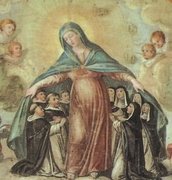
“One evening, Dominic was praying in the church until midnight, at which hour he entered the corridor where the Friars were asleep in their cells. Having finished his business, he resumed his prayers at the end of the corridor where the Friars were asleep in their cells. Having finished his business, he resumed his prayers at the end of the corridor, when chancing to turn his eyes to the other end, he beheld three women approaching, the center on being the most beautiful and venerable. One of her companions carried a magnificent vase, and the other an aspersorium, which she presented to her mistress, who sprinkled and blessed all the Friars save one. Dominic, after noting who the Friar was, advanced to meet the woman, who had already reached the middle of the corridor, near the lamp suspended in that spot. He prostrated himself at her feet, and although he had recognized her, entreated her to tell him her name. At that same time, the beautiful and devotional anthem of the Salve Regina was not yet sung in the monastery and nunnery of the Order in Rome, but only recited, kneeling, after Compline. The woman replied, ‘I am she whom you invoke every eve, and when you say, Eia ergo, advocata nostra, I prostrate myself before my Son, entreating Him to protect this Order.’ The blessed Dominic then asked who her two companions were, on which the Blessed Virgin said, ‘One is Cecilia, and the other Catherine.’ The blessed Dominic then inquired the reason for her omitting to bless one of the Friars, and she replied, ‘Because he was not in a becoming posture.’ Then having finished her round, and sprinkled and blessed the Friars, she disappeared. The blessed Dominic returned to the spot where he had been praying, and hardly had he recommenced his devotions when he was raised in spirit to the presence of God. He beheld the Lord, having at his right hand the Blessed Virgin, who seemed to Dominic to be robed in a sapphire-colored mantle. Looking around and discerning Religious of every Order but his own, he began to weep bitterly, not daring to approach our Lord or his Blessed Mother. Our Lady motioned him to draw near, but he dared not comply until encouraged by our Lord. Then he approached and prostrated himself weeping bitterly. The Lord said, ‘Why weepest thou so bitterly?’ and he replied, ‘Because I see members of every Order but my own.’ The Lord said to him, ‘Dost thou wish to see thy Order?’ He tremblingly replied, ‘Yes, Lord;’ and the Lord rested His hand on the shoulder of the Blessed Virgin, saying to Dominic, ‘I have confided thy Order to my mother.’ Then He added, ‘Wilt thou indeed see thy Order?’ to which Dominic replied, ‘Yes, Lord.’ Then the Blessed Virgin unfolding her mantle in Dominic’s sight, so that it covered the whole of the celestial abode, he beheld beneath it a multitude of his children. The blessed Father prostrated himself to render thanks to God and to our Lady, and the vision disappeared. As he recovered consciousness, the bell was ringing for Matins, and when they were ended, he convoked a chapter of his Friars, and discoursed to them on the love and veneration they ought to have to the Blessed Virgin, and among other things he related this vision. At the close of the chapter, he privately took aside the brother whom Our Lady had not blessed, and gently asked him if he had not kept back something in the general confession he had made. He replied, ‘Holy Father, my conscience accuses me of nothing, save that last night, when I awoke, I found I had been sleeping with no garments on.’ At Saint-Sixtus the blessed Dominic related his vision to Sister Cecilia and the others, as if it had been beheld by another person, but the Friars present made a sign to the sisters that it was Dominic who had seen it. It was on this occasion that the blessed Dominic enjoined that, wherever they slept, the Friars should wear their girdle and their sandals.”
Thursday, April 12, 2007
Lacordaire: Conferences
The following is continued from Lacordaire's
"God: Conferences delivered at Notre Dame in Paris"
(series begins here)
"God: Conferences delivered at Notre Dame in Paris"
(series begins here)
CONFERENCES
THE INNER LIFE OF GOD
(continued)
We would understand something of the divine life: the first question, therefore, we have to ask is: What is life? For, as long as we do not know what life is in itself, it is clear that we shall not be able to form any idea of the life of God. What, then, is life? In order to comprehend this, we must learn what being is; for life is evidently a certain state of being. We thus arrive at that first and supreme question: What is being? And we shall solve it by seeking what is permanent and common in the infinitely varied beings which surround us. Now, in all of these, whatsoever their name, their form, their degree of perfection or inferiority, we find a mysterious force which is the principle of their substance and organization, and which we call activity. Every being, even the most inert in appearance, is active; it condenses, it resists foreign efforts, it attracts and incorporates to itself element which obey it. A grain of sand is in contest and in harmony with the whole universe, and maintains itself by that force which is the very seat of its being, and without which it would become lost in the absolute incapacity of nothingness. Activity, being the permanent and common characteristic, of all that is, it follows that being and activity are one and the same thing, and that we are warranted in making this definition: Being is activity. St. Thomas of Aquinas gave us an example when, having to define God, who is being in its total reality, he said: God is a pure act.
But activity supposes action, and action is life. Life is to being what action is to activity. To live, is to act. It is true that spontaneous, and above all, free action, being perfect action, the birth or apparition of life is generally marked at the point where that kind of action is manifested. Thus we say that the stone is, that the plant grows, that the animal lives; but these different expressions mark only the gradations of activity, whose presence, how feeble soever it may be, everywhere constitutes the living being.
We know what life is. Let us advance another step, let us learn what are its general laws, and then apply them to God.
The first general law of life is: The action of a being is equal to its activity. In fact the action of a being can be limited only by a foreign force, or by its own will. Now a foreign force checks it only at the point where its own energy ceases, and as to its own will, should it possess any, that necessarily bears it as far as it can reach by its own nature. An action superior to its activity is impossible to it; an action inferior is insufficient; an action equal to its activity is the only action that places it in harmony with itself and with the rest of the universe. Therefore, whether you consider the general movement of worlds or the tendency of each being in particular, you will find them all acting according to the measure of their forces, and placing limits to their ambition only because they exist to their faculties. All, and man among the rest, advance as far as they can; all, having reached the point which exhausts and stops them, write like the poet, proudly accusing their own powerlessness:
SISTIMUS HIC TANDEM NOBIS UBI DEFUIT ORBIS.
Henri-Dominique Lacordaire
God: Conferences - Notre-Dame in Paris (1871)

Duck tape
A post at Mulier Fortis on this marvelous substance...

No, this is not what it's for...

It is said that the home took kit needs only two things, Duct tape and WD40. If it moves and it's not supposed to, use duct tape. If it doesn't move and it's supposed to, use WD40.
No, this is not what it's for...

It is said that the home took kit needs only two things, Duct tape and WD40. If it moves and it's not supposed to, use duct tape. If it doesn't move and it's supposed to, use WD40.
Sophia update with Caringbridge link
Sophia's mother sent last week, but I'm afraid my ISP's spam filter ate it and I just found it. My apologies for not catching it sooner!
The picture is from the Caringbridge site, and you can click it to bring up the site. I'm adding the link on the navigation part of the blog to for easy reference.

The picture is from the Caringbridge site, and you can click it to bring up the site. I'm adding the link on the navigation part of the blog to for easy reference.
Dear friends and family,
I have to admit that I don't even know where to start. After this long journey it seems like I would have a lot to say, but my sister Daniela has done an amazing job keeping everyone informed.
First of all we want to say THANK YOU! to my incredible sister for all she did, we don't know what we would have done without her. Not only does she have a husband and three children at home, she also has a job (I hope she still has it!) and a household to run, and she still managed to be at the hospital to support us, helped us with Matias, sent daily updates and answered hundreds of emails. We are so very thankful for her! I feel so blessed to have YOU Daniela as my sister.
We want to also say THANK YOU! to all of you. It's impossible to describe what we feel in our hearts, only God knows, and we always thank Him, our Father in heaven, for you all. We prayed at the beginning of our journey that we would feel His love, His arms around us, we knew that we couldn't do it alone in our own power, He answered our prayers through all of you. We felt His amazing love being pour out on our family through all of you, daily. We felt amazed and overwhelmed and so grateful for all of you. THANK YOU from the bottom of our hearts for your continuous prayers, your beautiful cards, letters, messages, meals, gifts and for just letting us know you were praying. I can't explain with words how comforting your support was and still is. We learned through all this how powerful the family of Christ really is and how God works in such amazing ways.
Now I want to tell you, as you probably already know, that we started our second phase of the journey with our return home. We are so grateful that Sophia is here, at home with us today. Getting home was very exciting but at the same time very scary, no nurses to check blood pressure, heart rate, pupils' reactions, etc. We were here alone with a whole bunch of medicine. The first few days were very difficult especially because Sophia wasn't sleeping through the night and we were exausted. She wouldn't sleep even 2 hours straight, she would cry and make grunting noises all night. But thankfully those days are over, she's sleeping much better now, waking up only once or twice a night.
She still has no short term memory and she is constantly hungry, an effect from damage to the hypothalamus that we hope is temporary (sometimes is not). She eats breakfast and five minutes later she is asking for breakfast again because she feels hungry and forgets she just ate.
Her moods are getting better, she is not so grumpy. She can get more agitated if it's too noisy or there is too much going on. We usually have to keep visits short if they involve children. She gets tired very easily and wants to sleep. But her mind is doing so much better, she stopped hallucinating and what she says now makes sense even though sometimes she has trouble finding the right words. We are seeing a lot more of Sophia's personality coming out and that is very exciting.
We go to therapy (occupational, physical and speech therapy) 4 times a week. She is getting so much stronger. She walks with no problem now, and goes up and down the stairs by herself (we usually watch her though because of her vision). Once a week we go in for blood tests which have been quite an adventure, to say the least. They have a very difficult time finding her veins and when they find one sometimes they can't even draw enough blood for all the tests. Last time they had to poke her 4 times, each time having to move the needle around looking for a vein, it was very painful for her and for us to watch. After all that they didn't even have enough blood and decided to wait until next week for some of the tests. They are thinking that maybe they'll have to place a pic line to make this procedure easier, we'll see.
We've also been busy with doctors' appointments, she has 6 different doctors to "visit". But some of those visits shouldn't be very often, after a while we expect not to see some of them much at all. Our new best friend will be Dr Karmazin, the pediatric endocrinologist, he will be the one keeping a close eye on Sophia for years to come. Right now his challenge has been finding the right dose of ddavp, the medicine that controls the fluid in her body. That affects the sodium level in the blood that is one of the things they have been checking weekly. If it goes to extremes it could be very dangerous. If it is high usually kids should feel thirsty and compensate by drinking more water but Sophia doesn't feel thirst (something else that sometimes happens with this kind of surgery) so it is more difficult to control. We have to constantly remind her to drink water.
Her vision continues to be a source of frustration for her. She loves to color and draw and now doesn't feel like doing that because her vision is limited. This coming Monday there is a teacher from the School of the Blind that will come to the house to evaluate her and see what her needs are to be able to read, write, and get ready for school. We are looking forward to that day.
We keep praying that most of the issues that she's dealing with now will go away with time. It is still too early to tell. We know for sure she'll need the replacements for everything created in the pituitary gland, but we pray that everything else will resolve with time -all the effects of the damage to the hypothalamus and maybe some of the vision. But we also pray that whatever the final outcome, we accept it as part of God's plan for Sophia and our family. It is impossible for us to understand now why all this is happening but we pray for peace in our hearts and acceptance and in the midst of this storm we still praise our Lord and thank Him for our beautiful daughter.
I hope I didn't give you too much detail that was too confusing to follow. I just wanted to give you an idea of how she's doing today. We started a site for Sophia at caringbridge so everybody can follow her progress there. It is at www.caringbridge.org/visit/sophiawilson. We have some pictures there too and you can leave messages to Sophia or the family in the guestbook if you wish. We will be giving updates there and any specific prayer requests. THANK YOU again so very much for your prayers. THANK YOU for the love and support you have shown us through these difficult times. We love you all!
Veronica, Scott, Matias and Sophia
En espanol, a nuestra querida familia y amigos que no entendieron nada les prometo mandarles otro email manana en espanol. Ahora es tan tarde y estoy muy cansada, pero manana va uno para ustedes. Un abrazo grande para todos. Los quiere, Veronica
Miraculous healing?!
Kathleen Schuck OPL sends the following:
Br. Boniface O.P. is from Emmett, Idaho, and is in formation at St. Albert's Priory in Oakland, California. Click the picture for his web page.
Praise be to God!
Glory report on Br. Boniface; he has been healed of Krohn's Disease. He has had problems with this since teenaged but in recent physical the Doc could find no evidence left in him. Praise be to the Great Healer! Father Yankos, an older Dominican Priest fell. He has a broken nose and is banged up from the fall, please pray for his recovery.
Br. Boniface O.P. is from Emmett, Idaho, and is in formation at St. Albert's Priory in Oakland, California. Click the picture for his web page.
Praise be to God!
Wednesday, April 11, 2007
China & the Church
This is from Fr. Z's blog, What Does the Prayer Really Say?
it is so amazing, I've copied it here:
Can you imagine? It is mind-numbing to consider what such an event would be like, we who are able to attend a mass at the time and place of our choosing! Perhaps that is why this other quote from Cdl Arinze (April 6, London) is also so apropos for us who have such comparative spiritual richness:
it is so amazing, I've copied it here:
Cardinal Zen was our parish priest some of the time we lived in Hong Kong. I can tell you all that he is a man of gentle steel, faithfully true to the Church and a liturgical delight. Not only that but he was a real father to his parish.
As for the struggle to be free in China, the following story may interest some:
Twelve years ago, when my daughter was baptised in Hong Kong, the priest who baptised her, Fr Bernard Tohill, SDB, had returned that morning from a short trip into the mainland. He had been asked to go and offer Mass in a small village about 300 miles into China for a community that had been without the Mass since 1949. He had relearned how to say the old Mass and was expecting be be saying Mass for about a dozen people.
When he arrived in the village, there were over 1,000 people waiting to hear Mass and after the first Mass he heard confessions for 6 hours straight. The following day he heard confessions for another 6 or 7 hours before celebrating Mass at which over 700 made their Communion.
The faith in this area had been kept alive by families and small groups meeting to pray the Rosary and to learn the Catechism, for over 45 years.
Whenever I hear stories about China, I am reminded of Fr Bernard’s story and I offer the day’s sufferings, frustrations and joys to our Lord through the intercession of His blessed Mother for the Church and people in China. Our Lady of Consolation, pray for China.
Comment by Stephen Morgan — 11 April 2007 @ 1:42 pm

Can you imagine? It is mind-numbing to consider what such an event would be like, we who are able to attend a mass at the time and place of our choosing! Perhaps that is why this other quote from Cdl Arinze (April 6, London) is also so apropos for us who have such comparative spiritual richness:
"Liturgy", says Pope John Paul II, "is never anyone’s private property, be it of the celebrant or of the community in which the mysteries are celebrated. Priests who faithfully celebrate Mass according to the liturgical norms, and communities which conform to those norms, quietly but eloquently demonstrate their love for the Church" (Eccl. de Euch., 52). At the direction of Pope John Paul II, the Congregation for Divine Worship and the Discipline of the Sacraments, in collaboration with the Congregation for the Doctrine of the Faith, issued the Instruction Redemptionis Sacramentum in March 2004 "precisely to bring out more clearly this deeper meaning of liturgical norms" (Eccl. de Euch., 52).
It follows that individuals, whether they be priests or lay faithful, are not free to add or subtract any details in the approved rites of the celebration of the Holy Eucharist (cf Sacrosanctum Concilium, 22). A do-it-yourself mentality, an attitude of nobody-will-tell-me-what-to-do, or a defiant sting of if-you-do-not-like-my-Mass-you-can-go-to-another-parish, is not only against sound theology and ecclesiology, but also offends against common sense. Unfortunately, sometimes common sense is not very common, when we see a priest ignoring liturgical rules and installing creativity in his case personal idiosyncracy as the guide to the celebration of Holy Mass. Our faith guides us and our love of Jesus and of his Church safeguards us from taking such unwholesome liberties. Aware that we are only ministers, not masters of the mysteries of Christ (cf I Cor 4:1), we follow the approved liturgical books so that the people of God are respected and their faith nourished, and so that God is honoured and the Church is gradually being built up.
Tuesday, April 10, 2007
Lacordaire, Conferences
The following is continued from Lacordaire's
"God: Conferences delivered at Notre Dame in Paris"
(series begins here)
next reading here
"God: Conferences delivered at Notre Dame in Paris"
(series begins here)
MY LORD, - GENTLEMAN,
CONFERENCES
(continued)
THE INNER LIFE OF GOD
GOD exists, but what does he? What is his action? What is his life? This question at once rises in our thoughts. As soon as the mind has recognized the existence of a being, it asks how that being lives; and still more so in regard to God, who, as the principle of beings, excites within us a thirst for knowledge of him, so much the more ardent and just as his action is the model of all action, and his life the pattern of all life. What then is the life of God? How does he employ his eternity? This is doubtless a bold question. Nevertheless, it is a question which men ask, and which they desire to solve. But how is it to be solved? How are we to penetrate the divine essence in order to catch a glimpse of the incomprehensible movement of an eternal, infinite, absolute, and immutable spirit?
Three doctrines come before us. One of these affirms that God is condemned by the sovereign majesty of his nature to isolation dreadful to imagine; that, alone in himself, he contemplates himself seeing only himself, and love himself with a love which has no other object than himself; and in this contemplation of this love, eternally solitary, the nature and perfection of his life consist.
According to the second doctrine, the universe shows us the life of God, or rather it is in itself the life of God. We behold in it his permanent action, the scene upon which his power is exercised, and in which all his attributes are reflected. God is not out of the universe any more than the universe is out of God. God is the principle, the universe is the consequence, but a necessary consequence, without which the principle would be inert, unfruitful, impossible to conceive.
Catholic doctrine condemns these two systems. It does not admit that God is a solitary being eternally employed in a sterile contemplation of himself; nor does it admit that the universe, although it is the work of God, is his proper and personal life. It soars above those feeble ideas, and, bearing us with the word of God beyond all the conceptions of the human mind, it teaches us that the divine life consists in the co-eternal union of three equal persons, in whom plurality destroys solitude, and unity division; whose thought corresponds, whose love is mutual, and who, in that marvelous communion, identical in substance, distinct in personality, form together an ineffable association of light and love. Such is the essence of God, and such is his life, both powerfully expressed in those words of the Apostle St. John: - TRES SUNT QUI TESTIMONIUM DARET IN CŒLO: PATER, VERBUM , ET SPIRITUS SANCTUS – There are three who give testimony in heaven; the Father, the Word, and the Holy Ghost. And these three are one (Jn 5:7).
Here, and very soon after having promised you light, it would seem that I am leading you into a maze of darkness; for, can anything be conceived more formidable to the mind than the terms by which I have just expressed, according to the Scriptures and the Church, the relations that constitute the inner life of God? Do not, however, yield to this first impression; trust rather to my promises, since they are those of the Gospel, wherein it is written: EGO SUM LUX MUNDI – I am the light of the world. And again: - QUI SEQUITUR ME NON AMBULAT IN TENEBRIS, SED HABEBIT LUMEN VITÆ – He that followeth me walketh not in darkness, but shall have the light of life (Jn 8:12). Yes, be confident, count upon God, who has proposed nothing to you unnecessary to be believed, and who has hidden marvelous treasures in the most obscure mysteries, as he has hidden the fires of the diamond in the depths of the earth. Follow me, let us pass the pillars of Hercules, and, leaving truth to fill our sails, let us fearlessly advance even to the transatlantic regions of light.
Henri-Dominique Lacordaire
God: Conferences - Notre-Dame in Paris (1871)
next reading here
Baptism congratulations!
To the family of Mike & Deb Lee!
Ezekiel born again!

More pictures and information here. my favorite, Zach peeking over the shoulder of Cardinal Schönborn!

And if I've given you the idea that this crowd showed up for the baptism, well, not quite... you'll have to follow the link :)
Ezekiel born again!

More pictures and information here. my favorite, Zach peeking over the shoulder of Cardinal Schönborn!
And if I've given you the idea that this crowd showed up for the baptism, well, not quite... you'll have to follow the link :)
Easter week
THE LORD IS RISEN!
Such a little phrase, such an immense event! I must confess I've not posted for a few days because the old noodle is trying to unwrap itself from the awesome Passion week, a Triduum to be remembered, a dear bishop, visibly suffering, who begged us to make a holy Triduum, preached on the Real Presence to the assembled C&E visitors, and was overheard to decry a Holy Friday post communion OCP "hymn" set to the Gilligan's Island theme song, glorious polyphony still the remembered impression.
This Easter scriptural passage will not stop bouncing in my head: Why do you seek the living among the dead? This is such a metaphor for the search for truth which attempts to exclude Truth, a Person, not a set of facts. Yet without faith, we are still driven by the impulse which God has built into us, to seek truth, for that is the image we are made in. So many imposters to be found among the dead; those not born again to life and living the life of grace. And yet, our Gracious Lord, St. Paul tells us, uses even this, for all things work to good for those who love God. And that even this search in the wrong places, will not open for us without heavenly intervention, for those who sought the Lord on that first Easter morning, found the stone rolled back for them. This is the action of grace, in revealing the Author of Life to the seeker who has made the committment of heart to find the truth, even if it leads where he does not want, to Truth.
Fr. Gabriel of St. Mary Magdalen O.C.D., in today's Divine Intimacy meditation, points out that Mary Magdalen was so consumed with our Lord, and that she simply assumed everyone else was as well. That is why she asked (a perceived) gardener, "I don't know where they have taken him" - Who? Mary assumes that we all think of nothing else but our Lord. This is quite profound. She makes an assumption, not to be confused with presumption.
Jesus saith to her: Mary. She turning, saith to him: Rabboni
My sheep know me, and I call them by name, He had said.
Let us be turned unto the Lord.
It is said that St. Dominic admonished his friars to speak only of or to God.
methinks he knew what Mary Magdalen had found.
I will soon resume the posts from Lacordaire, but in the meantime, thanks to the book recommend of Catholic Church Music at The New Liturgical Movement, here's a page with some awesome pre-reformation English music; in particular, the Ave Maria:
Robert Parsons Project: The Latin Works
We also have an exceptional Third Order Chapter meeting coming up; we will be hosting the Divine Mercy at 3PM Sunday, and have as a guest speaker Dr. Peter Kwasniewski, of Wyoming Catholic College. Peter and his wife are the only Third Order Dominicans in Wyoming!
Friday, April 06, 2007
Thursday, April 05, 2007
Lacordaire, Conferences
The following is continued from Lacordaire's
"God: Conferences delivered at Notre Dame in Paris"
(series begins here)
next reading here
"God: Conferences delivered at Notre Dame in Paris"
(series begins here)
CONFERENCES
THE EXISTENCE OF GOD
(continued)
But if God has on his side nature, intelligence, conscience, and society, what remains there to pantheism? Where is it to find its basis? It seeks its basis in the obscurities of abstruse metaphysics; withdrawing from all realities, from every feeling and every want, in order to form a labyrinth from whence thought can find no exit. It loses itself the clue, and shut up in the subtle prison which it has made, takes refuge in the sneer of self-deceived pride, and calling to its help, from the corrupted depths of ages, the prying spirits of subtle doctrines, it hurls against God and mankind the anathema of scorn. God passes by without hearing, and mankind without answering. Let us do likewise, let us pass by also.
We have a threefold intuition of God: a negative intuition in nature; a direct intuition in the ideas of truth and justice; a practical intuition in human society. Nature, in manifesting characteristics to us incompatible with a being existing of itself, causes us to mount to its source, the ideas of truth and justice name God to us, without whom they would be nothing; human society, which cannot do without him, proves to us his existence by its need of him. But besides these continuous and inadmissible revelations, there are others which divine providence scatters from time to time on the road of nations. He strikes with his thunders and rends the veils, he gives so full and deep a consciousness of his presence, than none can be deceived, and causes a whole nation to utter from its inmost heart that unanimous and involuntary cry: It is the hand of God! We are witnessing one of those times when God unveils himself; but yesterday he passed through our gates and the whole world beheld him. Shall I then remain silent before him? Shall I hold upon my trembling lips the prayer of a man who, once in his life, has seen his God before him?
O God, who has just dealt these terrible blows, O God, the judge of kings and arbiter of the world, look down in mercy upon this old Frank nation, the elder son of thy right hand and of thy Church. Remember its past services, thy first blessings; renew with it that ancient alliance which made it thy people; touch its heart which was so full of thee, and which now again, in the flush of a victory wherein it spared nothing royal, yielded to thee the empire which it yields to none other. O God, just and holy, by the cross of thy Son which their hands bore from the profaned palace of kings to the spotless palace of thy spouse, watch over us, protect us, enlighten us, prove once more to the world that a people that respects thee is a people saved!
Henri-Dominique Lacordaire
God: Conferences - Notre-Dame in Paris (1871)
next reading here
Sophia
Yesterday, the Chancel Choir offered their Wednesday Vespers for the intention of Sophia's healing. Now I'll admit that I don't see as well as I could; I need new glasses. But part way through the service, it began to sink in that I was looking at Sophia and her parents in the pews! Her mother was holding her, and she was tired, but she was there!

I was so overwhelmed that I fear I had great difficulty and muffed a take-up in the magnificat.
Never has a thank you, as uttered by Sophia after the service, ever reduced me to a quivering mess before.
Veronica, her mother, repeated Daniela's promise to get the Caringbridge link out soon. She repeated her gratitude for all the prayers offered on Sophia's behalf.

I was so overwhelmed that I fear I had great difficulty and muffed a take-up in the magnificat.
Never has a thank you, as uttered by Sophia after the service, ever reduced me to a quivering mess before.
Veronica, her mother, repeated Daniela's promise to get the Caringbridge link out soon. She repeated her gratitude for all the prayers offered on Sophia's behalf.
James 5:19-20, Morning prayer of 4th Friday of Lent
My brothers, if anyone among you should stray from the truth and someone bring him back, he should know that whoever brings back a sinner from the error of his way will save his soul from death and will cover a multitude of sins.
My thanks to Anita (V-For Victory) for helping me unravel this passage. I'd always felt uncomfortable about just who all was referred to by all the pronouns! Was the one bringing back, or the one brought back, saved from death, and whose multitude of sins was covered? The Haydock commentary confirmed Anita's analysis, that merit accrues to the one whom has allowed God to use him to rescue the lost; and said same person, by cooperating with grace, has many of his own unknown sins remitted.
The connection Anita made which I really appreciated was, was linking it to the opposite warning: to those who cause scandal to Christ's little ones, the millstone is threatened; thus it stands to reason that as additional punishment accrues to those who cause scandal, additional merit accrues to those who assist in the salvation of otheres. This can be opened a bit further, by applying St. Augustine's definition of Scandal; "that action which causes a member of the faithful to depart from Christ's Church." Now, this does not include the false scandal, as in Jn 6:66, where the unbelieving left because the Truth was a stumbling block they refused to accept. Neither does it include what we have come to know as the definition of scandal today; the moral outrage over acts which are contrary to justice and right reason. So one who causes a member of the faith, one of God's little ones, to renounce said little one's salvation, forfeits his own as well. and one who assists one who has fallen to return to a state of grace, accrues grace for his own salvation as well.
It does not cease to amaze me to see how evil is a perverse mirror of goodness, and perhaps that is why so many, left to their own devices because they reject Goodness Himself, confuse injustice for justice, and evil for good.
My thanks to Anita (V-For Victory) for helping me unravel this passage. I'd always felt uncomfortable about just who all was referred to by all the pronouns! Was the one bringing back, or the one brought back, saved from death, and whose multitude of sins was covered? The Haydock commentary confirmed Anita's analysis, that merit accrues to the one whom has allowed God to use him to rescue the lost; and said same person, by cooperating with grace, has many of his own unknown sins remitted.
The connection Anita made which I really appreciated was, was linking it to the opposite warning: to those who cause scandal to Christ's little ones, the millstone is threatened; thus it stands to reason that as additional punishment accrues to those who cause scandal, additional merit accrues to those who assist in the salvation of otheres. This can be opened a bit further, by applying St. Augustine's definition of Scandal; "that action which causes a member of the faithful to depart from Christ's Church." Now, this does not include the false scandal, as in Jn 6:66, where the unbelieving left because the Truth was a stumbling block they refused to accept. Neither does it include what we have come to know as the definition of scandal today; the moral outrage over acts which are contrary to justice and right reason. So one who causes a member of the faith, one of God's little ones, to renounce said little one's salvation, forfeits his own as well. and one who assists one who has fallen to return to a state of grace, accrues grace for his own salvation as well.
It does not cease to amaze me to see how evil is a perverse mirror of goodness, and perhaps that is why so many, left to their own devices because they reject Goodness Himself, confuse injustice for justice, and evil for good.
Criticism of Bishops and Priests
A recent article in HPR:
The Danger of Criticizing
Bishops and Priests
discusses the dangers to us of gossiping about men in holy orders. It is a good article, but I also think it is incomplete. To illustrate my point, consider the following example:
I like to catch bull snakes. They are mean, hiss, sometimes bite, but are harmless.

Now, suppose if I went to India, and decided to catch this dude,

and you did not warn me, would not you have been deficient in you duty both to truth and charity?
Certainly there is a difference between gossip and detraction, and the necessity of truth and charity. Not an easy minefield to walk in. St. Francis de Sales wrote about this and here is what he had to say...
Anita (V-For Victory) pointed out to me two things: First, the author of the article in HPR give as example, the witness of Jesus' criticism of those in authority in His time! Pretty mixed message in that! Second, this is the basis of public registration of sex offenders; the goal and aim of which is not the detraction of the offender, but the protection of the innocent.
The Danger of Criticizing
Bishops and Priests
discusses the dangers to us of gossiping about men in holy orders. It is a good article, but I also think it is incomplete. To illustrate my point, consider the following example:
I like to catch bull snakes. They are mean, hiss, sometimes bite, but are harmless.

Now, suppose if I went to India, and decided to catch this dude,

and you did not warn me, would not you have been deficient in you duty both to truth and charity?
Certainly there is a difference between gossip and detraction, and the necessity of truth and charity. Not an easy minefield to walk in. St. Francis de Sales wrote about this and here is what he had to say...
"Introduction to the Devout life"
Public, notorious sinners may be spoken of freely, provided always even then that a spirit of charity and compassion prevail, and that you do not speak of them with arrogance or presumption, or as though you took pleasure in the fall of others. To do this is the sure sign of a mean ungenerous mind. And, of course, you must speak freely in condemnation of the professed enemies of God and His Church, heretics and schismatics, it is true charity to point out the wolf wheresoever he creeps in among the flock. Most people permit themselves absolute latitude in criticising and censuring rulers, and in calumniating nationalities, according to their own opinions and likings. But do you avoid this fault; it is displeasing to God, and is liable to lead you into disputes and quarrels. When you hear evil of any one, cast any doubt you fairly can upon the accusation; or if that is impossible, make any available excuse for the culprit; and where even that may not be, be yet pitiful and compassionate, and remind those with whom you are speaking that such as stand upright do so solely through God's Grace. Do your best kindly to check the scandal-bearer, and if you know anything favourable to the person criticised, take pains to mention it.
St. Francis de Sales,
CHAPTER XXIX.
On Slander
Anita (V-For Victory) pointed out to me two things: First, the author of the article in HPR give as example, the witness of Jesus' criticism of those in authority in His time! Pretty mixed message in that! Second, this is the basis of public registration of sex offenders; the goal and aim of which is not the detraction of the offender, but the protection of the innocent.
THE GIFT OF LOVE
Today is Holy Thursday, and we commemorate the institution of two Holy Sacraments; the Eucharist and Holy Orders. From Divine Intimacy by Fr. Gabriel of St. Mary Magdalen, O.C.D., comes the following meditation:
There are those who take the name “Christian,” but who refuse to walk with the Christ truly and really present and living among us; insisting that He did not mean literally what He stated to his followers, as recorded by St. John in chapter 6 of his gospel. Jesus tells his followers that His flesh and blood is the food they must eat, and although they think with justified horror of this in a carnal manner, he repeatedly insists that this is what they must do, not once saying that it is a symbol of Him that they must eat; confirming over and over again, you must eat my flesh and drink my blood. Those who reject the Catholic understanding point to 6:64 as the “refutation” of the Catholic and apostolic understanding; of “It is the spirit that quickeneth: the flesh profiteth nothing” they understand him to have said “my flesh profiteth nothing.” But, as we must gently insist that he specifically did not say: “My flesh profiteth nothing.” For by such an understanding, we protest that you prove too much, for if the flesh of Jesus “profiteth nothing,” then the incarnation and redemption on the cross are of no profit to us, and we are still lost in our sins. So those who fail to understand what he said, which was all present, responded in two ways: one group, saying, “this is a hard saying, who can hear it?” (Jn 6:61) abandoned Him (Jn 6:66). The second group, led by Peter, did not understand either. Peter spoke for most of them, in giving his reasons for staying, “To whom shall we go? You have the words of eternal life;” and one stayed because he was a devil.
St. Thomas speaks to this mystery in the second stanza of the Adoro te Devote:
THE GIFT OF LOVE
“Having loved His own…He loved them to the end” (Jn. 13:1-15), and in those last intimate hours spent in their midst, He wished to give them the greatest proof of His love. Those were hours of sweet intimacy, but also of the most painful anguish. Judas had already set the price of the infamous sale; Peter was about to deny his Master; all of them within a short time would abandon Him. The institution of the Eucharist appeared then as the answer of Jesus to the treachery of men, as the greatest gift of His infinite love in return for the blackest ingratitude. The merciful God would pursue His rebellious creatures, not with threats, but with the most delicate devices of His immense charity. Jesus had already done and suffered so much for sinful man, but now, at the moment when human malice is about to sound the lowest depths of the abyss, He exhausts the resources of His love, and offers Himself to man, not only as the Redeemer, who will die for him on the Cross, but also as the food which will nourish him. He will feed man with His own Flesh and Blood; moreover, death might claim Him in a few hours, but the Eucharist will perpetuate His real, living presence until the end of time. “O You who are mad about your creature!” exclaimed St. Catherine of Siena, “true God and true Man, You have left Yourself wholly to us, as food, so that we will not fall through weariness during our pilgrimage in this life, but will be fortified by You, celestial Nourishment!”
HOLY THURSDAY
There are those who take the name “Christian,” but who refuse to walk with the Christ truly and really present and living among us; insisting that He did not mean literally what He stated to his followers, as recorded by St. John in chapter 6 of his gospel. Jesus tells his followers that His flesh and blood is the food they must eat, and although they think with justified horror of this in a carnal manner, he repeatedly insists that this is what they must do, not once saying that it is a symbol of Him that they must eat; confirming over and over again, you must eat my flesh and drink my blood. Those who reject the Catholic understanding point to 6:64 as the “refutation” of the Catholic and apostolic understanding; of “It is the spirit that quickeneth: the flesh profiteth nothing” they understand him to have said “my flesh profiteth nothing.” But, as we must gently insist that he specifically did not say: “My flesh profiteth nothing.” For by such an understanding, we protest that you prove too much, for if the flesh of Jesus “profiteth nothing,” then the incarnation and redemption on the cross are of no profit to us, and we are still lost in our sins. So those who fail to understand what he said, which was all present, responded in two ways: one group, saying, “this is a hard saying, who can hear it?” (Jn 6:61) abandoned Him (Jn 6:66). The second group, led by Peter, did not understand either. Peter spoke for most of them, in giving his reasons for staying, “To whom shall we go? You have the words of eternal life;” and one stayed because he was a devil.
St. Thomas speaks to this mystery in the second stanza of the Adoro te Devote:
Godhead here in hiding, whom I do adore,
Masked by these bare shadows, shape and nothing more,
See, Lord, at Thy service low lies here a heart
Lost, all lost in wonder at the God thou art.
Seeing, touching, tasting are in thee deceived:
How says trusty hearing? that shall be believed;
What God's Son has told me, take for truth I do;
Truth Himself speaks truly or there's nothing true.
On the cross Thy godhead made no sign to men,
Here Thy very manhood steals from human ken:
Both are my confession, both are my belief,
And I pray the prayer of the dying thief.
I am not like Thomas, wounds I cannot see,
But can plainly call thee Lord and God as he;
Let me to a deeper faith daily nearer move,
Daily make me harder hope and dearer love.
O thou our reminder of Christ crucified,
Living Bread, the life of us for whom he died,
Lend this life to me then: feed and feast my mind,
There be thou the sweetness man was meant to find.
Bring the tender tale true of the Pelican;
Bathe me, Jesu Lord, in what Thy bosom ran
Blood whereof a single drop has power to win
All the world forgiveness of its world of sin.
Jesu, whom I look at shrouded here below,
I beseech thee send me what I thirst for so,
Some day to gaze on thee face to face in light
And be blest for ever with Thy glory's sight. Amen.
Wednesday, April 04, 2007
Catholic Church Music/English heritage
As one who sings "English church music," this is a fascinating find, and I'm glad it was pointed out over at The New Liturgical Movement The following is the end of the chapter, and it provides a fascinating insight, for which I am grateful.
From CATHOLIC CHURCH MUSIC (that link takes you to full text), by Richard R. Terry, 1907.
one cannot help but observe that the adaptation to English of traditional Latin hymns that we are subjected to in such things as the OCP Music Issue, has largely followed the path outlined above.
From CATHOLIC CHURCH MUSIC (that link takes you to full text), by Richard R. Terry, 1907.
CHAPTER XXIII
THE FATE OF ENGLISH CHURCH MUSIC AT THE
REFORMATION
THE FATE OF ENGLISH CHURCH MUSICIn brief, the case against the English origin of these early anthems, of which we have no Latin versions, is simply this—they are in the contrapuntal style of the old Catholic composers, which is as distinct from the "full chord" style of the reformers as anything can possibly be. Is it likely, then, that their authors should have written them for the services of the Established Church, seeing that they are composed in a style which, at that period, was strongly denounced, and the use of which was specifically forbidden? No; the fact really is that they never made their appearance in English until the times had changed, and (mark this) every one of their composers was dead.
I now come to my last point with regard to these adaptations. Up to the present I feel sure that I have said nothing with which well-informed Anglican musicians will not agree. Such of them as are High Churchmen will naturally say: "What if we did continue to use the old motets by translating the words into English? We are the same old Church which existed before the Reformation, and what you say is only one more proof that we had no intention of breaking with the past." It is here that we must (in all charity) part company with them. As Catholics, we welcome these appeals to the "Continuity Theory”; it always breaks down when used against us, and nowhere more completely than in the case of these musical adaptations. If there is one fact which points more clearly than another to a complete break with the past—to a definite repudiation of the Mass and all it implies, it is this: That when the music of sacramental motets was adapted to English words, the custom of translating the Latin was abandoned, and different words were substituted. The best known anthem of Tallis ("I call and cry") was originally O sacrum conviviuin. His O salutaris Hostia is altered to "O Praise the Lord," and Byrd's Ave verum corpus appears as "O Lord God of Israel." There is not a single instance forthcoming of a sacramental motet having been Englished to its original words. Further than this, in not a single instance has the music of what we commonly call a Mass (i.e., Kyrie, Gloria, Credo, Sanctus, Benedictus, and Agnus) been adapted, either to a Communion Service or anything else. Although the Proper of the Mass (i.e., Introit, Gradual, etc.) was frequently drawn upon for anthems, it must be remembered that, divorced from their special service or feast, these items became mere motets, with no special “popish” significance. When wholesale adaptation was the order of the day, it is difficult to understand why the beautiful Mass music of the old composers was left untouched except on the assumption that anything distinctively suggestive of the Mass was anathema. All this points to the fact that the breaking with old traditions at the Reformation had a like effect on ecclesiastical music. True, in the transition period we find music written for the old and the new form of service by the same men, but the two styles are so distinct that there is no difficulty in recognising which is which. There is no doubt as to which is the superior style of the two. There is no doubt that our Tallises and Byrds considered themselves to be writing, not different styles of music for the same ecclesiastical body, but different styles of music for two different and distinct bodies. If the Anglican Church has since adapted and assimilated the old contrapuntal music, it still remains as much an "outside" product as the music she has adapted of late years from continental Lutheran and Catholic sources, with the sole difference that it was written by Englishmen.
To sum up: Why have I dealt at such length with this old English music? Has it been merely from a desire to break a lance with our Anglican friends? Let me most emphatically repudiate any such intention. It is impossible to dissociate the church music of the sixteenth century from the theological changes which were then taking place, and, in discussing the question, it is impossible to avoid touching on disputed points. A controversial attitude is only to be deprecated when undertaken in a spirit of hostility rather than charity. I would further urge in my defence that I am not in this case stirring up the dying embers of a burnt-out controversy. The question is a new one. This early English music is at present an unexplored field to all save a very, very few students. It is only right, therefore, that Catholics should be put in possession of facts which have been too long withheld from them. How often have we not heard Tallis and Byrd claimed as Anglicans, and called the " Fathers of Anglican Church Music " ? How often have we not had Anglican Cathedral music pointed out to us with pride, as a national product, and that in common use amongst us derided as a foreign importation ? We have been too long ignorant of the fact that all (I say advisedly, all) the best of this early music—whether it has been sung and admired in Anglican cathedrals, as it has been for three hundred years, or buried in libraries and museums— is Catholic in spirit, and Catholic in origin ; written by Catholics for the services of the Catholic Church. It is our heritage—our birthright; and the fact that our claims to it have lain so long in abeyance does not make it any the less ours, or its revival any the less a duty which we owe to the memory of our Catholic forefathers. Its possession is one more link with our national past— that glorious past when this England of ours was undivided in her loyalty to the See of Peter, and our land was justly called an island of saints. Let us lay claim once more to our ancient patrimony. Let us prize it as a possession at once thoroughly English and thoroughly Catholic. Let the revival of its glories be one more mark of that second spring which is bursting around us on every side. Let us show to the world that into whatever alien dwellings this music of our Catholic sires has strayed during our long years of exile, its rightful home is in the Church we love so well—the Church of Cuthbert, of Bede, of Alban, of Thomas of Canterbury, and of Peter.
one cannot help but observe that the adaptation to English of traditional Latin hymns that we are subjected to in such things as the OCP Music Issue, has largely followed the path outlined above.
Tuesday, April 03, 2007


Music: From "The New Liturgical Movement"
I have copied this complete from the blog, The New Liturgical Movement
Certainly something to think about here, folks!
Richard Terry on pop music circa. 1907
Lots of discussion of music today, so it is a good time to draw your attention to one of the greatest books ever written on Catholic music (that link takes you to full text), by Richard R. Terry. It was published in 1907.I THINK we may say that modern individualistic music, with its realism and emotionalism, may stir human feeling, but it can never create that atmosphere of serene spiritual ecstasy that the old music generates. It is a case of mysticism versus hysteria. Mysticism is a note of the Church: it is healthy and sane. Hysteria is of the world: it is morbid and feverish, and has no place in the Church. Individual emotions and feelings are dangerous guides, and the Church in her wisdom recognises this. Hence in the music which she gives us, the individual has to sink his personality, and become only one of the many who offer their corporate praise.
Certainly something to think about here, folks!
Lacordaire, Conferences
The following is continued from Lacordaire's
"God: Conferences delivered at Notre Dame in Paris"
(series begins here)
next reading here
"God: Conferences delivered at Notre Dame in Paris"
(series begins here)
CONFERENCES
THE EXISTENCE OF GOD
(continued)
Perhaps you will still better understand the force of this conclusion by applying it to the order of conscience. Even as truth is the object and life of the mind, justice is the object and life of conscience. Conscience sees and approves a rule of the rights and duties between beings endowed with liberty. That rule is justice. But where is justice? Is it a simple result of human will? It that case justice would e but a convention, a fragile law called into life today and which may fall tomorrow. Is it an order founded on the very nature of man? But that nature is variable, corruptible, subject to passions that lead it astray. What is order for one would be disorder for another. If then justice be a reality, it must be an eternal and absolute law regulating the relations of material beings, and metaphysics an eternal and absolute law regulating the relations of intelligent beings with all beings, either existing or possible. Beyond this notion, justice is but a name which arms the strong against the weak, the prosperous against the needy. Now, this notion necessarily calls forth the notion of God, since an eternal and absolute law could only be a reality in the person of a being subsisting of himself, possessing a will active and just, able to promulgate an order, to maintain it, to reward obedience and punish rebellion.
Truth is the first name of God; justice is the second.
Now it is easy to conceive that there may be men for whom truth and justice are nothing but philosophical speculations, men who shut themselves up in the proud solitude of their own thoughts, and build up in them their own glory upon systems that bear their names. But it is not so with poor and suffering mankind: it needs truth for its nourishment, justice for its defense, and it knows that the real name of both is the name of God, and t hat the real strength of both is the power of God. The poor and the afflicted have never been deceived herein. When they are oppressed, they lift up their hands towards God, they write his name upon their banners, they pronounce to the oppressor that last and solemn expression of the soul that believes and hopes: I cite you before the tribunal of God!
The time of that tribunal comes sooner of later, its temporal and visible, as well as its eternal time. Kings even here below are cited before it, and nations also. It is the permanent tribunal set up in the midst of error and wickedness, and which saves the world. In vain would pride destroy it; the people saved by it save it in their turn. If there were none but sages among us, the idea of God might perish here, for a man alone is always powerful against God; but happily nations are feeble against him, because they cannot do without justice and truth. They protect him against the learned chimeras of false wisdom; they preserve his memory with a faithfulness which does not always preserve the perfect idea of him, but which at least has never yet permitted the sun and history to see a nation of atheists. Notwithstanding all that men have done, God remains as the corner-stone of human society; no legislator has dared to banish him, no age has ignored him, no language has effaced his name. Upon earth as in heaven, his is because he is.
Henri-Dominique Lacordaire
God: Conferences - Notre-Dame in Paris (1871)
next reading here
Sophia update
From Daniela,
Hello Prayer Angels! Veronica asked me for all the email addresses because she wants to write to you, so I’m going to let her update you on Sophia’s life at home during the last couple of weeks. It’s been strange for me not to be writing to you daily! I can’t wait until Sophia is well enough to be able to have a big party with all of you, hopefully this summer ! Some of you told us about the “caringbridge” website as an easy way to continue posting updates and photos. Veronica and I are working on it, we added all my emails to the journal, and we’ll be adding new photos and updates. You all can go into a “guestbook” and write messages if you’d like. Veronica will give you the exact web page and information on her email. I’m praying for each and every one of you. GOD BLESS YOU !! Daniela
Y para los que no entendieron nada J, decia que Veronica me pidio que le mandara todas las direcciones asi ella les escribe, asi que dejo que ella los ponga al dia con las ultimas noticias de como va Sophia. Empezamos a poner informacion y fotos en el internet, Veronica les dara mas informacion, pero sera una forma facil de mantener a todos informados de los progresos y de poner fotos. Un beso grandote a todos. Daniela
When I get the link to Caringbridge, I'll post it.
Monday, April 02, 2007
Palm Sunday thoughts

Palm Sunday brought yet another homily on the fickle people of Jerusalem who welcomed Jesus as king one week and demanded his crucifixion the following week.
While certainly this is a good reminder to examine our conscience, are we living or denying our citizenship in the heavenly kingdom?
Yet, is it possible that this is an injustice to the memory of the good citizens who may not have understood the nature of the Messiah (the Apostles didn't, how could they?), but welcomed him none the less?
If you read the scriptural accounts, there is no explicit statement that those who called for His crucifixion from Pilate, were the same people who had welcomed him to Jerusalem as king, those few short days before.
By way of analogy, and irrespective of your politics, was not George Bush welcomed to the presidency in 2000 and again in '04, in an almost victorious messianic fervor, the friend of the unborn, the future appointer of the SC judges who would overturn RvW? Yet today, do we not hear hue and cry from all quarters, perhaps not for crucifixion, but of impeachment, a bitter and vitriolic hatred which looks forward to the day he is turned out of office?
Yet, were not the majority of this second group of that opinion prior to his election, and is this second group populated by former members of the first group? Maybe a small number, but I think not; are not most of the first group hanging their heads, much like the disciples on the road to Emmaus, thinking something like "we though this would be the one..."
No, I submit to you, according to the interpretation of St. Augustine, that in the large city of Jerusalem 2000 years ago, there was a vocal population that hated Jesus when he rode into town, and before that vitriolic crowd those who had welcomed him as king melted away, as did all but one of the apostles. Jerusalem was big enough to have two such parties, just as we see in US politics.
I think it good that we examine our own conscience, and ask, as Elijah did, are we double minded? Do we say the creed, in which we affirm that we believe the Holy Catholic Church but not accept what that same Holy Catholic Church has to say with divine authority? This is a good and salutary examination, but I fear we go to far to cast such horrid aspersions on those who welcomed Jesus as king on that first "Palm Sunday."
Lacordaire, Conferences
The following is continued from Lacordaire's
"God: Conferences delivered at Notre Dame in Paris"
(series begins here)
next reading here
"God: Conferences delivered at Notre Dame in Paris"
(series begins here)
CONFERENCES
THE EXISTENCE OF GOD
(continued)
In contemplating nature, man sees realities; in contemplating his intelligence, he sees truths. Realities are finite like the nature that contains them; truths are infinite, eternal, absolute, that is to say, greater than the intelligence in which we find them. Nature shows us geometrical figures; the intelligence reveals to us the mathematical law itself, the general and the abstract law of all bodies. It does more, it reveals to us the metaphysical law, that is to say, the law of all beings of what kind soever, the law which is as applicable to spirits as to bodies. At this height, and in this horizon, the universe disappears from our mental vision, or, at least, we no longer perceive it save as the reflection of a higher world, as the shadows of a boundless light; the real becomes absorbed in the true, which is its root, reality becomes measured by truth.
But where is truth? Where is its dwelling place, its seat, its living essence? Is it a pure abstraction of our mind? Is it nothing by the universe magnified by a dream? If it were so, our intelligence itself would be but a dream; truth, which appears to us as the principle of all things, would be only the exaggeration, and, as it were, the extravagance of sensible reality.
Shall we say that truth has its seat in our mind? But our mind is limited, truth has no limits; our mind had a beginning, truth is eternal; our mind is susceptible of more or less, truth is absolute. To say that our mind is the seat of truth, is to say in obscure terms that our mind is truth itself, living truth: who is so mad as to believe this? Besides the contradiction existing between the nature of our mind and the nature of truth, do we not see the minds which form mankind engaged in a perpetual war of affirmations and negations? Truth would then be battling with itself. It would affirm and deny at the same time, although remaining absolute. It is the very height of folly!
If truth be not a vain name, it is in the universe only in the state of expression, and in our mind only in the state of apparition; it is in the universe as the artist is in his work, it is in our mind as the sun is in our eyes. But beyond the universe and our mind, it subsists of itself, it is a real, an infinite, an eternal, an absolute essence, existing of itself; for how could it be that truth should not understand itself, since it is the source of all understanding! Now, so to speak of truth is to define God; God is the proper name of truth, as truth is the abstract name of God.
There is then a God, if truth exists. Would you say that there is no truth? It is for you to choose. I do not deny your liberty.
Henri-Dominique Lacordaire
God: Conferences - Notre-Dame in Paris (1871)
next reading here
Subscribe to:
Posts (Atom)