Here's a true story:
A priest friend of my husband's was once asked if he ever did any special blessings over animals.
His reply: I pray over animals every day... I call it "Grace".
hat tip to antonia's world by way of Mulier Fortis
Here's a true story:
A priest friend of my husband's was once asked if he ever did any special blessings over animals.
His reply: I pray over animals every day... I call it "Grace".


 Hat tip to TRITON UNLEASHED

The Dominican Order - 1964 vocation film excerpts 09:39
Excerpts from "And the world looks at us", a 1964 Dominican Province of Saint Joseph vocation film written by Fr. Dominic Rover, O.P., and narrated by Dana Elcar. The original film was 28 min in length. The scenes included here were filmed Excerpts from "And the world looks at us", a 1964 Dominican Province of Saint Joseph vocation film written by Fr. Dominic Rover, O.P., and narrated by Dana Elcar. The original film was 28 min in length. The scenes included here were filmed at St. Stephen Priory in Dover, MA, the Dominican House of Studies, Washington, D.C., and St. Dominic Church, Washington, D.C. From the archives of the Dominican Theological Library at the Dominican House of Studies, Washington, D.C.

The Brief of Clement IX, for the beatification of S. Rose, is dated 12th of February, 1668; and she was canonized three years later, 1671, by Clement X, who appointed the 30th of August for her feast. Thus solemnly has the Church of God set the seal of Her unerring approval upon that series of wonders, that endless chain of miracles, which, reaching from her cradle to her grave, make up the life of this American virgin. There was never a time and never a land, which and where it was more needful for the daughters of the Church to learn how to make for themselves a cloister in the world, than England and America in the present age; and it is precisely this lesson which the life of S. Rose conveys. Amidst so much that is false and hollow, heartless and unreal, how beautiful before Almighty God would be the child-like simplicity of this Virgin of the South, copied even faintly in the lives of our Catholic country-women! For it is this simplicity which was her fairest ornament: indeed, so completely child-like was she herself, and so child-like the wonders with which her Divine Spouse encircled her, that in reading her Life it seems hardly ever to strike us that she was any thing but a little girl. It is as though she grew no older, but remained still the baby, cradled in the arms of Jesus, as when the vermilion rose bloomed miraculously on her little face when three months old. Let us also thank Almighty God in the fervent simplicity of our faith for the seal His Church has set upon these authentic wonders; wonders not lost in dubious antiquity, but adequately proved in the face of modern criticism so short a time age; and remembering that this bold exhibition of the marvelous is by no less an authority that the Catholic Church presented to our veneration and our love, let us take it like awe-struck children, as a page from the lost chronicles of Eden, and strive to unlearn that bold timidity with which we have too often been inclined to court favor where we shall never get it, and to avoid sneers which are to us an heritage and vouchers of our truths, by smiling with the profane, and doubting with the skeptical. For one of the faithful to try to look as like an unbeliever as he can, is a sight which never won a soul to Christ, or gained for the Church the esteem of an opponent. Rose of Lima is now raised upon the altars of the Church by the decree of her canonization; she is a Catholic Saint; no sneer of man can wither the marvelous blooming of her leaves; but he will find a thorn who shall dare to handle roughly this sweet mysterious Rose which S. Dominic planted in the garden of his Master.


From Divine Intimacy by Fr. Gabriel of St. Mary Magdalen, O.C.D.,
#154, THE GOOD SHEPHERD
In truth, Jesus could well repeat to each one of us: “What more could I have done for you that I have not done?” (cf. Is 5:4). Oh, would that our generosity in giving ourselves to Him had no limits, after the pattern of His own liberality in giving Himself to us!
“O good Lord Jesus Christ, my sweet Shepherd, what return shall I make to You for all that You have given me? What shall I give You in exchange for Your gift of Yourself to me? Even if I could give myself to You a thousand times, it would still be nothing, since I am nothing in comparison with You. You, so great, have loved me so much and so gratuitously, I who am so small, so wicked and ungrateful! I know, O Lord, that Your love tends toward the immense, the infinite, because You are immense and infinite. Please tell me, O Lord, who I ought to love You.
“My love, O Lord, is not gratuitous, it is owed You…. Although I cannot love You as much has I should, You accept my weak love. I can love You more when You condescend to increase my virtue, but I can never give You what You deserve. Give me then, Your most ardent love by which, with your grace, I shall love You, please You, serve You, and fulfill Your commands. May I never be separated from You, either in time or in eternity, but abide, united to You in love, forever and ever: (Ven R. Jourdain).
CHRIST THE LIFE OF THE SOUL
D. Columba Marmion, (ed 1925)
V. THE CHURCH, THE MYSTICAL BODY OF CHRIST
SUMMARY. The mystery of the Church inseparable from the Mystery of Christ: they form only one mystery.
According to the beautiful words of St. Augustine, we cannot have a full conception of Christ considered apart from the Church: Totus Christus caput et corpus est: caput unigenitus Dei Filius, et corpus ejus Ecclesia.(2)
I
How does the Church continue Christ by her doctrine and jurisdiction?
When Christ came into this world, the only means of going to the Father was to submit oneself entirely to His Son Jesus: Hic est filius meus dilectus, ipsum audite. In the beginning of the public life of the Savior, the Eternal Father showed His Son to the Jews, and said to them: Hear Him because He is My Only Son; I send Him to reveal to you the secrets of My Divine life and My will: Ipse enarravit … ipsum audite.
But since His Ascension, Christ has left His Church on earth, and this Church is like the extension of the Incarnation amongst us. The Church-that is to say, the Sovereign Pontiff, and the Bishops, with the pastors who are subject to them-speaks to us with all the infallible authority of Jesus Christ Himself.
While He was upon earth, Christ contained infallibility in Himself: Ego sum veritas. “I am the Truth; I am the Life; he that followeth Me, walketh not in darkness, but shall have the light of life.”(6) Before leaving us, He confided these powers to His Church: Sicut misit Me Pater, et ego mitto vos. “As the Father hath sent Me, I also send you;(7) he that heareth you heareth Me, and he that despiseth you, despiseth Him that sent Me.” Qui vos audit, Me audit: et qui vos spernit, Me spernit. Qui autem Me spernit, spernit eum qui misit Me.”(8) “In the same way that I hold My doctrine from My Father, so the doctrine that you teach, you hold from Me; whosoever receives this doctrine, receives My doctrine, which is that of My Father; whosoever despises it, in whatever degree or measure it may be, despises My doctrine, despises Me, and despises My Father.”
Consider then this Church, possessing all the power, all the infallible authority of Christ, and understand that the absolute submission to the Church of all your being, intellect, will, and energies is the only means of going to the Father. Christianity in its true expression, only exists by means of this absolute submission to the doctrine and laws of the Church.
Properly speaking, this submission to the Church distinguishes the Catholic from the Protestant. For example, the latter may believe in the Real Presence of Jesus in the Eucharist, but if he believes in it, it is because he has found this doctrine in the Scriptures and tradition, by his own efforts and personal lights; the Catholic believes it because the Church, which holds the place of Christ, teaches him this doctrine. Both hold the same truth, but the manner of holding is different. The Protestant does not submit to any authority; he depends only on himself; the Catholic receives Christ with all that He has taught and founded. Christianity is, in practice, submission to Christ in the person of the Sovereign Pontiff and the pastors united to him: submission of the intellect to their teaching, submission of the will to their commandments. This way is safe, for Our Lord is with His Apostles until the consummation of the world, and He has prayed for Peter and his successors that their faith shall not fail.(9)
(2) De Unitate Eccles.
(6) John 14:6, 8:12
(7) ibid 20:21
(8) Luke 10:16
(9) ibid 22:32
Hi Mark, thank you for making me go into a close reading of Lacordaire, although I hardly should do that now in midtearm grading time.
I first noticed that Lacordaire in the first chapter has
"nous avons prouvé la divinité de la doctrine
catholique en deux manières "
where you have
"We have proved the divinity of Christian doctrine in a two-fold manner"
choosing Christian instead of Catholic. (Staffan picks up on 1860s PC??)
Then as to his nice thinking about being and acting. As I read (found the text on gallica.bnf.fr) him he first finds a mystical force, common and permanent to all beings, whatever their form or degree of perfection. This force "we call" activity. Even intertia is an activity. This force is a formgiving activity, resisting influences, keeping the individual life-form intact. Even a grain of sand is active with this force. Whithout this force in activity forms would nihilate and go into nothingness (which is not the heideggerian nice form of nothingness).
Then he makes a rather cartesian identification of this activity and being itself. Descartes makes it when he says that the activity "I think" actually is my soul. Others separates being as substance from acts as something contingent. But Lacordaire has the very force of activity to constitute being. It's dynamic being so to speak. And it points to the later Blondel who centers on L'activité and somewhat away from St Thomas whose act is pure act, which is probably not what L has in mind, although he cites T.
This is very interesting.
To live is to act L says, he is really coming on strong there. Of course some acts are more free than other in the universe, and then he refers to aristotelian gradations of life. But, he emphazises: it is one and the same force/being/action.
Then he goes into what limitations are. Each life-forms own will is one. Other wills or force to invade me are other limitations. Every form has a set limitation. He seems also to include personal intelligence and talents into these limitations of activity (leurs facultés). No one can transgress those given limits.
After the latin quote about not going outside of you orbis, he comes to the infinite activity of God. While all living forms have limits, God does not. God is infinite force and infinite activity. He finds a law here: just as the acts of a limited form of life is equal to his own activity limit, we find in God an infinite action. An infinite act constitutes in God the very life of God. L seems to say that this we know for sure about the life of God.
The L comes to the question What is an action? L says, and it's a little obscure:
"La nature et l' humanité ne se composent que d' un tissu d' actions ;"
Hmmm.... "Nature and humanity is merely one fabric of actions"
And he goes on to say that from birth to death all we do is act. Then he really sings the praise of "movement" apparently as a synonym for activity.
But now I have to go to bed Mark. Hope my rambling gave something! // Staffan
(They did, thank you!)
Here are Lacordaire's words:
Or, en tous, quels que soient leur
nom, leur forme, leur degré de perfection ou
d' infériorité, nous découvrons une force
mystérieuse qui est le principe de leur
subsistance et de leur organisation, et que
p37
nous appelons l' activité. Tout être, même le plus
inerte en apparence, est une activité ; il se
condense en lui-même, il résiste aux efforts
étrangers, il attire et s' incorpore des
élémens qui lui obéissent.
Un grain de sable
est en lutte et en harmonie avec l' univers
entier, et il se conserve par cette force qui est
le fond même de son être, et sans quoi il
s' abîmerait dans l' incapacité absolue du néant.
L' activité étant le caractère permanent et
commun de tout ce qui est, il s' ensuit que
l' être et l' activité sont une seule et même
chose, et que nous avons le droit de poser
cette définition : l' être est l' activité.
Saint Thomas D' Aquin nous en a donné l' exemple,
lorsque ayant à définir Dieu, qui est l' être
dans sa réalité totale, il a dit : Dieu est
un acte pur .
Mais l' activité entraîne l' action, et l' action
c' est la vie. La vie est à l' être ce que l' action
est à l' activité. Vivre, c' est agir.
Il est vrai
que l' action spontanée, et surtout libre,
étant l' action parfaite, on marque
ordinairement la naissance ou l' apparition de la
vie là où se manifeste ce genre d' action. Ainsi
l' on dit que la pierre est, que la plante
végète, que l' animal vit ; mais ces différentes
expressions ne signalent que les gradations
de l' activité dont la présence, si faible qu' elle
soit, constitue partout l' être vivant.
Nous savons ce que c' est que la vie. Faisons un
pas de plus, cherchons-en les lois générales,
et appliquons-les à Dieu.
La première loi générale de la vie est
celle-ci : l' action d' un être est égale à
son activité . En effet, l' action
p38
d' un être ne saurait être limitée que par une
force étrangère ou par sa propre volonté. Or,
une force étrangère ne l' arrête qu' au degré où
il manque lui-même d' énergie, et quant à sa
volonté propre, s' il en est doué, elle le porte
nécessairement jusqu' où il peut atteindre par
sa nature.
Une action supérieure à son
activité lui est impossible ; une action
inférieure ne lui suffit pas ; une action égale à
son activité est la seule qui le mette d' accord
avec lui-même et avec le reste de l' univers.
Aussi, messieurs, soit que vous considériez
le mouvement général des mondes ou la tendance
de chaque être en particulier, vous les verrez
tous agir selon la quantité de leurs forces, et
ne mettre de bornes à leur ambition, que parce
qu' il en existe à leurs facultés.
Tous,
l' homme compris, vont jusqu' où ils peuvent ;
tous, parvenus au terme qui les épuise et les
arrête, écrivent comme le poète en
accusant leur impuissance avec orgueil :
sistimus tandem nobis ubi defuit orbis.
Cette première loi générale connue, je conclurai
déjà quelque chose touchant la vie de Dieu ;
car l' action d' un être étant égale à son
activité, et Dieu étant l' activité infinie, il
s' ensuit qu' il y a en Dieu une action
infinie ou, pour parler plus clairement encore,
qu' une action infinie constitue en Dieu la vie
même de Dieu.
Mais qu' est-ce qu' une action ? La
nature et l' humanité ne se composent que d' un
tissu d' actions ;
p39
nous ne faisons pas autre chose depuis l' instant de
notre naissance jusqu' à celui de notre mort : et
pourtant savez-vous bien ce que c' est qu' une
action ?
Avez-vous jamais médité sur le sens de ce
mot, qui renferme à lui seul tout ce qui se passe
au ciel et sur la terre ? L' action est un
mouvement ; il nous est impossible d' en concevoir
la nature sous une forme plus claire et plus
générale.
Le corps se meut quand il agit, la
pensée se meut quand elle travaille, le coeur
se meut quand il conçoit des affections ; de
quelque part que vienne l' acte, la langue n' a
qu' un terme pour l' exprimer, et l' entendement
qu' une idée pour se le représenter.
Tout est en mouvement dans l' univers parce que tout y est
action, et tout y est action parce que depuis
l' atôme jusqu' à l' astre, depuis la poussière
jusqu' à l' esprit, tout y est activité. Mais le
mouvement suppose un but, un terme où l' être
aspire. Je m' agite, je cours, j' expose ma vie :
pourquoi ? Qu' est-ce que je veux ?
Apparemment je cherche quelque chose qui
me manque et dont j' ai besoin : car si rien ne me
manquait, mon mouvement n' aurait pas de cause, le
repos serait mon état naturel, l' immobilité
mon bonheur. Puisque je me meus, c' est pour
faire ; faire est à la fois le motif et le terme
du mouvement, et par conséquent l' action est un
mouvement producteur.
Ne vous lassez pas de me suivre, messieurs ; il
est vrai, je vous emporte par des voies dont
peut-être vous n' entrevoyez pas encore l' issue ;
vous êtes passagers sur le vaisseau de
Colomb, vous cherchez en vain l' étoile
p40
qui vous annonce le port ; mais prenez courage,
tout à l' heure vous crierez : terre ! Nous y
touchons.
L' action est un mouvement producteur, je viens de
le démontrer, et comme l' action est la
conséquence de l' activité, il s' en suit que la
production est la fin dernière de l' activité,
c' est-à-dire de l' être, puisque l' être et
l' activité sont une seule et même chose. Mais
dans quelle proportion l' être produira-t-il ?
évidemment dans la proportion de son activité,
puisque, selon la première loi générale de la
vie, l' action d' un être est égale à son
activité. Ainsi vivre, c' est agir ; agir, c' est
produire ; produire, c' est tirer de soi
quelque chose d' égal à soi. Sans doute on peut
concevoir une production inférieure à l' être
d' où elle émane ; mais cette production, si elle a
lieu, ne sera pas l' acte principal de la vie, elle
n' en sera que l' accessoire et l' accident. Tout
être tend à produire dans la plénitude de ses
facultés, parce qu' il tend à vivre de la
plénitude de sa vie, et il n' atteint ce terme
naturel de son ambition qu' en tirant de lui
quelque chose d' égal à lui-même. Il est aisé
de le constater par l' observation, après l' avoir
établi par le raisonnement. En quoi consiste,
par exemple, le douloureux travail de l' artiste ?
L' artiste a eu dans son âme une vision du vrai
et du beau ; l' horizon s' est déchiré sous son
regard, et il a saisi dans le lointain lumineux
de l' infini une idée qui est devenue la sienne
et qui le tourmente jour et nuit. Que
veut-il et qu' est-ce qui le trouble ? Il
veut rendre ce qu' il a vu ou entendu ; il veut
qu' une
p41
toile, qu' une pierre ou qu' une parole exprime sa
pensée comme elle est en lui, avec la même
clarté, la même force, la même poésie, la
même accentuation. Tant qu' il n' obtient pas
cette bienheureuse égalité entre sa conception
et son style, il est sous le poids d' un
malheur qui le désespère ; car il reste
au-dessous de lui-même, et il pleure en larmes
ardentes l' inefficacité de son génie, qui lui
paraît comme une insulte et une mort. celui à
qui il a été donné davantage, dit
l' évangile, on lui demandera davantage . Telle
est la loi de la production aussi bien dans
l' ordre de la nature et de l' art que dans
l' ordre de la vertu.
Mais, messieurs, pour que la vie produise quelque
chose d' égal à elle-même, il faut qu' elle produise la
vie ; pour que l' être vivant produise quelque
chose d' égal à lui-même, il faut qu' il produise
son semblable, ou, en d' autres termes, qu' il
soit fécond. La fécondité est le terme extrême
et complet de la production, qui est elle-même
le terme nécessaire de l' activité. Nous
arrivons de la sorte à connaître et à poser
cette seconde loi générale de la vie :
l' activité d' un être se résume dans sa
fécondité .
Ici, messieurs, le spectacle des choses parle si
haut, qu' il est presque inutile de l' invoquer.
Quel est dans la nature l' être vil et
déshérité qui n' ait reçu de Dieu la grâce de
produire son semblable, de se voir dans un
autre lui-même émané de lui ? La plante ne
cesse de semer dans la terre le germe qui la
multiplie ; l' arbre répand autour de lui et
confie aux vents du
p42
The other day I thought about the "brownian movements", the irregular motion of coal dust particles observed on the surface of alcohol in 1785 but generally regarded as having been discovered by the botanist Robert Brown in 1827. It is believed that Brown was studying pollen particles floating in water under the microscope. He then observed minute particles within the vacuoles of the pollen grains executing a jittery motion. Einstein later went on to study them.
Could Lacordaire, inquisitive as he was, heard about this I wonder. His wonderful exhortation on the force of motion and activity really fits well for the Brownian motions.
Finding our path to holiness by listening to God's call
E-Column by Bishop Robert Vasa
Several weeks ago, in writing about the shortage of vocations to the priesthood and religious life I opined that "the shortage rests not in the number being called but only in the number responding to the invitation."
This raised the very important question of God's will. There are some who maintain that "if it is God's will" then no matter what a young man or woman does then they will end up being what God wants them to be. The obvious conclusion that one would have to draw from this kind of reasoning is that God is not calling very many young men in America to the Priesthood nor young women to Religious Life despite the great need in the Church. Some time ago in a discussion with someone defending the use of artificial contraception, I was told that "if it is God's will" then a pregnancy will occur even if the couple does not desire or intend additional children and uses artificial contraception to help ensure that a pregnancy does not occur.
While it does happen that pregnancy can occur even under these adverse conditions I would hardly describe such a couple as being positively open to God's will. Fortunately God's will is not coercive; He respects our own free will choices and He allows consequences. I read a very insightful reflection on the will of God in Slawomir Biela's book, "Open Wide the Door to Christ." I believe his views are worth considering. I will cite extensively from a couple of pages because I think what he has to say is significant.
He writes: "Even if we intellectually accept that God's will is the best, we often strive to convince not only ourselves and others, but also God Himself, that our own wants coincide with His will. Because God respects our freedom and our choices, we can impose our desires upon God and compel Him to change His holy plans." Thus, rather than God coercing us to change our plans He only graces and invites despite the fact that He knows that His will is the best for us. He knows us best and He loves us best but He still respects our freedom.
I have often questioned what happens when God's will, shall we call it His primary will, is thwarted. Mr. Biela considers this: "The Lord consents to this (the change of His holy plans) even though each modification of His will means only greater suffering for us." Parents love their children and want the best for them but when they are adults these same parents are not able to coerce their children to do that which they, as parents, know, believe or understand to be the best for their children. Parents often see that the choices made contrary to the desire they have for their children will mean greater suffering for their children and often for the parents as well. Nevertheless they recognize that they cannot restrain or constrain their adult children and passively permit them to go their own path, to follow their own will. This is comparable to God's "permissive will." He allows choices contrary to His primary will.
Mr. Biela continues his consideration making an application to Religious Life: "If, for example, someone who is called to consecrate his life to the Lord God through priesthood or religious life rejects this vocation, then God will permit this person's decision and provide another solution, another path to holiness, such as in marriage."
Clearly there is more than one path to holiness and life is not a maze with only one path which winds through to paradise. There are many paths to holiness and to heaven and God's global will is that we be saved. It is His will and plan that the path to salvation be rather direct and unencumbered but our intervening willful choices often render the straight very crooked.
According to Mr. Biela: "This path, however, will be more difficult and longer because it is not according to the initial, merciful plan of God. On this path there is a multitude of unnecessary torment, suffering and pain because God's initial plan was different, better, and gentler. Therefore, for someone who opposes God's will, the burden becomes heavier and the yoke becomes bitterer." This certainly applies to major life choices such as Marriage, Priesthood, Religious Life, but it also applies, perhaps in a more readily recognizable way, to the day-to-day minor life choices which are made throughout the course of each day. It certainly applies to every weak and sinful action which is, however slight, a rejection of God's will, a rejection of God's holy plan for us.
Fortunately, this heavier burden and bitterer yoke is not at all permanent. God is too merciful for that. The resolution, however, according to Mr. Biela, is not automatic: "The only way to improve the situation is to return as soon as possible to fulfilling God's will on this new path of life. Even if a person willingly crucified God's initial plans, His new plan can become that which is the best and the easiest. Some additional and unnecessary suffering that cannot be avoided will remain: the consequences of despising God and His will."
Once again this is perhaps more easily seen in the consequences of sin and the reward of a return to God's grace. It often happens with sin, such as missing Mass on Sunday, that one can make a good and holy confession, be restored to grace and begin again to follow the path of God's will more faithfully. When one rejects or refuses to consider God's will relative to a religious vocation one does not necessarily sin and separate oneself from God's love but one has chosen a more difficult path. At the same time one who refuses to consider the possibility of a religious vocation despite strong signs that this is God's primary plan, will only very rarely find his way back to that primary plan in the future.
Mr. Biela offers a bit of very sound advice: "Do not reject that which has been prepared for you by the One who loves you. Do not refuse the will of the One who wants to give you everything that is best - best, however, in the broader scope of your entire life. This perspective keeps in mind that which is most important."
In considering a vocation to the Priesthood or the Religious Life, in considering day to day holiness, do not reject that which has been prepared for you by the One who loves you. Do not refuse the will of the One who wants to give you everything that is best
 Homiletic and Pastoral Review, a magazine primarly for clergy from Ignatius Press, has for over twenty years run a regular feature called "My Favorite Priest," which is meant to provide inspiring witness to the wonderful work done by so many good and faithful priests. It is especially meaningful these days when the Church and the priesthood are under such intense attack, both from without and within. The editor of HPR, Fr. Kenneth Baker S.J., this month called for additional submissions.
 Anita Moore has written a glowing tribute to Fr. Donoghue, A Good and Faithful Servant. With minor editing, she submitted it to HPR, which has accepted it for publication in the Aug-Sept issue. Nice work, Anita!

Book Description: Penguin Books; Penguin Twentieth-Century Classics Ser., Harmondsworth, 1977. Trade Paperback. Book Condition: Fair. Revised and Enlarged Edition. 8vo - over 7¾" - 9¾" tall. Reprint, 1977. Tight, clean copy. Worn wraps. Browning. The German-Jewish political philosopher Hannah Arendt (1906-1975) studied philosophy with Martin Heidegger at Marburg University in the mid-1920s and completed a PhD under Karl Jaspers, another professor interested in phenomenology. With the rise of the Nazis, she fled to Paris, and arrived in New York in 1941. Her first major book "The Origins of Totalitarianism" was published in 1951, although she achieved greater notoriety for her examination of the kidnapping of Adolph Eichmann and his subsequent execution by the Israels in "Eichmann in Jerusalem: A Report on the Banality of Evil" (1963). More relevant than ever. Bookseller Inventory # 016600


From "Life of St. Dominic," Chapter XII, by Henri Lacordaire
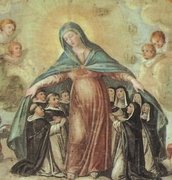
“One evening, Dominic was praying in the church until midnight, at which hour he entered the corridor where the Friars were asleep in their cells. Having finished his business, he resumed his prayers at the end of the corridor where the Friars were asleep in their cells. Having finished his business, he resumed his prayers at the end of the corridor, when chancing to turn his eyes to the other end, he beheld three women approaching, the center on being the most beautiful and venerable. One of her companions carried a magnificent vase, and the other an aspersorium, which she presented to her mistress, who sprinkled and blessed all the Friars save one. Dominic, after noting who the Friar was, advanced to meet the woman, who had already reached the middle of the corridor, near the lamp suspended in that spot. He prostrated himself at her feet, and although he had recognized her, entreated her to tell him her name. At that same time, the beautiful and devotional anthem of the Salve Regina was not yet sung in the monastery and nunnery of the Order in Rome, but only recited, kneeling, after Compline. The woman replied, ‘I am she whom you invoke every eve, and when you say, Eia ergo, advocata nostra, I prostrate myself before my Son, entreating Him to protect this Order.’ The blessed Dominic then asked who her two companions were, on which the Blessed Virgin said, ‘One is Cecilia, and the other Catherine.’ The blessed Dominic then inquired the reason for her omitting to bless one of the Friars, and she replied, ‘Because he was not in a becoming posture.’ Then having finished her round, and sprinkled and blessed the Friars, she disappeared. The blessed Dominic returned to the spot where he had been praying, and hardly had he recommenced his devotions when he was raised in spirit to the presence of God. He beheld the Lord, having at his right hand the Blessed Virgin, who seemed to Dominic to be robed in a sapphire-colored mantle. Looking around and discerning Religious of every Order but his own, he began to weep bitterly, not daring to approach our Lord or his Blessed Mother. Our Lady motioned him to draw near, but he dared not comply until encouraged by our Lord. Then he approached and prostrated himself weeping bitterly. The Lord said, ‘Why weepest thou so bitterly?’ and he replied, ‘Because I see members of every Order but my own.’ The Lord said to him, ‘Dost thou wish to see thy Order?’ He tremblingly replied, ‘Yes, Lord;’ and the Lord rested His hand on the shoulder of the Blessed Virgin, saying to Dominic, ‘I have confided thy Order to my mother.’ Then He added, ‘Wilt thou indeed see thy Order?’ to which Dominic replied, ‘Yes, Lord.’ Then the Blessed Virgin unfolding her mantle in Dominic’s sight, so that it covered the whole of the celestial abode, he beheld beneath it a multitude of his children. The blessed Father prostrated himself to render thanks to God and to our Lady, and the vision disappeared. As he recovered consciousness, the bell was ringing for Matins, and when they were ended, he convoked a chapter of his Friars, and discoursed to them on the love and veneration they ought to have to the Blessed Virgin, and among other things he related this vision. At the close of the chapter, he privately took aside the brother whom Our Lady had not blessed, and gently asked him if he had not kept back something in the general confession he had made. He replied, ‘Holy Father, my conscience accuses me of nothing, save that last night, when I awoke, I found I had been sleeping with no garments on.’ At Saint-Sixtus the blessed Dominic related his vision to Sister Cecilia and the others, as if it had been beheld by another person, but the Friars present made a sign to the sisters that it was Dominic who had seen it. It was on this occasion that the blessed Dominic enjoined that, wherever they slept, the Friars should wear their girdle and their sandals.”
CONFERENCES
THE INNER LIFE OF GOD
(continued)
We would understand something of the divine life: the first question, therefore, we have to ask is: What is life? For, as long as we do not know what life is in itself, it is clear that we shall not be able to form any idea of the life of God. What, then, is life? In order to comprehend this, we must learn what being is; for life is evidently a certain state of being. We thus arrive at that first and supreme question: What is being? And we shall solve it by seeking what is permanent and common in the infinitely varied beings which surround us. Now, in all of these, whatsoever their name, their form, their degree of perfection or inferiority, we find a mysterious force which is the principle of their substance and organization, and which we call activity. Every being, even the most inert in appearance, is active; it condenses, it resists foreign efforts, it attracts and incorporates to itself element which obey it. A grain of sand is in contest and in harmony with the whole universe, and maintains itself by that force which is the very seat of its being, and without which it would become lost in the absolute incapacity of nothingness. Activity, being the permanent and common characteristic, of all that is, it follows that being and activity are one and the same thing, and that we are warranted in making this definition: Being is activity. St. Thomas of Aquinas gave us an example when, having to define God, who is being in its total reality, he said: God is a pure act.
But activity supposes action, and action is life. Life is to being what action is to activity. To live, is to act. It is true that spontaneous, and above all, free action, being perfect action, the birth or apparition of life is generally marked at the point where that kind of action is manifested. Thus we say that the stone is, that the plant grows, that the animal lives; but these different expressions mark only the gradations of activity, whose presence, how feeble soever it may be, everywhere constitutes the living being.
We know what life is. Let us advance another step, let us learn what are its general laws, and then apply them to God.
The first general law of life is: The action of a being is equal to its activity. In fact the action of a being can be limited only by a foreign force, or by its own will. Now a foreign force checks it only at the point where its own energy ceases, and as to its own will, should it possess any, that necessarily bears it as far as it can reach by its own nature. An action superior to its activity is impossible to it; an action inferior is insufficient; an action equal to its activity is the only action that places it in harmony with itself and with the rest of the universe. Therefore, whether you consider the general movement of worlds or the tendency of each being in particular, you will find them all acting according to the measure of their forces, and placing limits to their ambition only because they exist to their faculties. All, and man among the rest, advance as far as they can; all, having reached the point which exhausts and stops them, write like the poet, proudly accusing their own powerlessness:
SISTIMUS HIC TANDEM NOBIS UBI DEFUIT ORBIS.
Henri-Dominique Lacordaire
God: Conferences - Notre-Dame in Paris (1871)


Dear friends and family,
I have to admit that I don't even know where to start. After this long journey it seems like I would have a lot to say, but my sister Daniela has done an amazing job keeping everyone informed.
First of all we want to say THANK YOU! to my incredible sister for all she did, we don't know what we would have done without her. Not only does she have a husband and three children at home, she also has a job (I hope she still has it!) and a household to run, and she still managed to be at the hospital to support us, helped us with Matias, sent daily updates and answered hundreds of emails. We are so very thankful for her! I feel so blessed to have YOU Daniela as my sister.
We want to also say THANK YOU! to all of you. It's impossible to describe what we feel in our hearts, only God knows, and we always thank Him, our Father in heaven, for you all. We prayed at the beginning of our journey that we would feel His love, His arms around us, we knew that we couldn't do it alone in our own power, He answered our prayers through all of you. We felt His amazing love being pour out on our family through all of you, daily. We felt amazed and overwhelmed and so grateful for all of you. THANK YOU from the bottom of our hearts for your continuous prayers, your beautiful cards, letters, messages, meals, gifts and for just letting us know you were praying. I can't explain with words how comforting your support was and still is. We learned through all this how powerful the family of Christ really is and how God works in such amazing ways.
Now I want to tell you, as you probably already know, that we started our second phase of the journey with our return home. We are so grateful that Sophia is here, at home with us today. Getting home was very exciting but at the same time very scary, no nurses to check blood pressure, heart rate, pupils' reactions, etc. We were here alone with a whole bunch of medicine. The first few days were very difficult especially because Sophia wasn't sleeping through the night and we were exausted. She wouldn't sleep even 2 hours straight, she would cry and make grunting noises all night. But thankfully those days are over, she's sleeping much better now, waking up only once or twice a night.
She still has no short term memory and she is constantly hungry, an effect from damage to the hypothalamus that we hope is temporary (sometimes is not). She eats breakfast and five minutes later she is asking for breakfast again because she feels hungry and forgets she just ate.
Her moods are getting better, she is not so grumpy. She can get more agitated if it's too noisy or there is too much going on. We usually have to keep visits short if they involve children. She gets tired very easily and wants to sleep. But her mind is doing so much better, she stopped hallucinating and what she says now makes sense even though sometimes she has trouble finding the right words. We are seeing a lot more of Sophia's personality coming out and that is very exciting.
We go to therapy (occupational, physical and speech therapy) 4 times a week. She is getting so much stronger. She walks with no problem now, and goes up and down the stairs by herself (we usually watch her though because of her vision). Once a week we go in for blood tests which have been quite an adventure, to say the least. They have a very difficult time finding her veins and when they find one sometimes they can't even draw enough blood for all the tests. Last time they had to poke her 4 times, each time having to move the needle around looking for a vein, it was very painful for her and for us to watch. After all that they didn't even have enough blood and decided to wait until next week for some of the tests. They are thinking that maybe they'll have to place a pic line to make this procedure easier, we'll see.
We've also been busy with doctors' appointments, she has 6 different doctors to "visit". But some of those visits shouldn't be very often, after a while we expect not to see some of them much at all. Our new best friend will be Dr Karmazin, the pediatric endocrinologist, he will be the one keeping a close eye on Sophia for years to come. Right now his challenge has been finding the right dose of ddavp, the medicine that controls the fluid in her body. That affects the sodium level in the blood that is one of the things they have been checking weekly. If it goes to extremes it could be very dangerous. If it is high usually kids should feel thirsty and compensate by drinking more water but Sophia doesn't feel thirst (something else that sometimes happens with this kind of surgery) so it is more difficult to control. We have to constantly remind her to drink water.
Her vision continues to be a source of frustration for her. She loves to color and draw and now doesn't feel like doing that because her vision is limited. This coming Monday there is a teacher from the School of the Blind that will come to the house to evaluate her and see what her needs are to be able to read, write, and get ready for school. We are looking forward to that day.
We keep praying that most of the issues that she's dealing with now will go away with time. It is still too early to tell. We know for sure she'll need the replacements for everything created in the pituitary gland, but we pray that everything else will resolve with time -all the effects of the damage to the hypothalamus and maybe some of the vision. But we also pray that whatever the final outcome, we accept it as part of God's plan for Sophia and our family. It is impossible for us to understand now why all this is happening but we pray for peace in our hearts and acceptance and in the midst of this storm we still praise our Lord and thank Him for our beautiful daughter.
I hope I didn't give you too much detail that was too confusing to follow. I just wanted to give you an idea of how she's doing today. We started a site for Sophia at caringbridge so everybody can follow her progress there. It is at www.caringbridge.org/visit/sophiawilson. We have some pictures there too and you can leave messages to Sophia or the family in the guestbook if you wish. We will be giving updates there and any specific prayer requests. THANK YOU again so very much for your prayers. THANK YOU for the love and support you have shown us through these difficult times. We love you all!
Veronica, Scott, Matias and Sophia
En espanol, a nuestra querida familia y amigos que no entendieron nada les prometo mandarles otro email manana en espanol. Ahora es tan tarde y estoy muy cansada, pero manana va uno para ustedes. Un abrazo grande para todos. Los quiere, Veronica
Glory report on Br. Boniface; he has been healed of Krohn's Disease. He has had problems with this since teenaged but in recent physical the Doc could find no evidence left in him. Praise be to the Great Healer! Father Yankos, an older Dominican Priest fell. He has a broken nose and is banged up from the fall, please pray for his recovery.
Cardinal Zen was our parish priest some of the time we lived in Hong Kong. I can tell you all that he is a man of gentle steel, faithfully true to the Church and a liturgical delight. Not only that but he was a real father to his parish.
As for the struggle to be free in China, the following story may interest some:
Twelve years ago, when my daughter was baptised in Hong Kong, the priest who baptised her, Fr Bernard Tohill, SDB, had returned that morning from a short trip into the mainland. He had been asked to go and offer Mass in a small village about 300 miles into China for a community that had been without the Mass since 1949. He had relearned how to say the old Mass and was expecting be be saying Mass for about a dozen people.
When he arrived in the village, there were over 1,000 people waiting to hear Mass and after the first Mass he heard confessions for 6 hours straight. The following day he heard confessions for another 6 or 7 hours before celebrating Mass at which over 700 made their Communion.
The faith in this area had been kept alive by families and small groups meeting to pray the Rosary and to learn the Catechism, for over 45 years.
Whenever I hear stories about China, I am reminded of Fr Bernard’s story and I offer the day’s sufferings, frustrations and joys to our Lord through the intercession of His blessed Mother for the Church and people in China. Our Lady of Consolation, pray for China.
Comment by Stephen Morgan — 11 April 2007 @ 1:42 pm
"Liturgy", says Pope John Paul II, "is never anyone’s private property, be it of the celebrant or of the community in which the mysteries are celebrated. Priests who faithfully celebrate Mass according to the liturgical norms, and communities which conform to those norms, quietly but eloquently demonstrate their love for the Church" (Eccl. de Euch., 52). At the direction of Pope John Paul II, the Congregation for Divine Worship and the Discipline of the Sacraments, in collaboration with the Congregation for the Doctrine of the Faith, issued the Instruction Redemptionis Sacramentum in March 2004 "precisely to bring out more clearly this deeper meaning of liturgical norms" (Eccl. de Euch., 52).
It follows that individuals, whether they be priests or lay faithful, are not free to add or subtract any details in the approved rites of the celebration of the Holy Eucharist (cf Sacrosanctum Concilium, 22). A do-it-yourself mentality, an attitude of nobody-will-tell-me-what-to-do, or a defiant sting of if-you-do-not-like-my-Mass-you-can-go-to-another-parish, is not only against sound theology and ecclesiology, but also offends against common sense. Unfortunately, sometimes common sense is not very common, when we see a priest ignoring liturgical rules and installing creativity in his case personal idiosyncracy as the guide to the celebration of Holy Mass. Our faith guides us and our love of Jesus and of his Church safeguards us from taking such unwholesome liberties. Aware that we are only ministers, not masters of the mysteries of Christ (cf I Cor 4:1), we follow the approved liturgical books so that the people of God are respected and their faith nourished, and so that God is honoured and the Church is gradually being built up.
MY LORD, - GENTLEMAN,
CONFERENCES
(continued)
THE INNER LIFE OF GOD
GOD exists, but what does he? What is his action? What is his life? This question at once rises in our thoughts. As soon as the mind has recognized the existence of a being, it asks how that being lives; and still more so in regard to God, who, as the principle of beings, excites within us a thirst for knowledge of him, so much the more ardent and just as his action is the model of all action, and his life the pattern of all life. What then is the life of God? How does he employ his eternity? This is doubtless a bold question. Nevertheless, it is a question which men ask, and which they desire to solve. But how is it to be solved? How are we to penetrate the divine essence in order to catch a glimpse of the incomprehensible movement of an eternal, infinite, absolute, and immutable spirit?
Three doctrines come before us. One of these affirms that God is condemned by the sovereign majesty of his nature to isolation dreadful to imagine; that, alone in himself, he contemplates himself seeing only himself, and love himself with a love which has no other object than himself; and in this contemplation of this love, eternally solitary, the nature and perfection of his life consist.
According to the second doctrine, the universe shows us the life of God, or rather it is in itself the life of God. We behold in it his permanent action, the scene upon which his power is exercised, and in which all his attributes are reflected. God is not out of the universe any more than the universe is out of God. God is the principle, the universe is the consequence, but a necessary consequence, without which the principle would be inert, unfruitful, impossible to conceive.
Catholic doctrine condemns these two systems. It does not admit that God is a solitary being eternally employed in a sterile contemplation of himself; nor does it admit that the universe, although it is the work of God, is his proper and personal life. It soars above those feeble ideas, and, bearing us with the word of God beyond all the conceptions of the human mind, it teaches us that the divine life consists in the co-eternal union of three equal persons, in whom plurality destroys solitude, and unity division; whose thought corresponds, whose love is mutual, and who, in that marvelous communion, identical in substance, distinct in personality, form together an ineffable association of light and love. Such is the essence of God, and such is his life, both powerfully expressed in those words of the Apostle St. John: - TRES SUNT QUI TESTIMONIUM DARET IN CŒLO: PATER, VERBUM , ET SPIRITUS SANCTUS – There are three who give testimony in heaven; the Father, the Word, and the Holy Ghost. And these three are one (Jn 5:7).
Here, and very soon after having promised you light, it would seem that I am leading you into a maze of darkness; for, can anything be conceived more formidable to the mind than the terms by which I have just expressed, according to the Scriptures and the Church, the relations that constitute the inner life of God? Do not, however, yield to this first impression; trust rather to my promises, since they are those of the Gospel, wherein it is written: EGO SUM LUX MUNDI – I am the light of the world. And again: - QUI SEQUITUR ME NON AMBULAT IN TENEBRIS, SED HABEBIT LUMEN VITÆ – He that followeth me walketh not in darkness, but shall have the light of life (Jn 8:12). Yes, be confident, count upon God, who has proposed nothing to you unnecessary to be believed, and who has hidden marvelous treasures in the most obscure mysteries, as he has hidden the fires of the diamond in the depths of the earth. Follow me, let us pass the pillars of Hercules, and, leaving truth to fill our sails, let us fearlessly advance even to the transatlantic regions of light.
Henri-Dominique Lacordaire
God: Conferences - Notre-Dame in Paris (1871)