Thursday, January 05, 2012
Boise's missing altar(s)
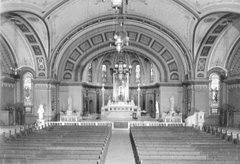
Recently I posted about the high altar which was built for the Cathedral in Boise but went to Utah instead (Got off the train in the wrong city). Thanks to an anonymous combox comment, I've learned that in 1917 the altar was sent from Utah to Lake Charles, LA. The mystery continues. But today I notice that the Utah State History site also has a picture of the St Joseph side altar as well:
Since the style seems to match the main altar rather well, I think it reasonable to assume that not only the main altar, but both side altars were also installed in the respective wrong cathedrals.
This copyrighted picture is from Utah State History collections, here
updated 5/16/12
Here is the St Mary side altar:
This copyrighted picture is from Utah State History collections, here
Tough Franciscans?!
This item from Fr Z's blog gave me a chuckle, so I'm reprinting it here!
Criminal Serving Time with Monks Begs to be Sent Back to Prison
Thank you, Fr Z!
Criminal Serving Time with Monks Begs to be Sent Back to Prison
Criminal serving his sentence with monks pleads to be sent back to prison… because monastery life is too hard
A convicted criminal who was serving out his sentence in a monastery has escaped for the second time and asked to be sent back to prison because life was too tough.
Thief David Catalano, 31, was sent to a Santa Maria degli Angeli community run by Capuchin monks in Sicily last November.
But he found their austere lifetstyle too tough to handle and soon escaped. After a short while on the run he was caught by police and sent back.
On Monday he fled for the second time in six weeks, only to swiftly turn himself in at a police station and beg officers to send him back to jail in the nearby town of Nicosia.
He told the stunned policemen: ‘Prison is better than being at that hostel run by monks.’
A police spokesman said: ‘Catalano arrived out of the blue and said there was no way he could stay on with the monks.
‘He said it was too tough and he wanted to go back to prison, so we happily obliged and he is now back behind bars serving the rest of his sentence.
‘Life with the monks can be pretty tough – there are no mod cons and they are up early and go to bed early. There are no luxuries at the hostel and the monks run a very austere regime.’
The Santa Maria degli Angeli community is based in a monastery near Enna on the island of Sicily.
It has been run as a halfway house by the Capuchin friars for more than 12 years with around 60 prisoners accommodated there as they near the end of their sentences.
[...]
Thank you, Fr Z!
Friday, December 16, 2011
Orestes Brownson and the twin evils of Capitalism & Socialism
The following quote is from Orestes Brownson, quoted by Michael Greaney at Just Third Way blog.
Brownson is on my reading list but hasn't floated to the top yet.
"Communion with God through Creation and Incarnation is religion, distinctively taken, which binds man to God as his first cause, and carries him onward to God as his final cause; communion through the material world is expressed by the word property; and communion with God through humanity is society. Religion, society, property, are the three terms that embrace the whole of man's life, and express the essential means and conditions of his existence, his development, and his perfection, or the fulfillment of his existence, the attainment of the end for which he is created."Michael has a multipost series on Brownsen and the mistaken view that the only options are Capitalism or Socialism. you can start the series here.
Brownson is on my reading list but hasn't floated to the top yet.
Tuesday, December 13, 2011
From Steve Ray
Vietnamese Father of 50 Babies – all saved from abortion
by Steve Ray on December 13, 2011
This man is a modern day hero. Watch the video to see his incredible story. When asked why he has saved all these babies from abortion and adopted them he said, “I am a Catholic!”
With over 7,000 graves of the unborn in his backyard he and his wife hold vigil for their little souls. This is a man and women who live their faith and make huge sacrifices for the unborn. Wait until you see the beautiful living babies who who have been slaughtered. Wait until you see his yard full of gravestones.
Saints still live among us. Living martyrs. Holy men and women who love God and others more than themselves.
Click to watch the report
Monday, December 12, 2011
St Albert, peace, and Dominicans
The following quote is from "St Albert the Great" by Kevin Vost:
This reflects a thought I have long harbored, and I think brings out what I believe to be the serious error espoused by those Dominicans who seek political solutions through political means, neglecting and even denigrating the preaching mission, which some have even called "useless" (in personal communications).
I will even offer this additional thought; the lack of peace the ends in war is the terminal symptom of the failure to preach; because of our fallen nature we will not fall far from the nature family tree (Cain) but will fall far from our adopted family tree (of Life).
St Albert well understood that men journeying together towards heaven live in a harmony not found amoung men journeying any other direction.
Albert was a consummate peacemaker among men because peace, like joy, is an effect that flows from charity, an infused virtue with which Albert was abundantly blessed. Peace is a concordance or harmony of desires among persons. When those persons’ desires are not fully just and their thoughts are not focused on good and honorable ends, peace will not last long. [Albert] knew well that true peace was only possible among good men, and that is why his greatest peacemaking efforts were performed not in the settlement of sundry disputes but through his teaching and preaching: by making men good .
This reflects a thought I have long harbored, and I think brings out what I believe to be the serious error espoused by those Dominicans who seek political solutions through political means, neglecting and even denigrating the preaching mission, which some have even called "useless" (in personal communications).
I will even offer this additional thought; the lack of peace the ends in war is the terminal symptom of the failure to preach; because of our fallen nature we will not fall far from the nature family tree (Cain) but will fall far from our adopted family tree (of Life).
St Albert well understood that men journeying together towards heaven live in a harmony not found amoung men journeying any other direction.
Wednesday, December 07, 2011
How to Preach A Very Bad Homily
This is actually rather priceless! From the blog of the Eastern Province:
How to Preach A Very Bad Homily, Fr Basil Cole, O.P., gave the following talk at a conference to the priests of the Archdiocese of Minneapolis/St. Paul....read it here
Tuesday, December 06, 2011
Peter Kreeft answers the question, "Can a Catholic be a Liberal?"
This interesting report is by Doug Erickson in the Wisconsin State Jornal, as reported by Fr Z here. I'll just snip a bit here...
Some strong words. First I am glad to see that the primier Social Justice issue is being called out; the bulk of purported social justice advocates these days seem to have no interest in the lives of the unborn, demonstrating a very inadequate understanding of justice and the hierarchy of value that necessarily attaches there-to.
It is the strong condemnation of dissident theologians which I believe is remarkable - a bit of straight talk the likes of which is rarely heard. Then to put it in perspective by stating that it caused more damage than pedophile priests; amazing. He's right, of course.
There is no middle ground to Kreeft. It would be silly and redundant to him, for instance, to call someone a “pro-life Catholic.” You cannot be anything but against abortion to be a Catholic, Kreeft said.Read the full article here
“To be a Catholic is to take the whole deal,” he told the crowd.
Kreeft said several definitions of a liberal can and should fit Catholics, including “someone who is generous and unselfish” and “someone who highly values liberty and freedom.”
On abortion, Kreeft contended Catholics are the “true liberals,” because a liberal wants to extend liberty to the oppressed, and “the unborn are the most oppressed,” he said.
Kreeft said these Catholic advisers “told the Kennedys how they could get away with murder.” Kreeft then made one of his boldest comments of the evening, suggesting the theologians who first convinced Democratic politicians they could support abortion rights and remain Catholic did more damage to the Catholic Church than pedophile priests.
“These were wicked people. These were dishonest people. These were people who, frankly, loved power more than they loved God,” Kreeft said. “Sorry, that’s just the way it is. In fact, I’d say these were even worse than the child molesters — though the immediate damage they did was not as obvious — because they did it deliberately, it wasn’t a sin of weakness. Sins of power are worse than sins of weakness. Cold, calculating sins — that’s straight from the devil.”
Some strong words. First I am glad to see that the primier Social Justice issue is being called out; the bulk of purported social justice advocates these days seem to have no interest in the lives of the unborn, demonstrating a very inadequate understanding of justice and the hierarchy of value that necessarily attaches there-to.
It is the strong condemnation of dissident theologians which I believe is remarkable - a bit of straight talk the likes of which is rarely heard. Then to put it in perspective by stating that it caused more damage than pedophile priests; amazing. He's right, of course.
Saturday, December 03, 2011
From Frederick Faber
THE ETERNITY OF GOD
O Lord! my heart is sick
Of this perpetually lapsing time,
So slow in grief, in joy so quick,
Yet ever casting shadows so sublime:
Time of all creatures is least like to Thee,
And yet it is our share of Thine eternity.
O change and time are storms
For lives so thin and frail as ours;
For change the works of grace deforms
With love that soils, and help that over powers;
And time is strong, and, like some chafing sea,
It seems to fret the shores of Thine eternity.
Weak, weak, forever weak!
We cannot hold what we possess;
Youth cannot find, age will not seek,
O weakness is the heart’s worst weakness:
But weakest hearts can lift their thoughts to Thee;
It makes us strong to think of Thine eternity.
Thou hadst no youth, great God,
An Unbeginning End Thou art;
Thy glory in itself abode,
And still abides in its own tranquil heart:
No age can heap its outward years on Thee:
Dear God! Thou art Thyself Thine own eternity!
Without an end or bound
Thy life lies all outspread in light;
Our lives feel The life all around,
Making our weakness strong, our darkness bright;
Yet is it neither wilderness nor sea,
But the calm gladness of a full eternity.
Oh Thou art very great
To set Thyself so far above!
But we partake of Thine estate,
Established in Thy strength and in Thy love:
That love hath made eternal room for me
In the sweet vastness of its own eternity.
Oh Thou art very meek
To overshade Thy creatures thus!
Thy grandeur is the shade we seek:
To be eternal is Thy use to us:
Ah Blessed God! What joy it is to me
To lose all thought of self in Thine eternity.
Self-wearied, Lord! I come;
For I have lived my life too fast:
Now that years bring me nearer home
Grace must be slowly used to make it last;
When my heart beats too quick I think of Thee,
And of the leisure of Thy long eternity.
Farwell, vain joys of earth!
Farewell, all love that is not His!
Dear God! Be Thou my only mirth,
Thy magesty my single timid bliss!
Oh in the bosom of eternity
Thou does not weary of Thyself, nor we of Thee!
Faber's Hymns, Frederick Faber, 1875
Friday, December 02, 2011
Silent Night
Soon we'll be singing that old favorite "Silent Night", a hymn to remind us of that anticipation of awaiting our Savior's humble entrance into our world. Yet, we come to church and await Him in a manner bereft of silence.
We so need to recover what is meant by "active participation" (actuosa participatio). What is it? It didn't spring immaculate and virginally from Vatican II, but already had a long history in the liturgical renewal.
"In order that the faithful may more actively participate in the sacred liturgy, let them be once again made to sing Gregorian Chant as a congregation." Pius X, motu proprio Tra Le Solicitudini
How did Vatican II expect "active participation" to be brought about? "Therefore, pastors of souls must zealously strive to achieve it by means of the necessary instruction in all their pastoral work." Vatican Council II, Sacrosanctum Concilium, n. 14
Surprise, surprise! The Fathers of Vatican II told the pastors that they should teach us Gregorian Chant so we could sing the mass as a congregation. I'm still waiting...
The quotes are from a wonderful article: The Mass of Vatican II | Fr. Joseph Fessio, S.J.
Saturday, November 26, 2011
Got off the train in the wrong city.
The old high altar in Boise's Cathedral of St John the Evangelist has long puzzled many people for it's two flanking pillars, each topped with what appears to be a jar, or a vase.
The explanation is that the altar was built by a company that at the same time built the high altar for Salt Lake City's Cathedral of the Madeleine. Both were shipped west on the same train, but Boise's was unloaded in Salt Lake City, and theirs went to Boise! Hence, Boise's high altar has the "alabastar jar of costly spikenard" motif to remind us of Mary Magdalene's unself-conscious and generous anointing of our Lord before his death.
The high altar that was built for the Cathedral of St John the Evangelist, Boise, was installed in the Cathedral of the Madeleine in Salt Lake City. It apparently fell victim to a post Vatican II wreckovation, I understand it was destroyed. It has, however, survived in photographic evidence (picture is from 1909).
So Boise, here's what we missed:
This copyrighted picture is from Utah State History collections, here
PS: Not only did Utah loose the high altar, even the stained glass windows behind the altar are gone, as this current picture attests:
Friday, November 25, 2011
Third Edition of the Roman Missal
Here's an interesting little video from the Corpus Christi Watershed folks. It addresses the form of the mass, particularly the replacement of the Introit with a hymn...
And of course, while we're at it, ccwatershed also has a new hymnal, the Vatican II Hymnal:
The Dominicans at St Albert Priory (and the Eastern Province) have chosen the New Edition of the St Michael Hymnal:
I'm pleased to see these fine efforts, but somehow I expect that I'll be subject to slight variations of the sameold-sameold instead of what the Church is asking for...
2011 GIRM 48. This chant is sung alternately by the choir and the people or similarly by a cantor and the people, or entirely by the people, or by the choir alone. In the Dioceses of the United States of America, there are four options for the Entrance Chant: (1) the antiphon from the Missal or the antiphon with its Psalm from the Gradual Romanum, as set to music there or in another setting; (2) the antiphon and Psalm of the Graduate Simplex for the liturgical time; (3) a chant from another collection of Psalms and antiphons, approved by the Conference of Bishops or the Diocesan Bishop, including Psalms arranged in responsorial or metrical forms; (4) another liturgical chant that is suited to the sacred action, the day, or the time of year, similarly approved by the Conference of Bishops or the Diocesan Bishop.
And of course, while we're at it, ccwatershed also has a new hymnal, the Vatican II Hymnal:
The Dominicans at St Albert Priory (and the Eastern Province) have chosen the New Edition of the St Michael Hymnal:
I'm pleased to see these fine efforts, but somehow I expect that I'll be subject to slight variations of the sameold-sameold instead of what the Church is asking for...
Wednesday, November 23, 2011
First Sunday of Advent
From the Fr Pius Pietrzyk OP of the Eastern Dominican Province, posting on Preacher's Sketchbook for First Sunday of Advent:
The above is a well written reminder that the Lord who came amoung us a Bethlehem and died for our salvation on the cross, has kept his promise to "be with us always". Now is the time to make friends with Him. When He comes in judgment, that time will be past.
Dom Prosper Gueranger, The Liturgical Year
We find that this mystery of the coming, or Advent, of Jesus is at once simple and threefold. It is simple, for it is the one same Son of God that is coining; it is threefold, because He comes at three different times and in three different ways. ‘In the first coming,’ says St. Bernard, ‘He comes in the flesh and in weakness; in the second, He comes in spirit and in power; in the third, He comes in glory and in majesty; and the second coming is the means whereby we pass from the first to the third.’
This, then, is the mystery of Advent. Let us now listen to the explanation of this threefold visit of Christ, given to us by Peter of Blois, in his third Sermon de Adventu: ‘There are three comings of our Lord; the first in the flesh, the second in the soul, the third at the judgement. The first was at midnight, according to those words of the Gospel: At midnight there was a cry made, Lo the Bridegroom cometh! But this first coming is long since past, for Christ has been seen on the earth and has conversed among men. We are now in the second coming, provided only we are such as that He may thus come to us; for He has said that if we love him, He will come unto us and will take up His abode with us. So that this second coming is full of uncertainty to us; for who, save the Spirit of God, knows them that are of God? They that are raised out of themselves by the desire of heavenly things, know indeed when He comes; but whence He cometh, or whither He goeth, they know not. As for the third coming, it is most certain that it will be, most uncertain when it will be; for nothing is more sure than death, and nothing less sure than the hour of death. When they shall say, peace and security, says the apostle, then shall sudden destruction come upon them, as the pains upon her that is with child, and they shall not escape. So that the first coming was humble and hidden, the second is mysterious and full of love, the third will be majestic and terrible. In His first coming, Christ was judged by men unjustly; in His second, He renders us just by His grace; in His third, He will judge all things with justice. In His first, a lamb; in His last, a lion; in the one between the two, the tenderest of friends.’
The above is a well written reminder that the Lord who came amoung us a Bethlehem and died for our salvation on the cross, has kept his promise to "be with us always". Now is the time to make friends with Him. When He comes in judgment, that time will be past.
Friday, November 18, 2011
Truth Be Told issue #19 - Newsletter of the Laity of the Province of the Most Holy Name of Jesus
The 19th issue of "Truth Be Told," the newsletter of the Laity of the Province of the Holy Name of Jesus has been posted to the web.The newsletter is available for download at the provincial web page here:
http://laydominicanswest.org/newsletter/
Wednesday, November 09, 2011
Benedict XVI on "We are Church"
The Holy Father made a reference to the "we are church" dissident movement in a speach to seminarians in Germany.
Contextual article by Sandro Magister at Chiesa Online is here
the Holy Father's full text is here
APOSTOLIC JOURNEY TO GERMANY
22-25 SEPTEMBER 2011
MEETING WITH SEMINARIANS
ADDRESS OF HIS HOLINESS BENEDICT XVI
St Charles Borromeo Seminary Chapel, Freiburg im Breisgau
Saturday, 24 September 2011
Personally being with Christ, with the living God, is one thing: another is that we can only ever believe within the “we”. I sometimes say that Saint Paul wrote: “Faith comes from hearing” – not from reading. It needs reading as well, but it comes from hearing, that is to say from the living word, addressed to me by the other, whom I can hear, addressed to me by the Church throughout the ages, from her contemporary word, spoken to me the priests, bishops and my fellow believers. Faith must include a “you” and it must include a “we”. And it is very important to practise this mutual support, to learn how to accept the other as the other in his otherness, and to learn that he has to support me in my otherness, in order to become “we”, so that we can also build community in the parish, calling people into the community of the word, and journeying with one another towards the living God. This requires the very particular “we” that is the seminary, and also the parish, but it also requires us always to look beyond the particular, limited “we” towards the great “we” that is the Church of all times and places: it requires that we do not make ourselves the sole criterion. When we say: “We are Church” – well, it is true: that is what we are, we are not just anybody. But the “we” is more extensive than the group that asserts those words. The “we” is the whole community of believers, today and in all times and places. And so I always say: within the community of believers, yes, there is as it were the voice of the valid majority, but there can never be a majority against the apostles or against the saints: that would be a false majority. We are Church: let us be Church, let us be Church precisely by opening ourselves and stepping outside ourselves and being Church with others.
Contextual article by Sandro Magister at Chiesa Online is here
the Holy Father's full text is here
November Chapter meeting
The November Chapter meeting will be held at St Paul Newman Center, BSU, instead of in Caldwell. It also will start earlier, at 9:30AM Saturday, Nov 19, 2011. Fr Vincent Kelber OP will be with us, and it is planned that he will offer mass at approximately 10AM in the chapel.
there will be a Thanksgiving potluck meal, turkey provided! Sides should be coordinated with Stephanie DeNinno - ssdeninno [at dog] yahoo.com
So I said...
I know. I said I don't spend a lot of time looking at Chant and Music sites, but sometimes they find me anyway! This one is worth passing along, it's the Liturgy of the Hours set to Gregorian Chant.
Tuesday, November 08, 2011
All Souls of the Dominican Order
For those who have gone ahead of us in the Order, we celebrate All Dominican Souls day today. May we join you in the heavenly chorus!
Monday, November 07, 2011
All Saints of the Dominican Order
From the Provincial web site, http://opwest.org
All Saints of the Dominican Order
Feast for the Order
Today we faithfully remember "those who have gone before us in the family of Saint Dominic and who offer us the example of their way of life, their company in the communion of saints, and the help of their intercession. By this celebration may we be moved to imitate them and be strengthened in the spirit of our vocation." [LCO, nn. 16, 67]
Prayer:
God, source of all holiness, you have enriched your Church with many gifts in the saints of the Order of Preachers. By following their example may we come to enjoy their company forever in the kingdom of our Lord Jesus Christ, your Son, who lives and reigns with you and the Holy Spirit, one God, for ever and ever.
Fr. Vincent Benoit, O.P.
Thursday, November 03, 2011
Cool find
I found this over at Dominican Liturgy blog in a post titled Dominican Prayers on the iPhone
I'll also confess that I spend almost no time on the music and liturgy blogs, I get too depressed. I used to, but it's like window shopping when you have no money; you want but you can't have, and the intense beauty drives one a bit nutters with desire because it has been banished and demonized in this part of the world, where it is preferred to sing(sic) music(sic) set to "I wish I were an Oscar Mayer weener" and suchlike. OK, some are nice campfire songs, but I don't see a campfire when I look at the candles on the altar...
Behold the golden dawn arise;No, I don't have an iPhone, but I do love Old 100th!
The paling night forsakes the skies:
Those shades that hid the world from view,
And us to dangerous error drew.
May this new day be calmly passed,
May we keep pure while it shall last:
Nor let our lips from truth depart,
Nor dark designs engage the heart.
So may the day speed on; the tongue
No falsehood know, the hands no wrong:
Our eyes from wanton gaze refrain,
o guilt our guarded bodies stain.
For God all-seeing from on high
Surveys us with a watchful eye:
Each day our every act he knows
From early dawn to evening’s close.
All laud to God the Father be;
All praise, eternal Son, to thee;
All glory, as is ever meet,
To God the Holy Paraclete. Amen.
Melody: Old 100th L.M.
Music: Louis Bourgeois, 1500-1561
Text: Sol ecce surgit igneus, eleventhth century Anglo Saxon
Translation: John M. Neale, 1818-1866
I'll also confess that I spend almost no time on the music and liturgy blogs, I get too depressed. I used to, but it's like window shopping when you have no money; you want but you can't have, and the intense beauty drives one a bit nutters with desire because it has been banished and demonized in this part of the world, where it is preferred to sing(sic) music(sic) set to "I wish I were an Oscar Mayer weener" and suchlike. OK, some are nice campfire songs, but I don't see a campfire when I look at the candles on the altar...
Saturday, October 29, 2011
Pontifical Council for Justice and Peace: recommendation of a global financial authority
A couple days ago the Pontifical Council for Justice and Peace issued a position paper recommending, as a solution to the world's financial problems, what some would attribute as "more of the cause." The Document, titled: "TOWARDS REFORMING THE INTERNATIONAL FINANCIAL AND MONETARY SYSTEMS IN THE CONTEXT OF GLOBAL PUBLIC AUTHORITY", can be read here.
The paper, which doesn't seem to have an attribution of authorship, and certainly does not bear the imprimatur of the church, much less the Holy Father, has been written about by more competent authors than me, so I'll let you find those articles on your own and form your own opinions. What strikes me as a layman, is that the Vatican, with it's scandal-plagued Vatican Bank, would offer suggestions of this nature when it has clearly demonstrated deficiency in this department; a department that it seems lies outside the competence of the Church. From a moral standpoint, if the world had embraced Christ and lived a devout faith, there would be no financial crisis, right? given fallen human nature, there will always be crisis of one sort or another, as man seeks to assert his will over his fellow man, rather than serve his neighbor as one created in the image of God.
So it seems to this financially-challenged mind, that a document that suggests that to make things right, the world needs to live as though the fruits of charity were present and could be counted upon, without ever mentioning the name of Jesus, from whom all charity flows, has missed the mission statement:
"Go, therefore, and make disciples of all nations, baptizing them in the name of the Father, and of the Son, and of the holy Spirit, 20 teaching them to observe all that I have commanded you. And behold, I am with you always, until the end of the age.” [Mt 28:18ff]
Tuesday, October 04, 2011
Chrysostom on Withholding Communion
Leon Suprenaut has started blogging for the Diocese of Kansas City, Kansas. here's an interesting post he put up!
Today is the feast of St. John Chrysostom, the famous Bishop of Constantinople at the turn of the fifth century. He was given the title “Chrysostom, which means “golden mouthed,” because of his eloquent sermons. He’s also known as a doctor of the Church because of his timeless, orthodox teaching.
In his book Luminous Mysteries, Scripture scholar Tim Gray quotes at length from St. John Chrysostom’s homily “On the Institution of the Eucharist,” which I reprint below. I think you’ll agree that it’s quite instructive on the controversial subject of the sacred minister’s duty to withhold Communion from a notorious sinner:
“I speak not only to the communicant, but also I say to the priest who ministers the Sacrament: Distribute this gift with much care. There is no small punishment for you, if being conscious of any wickedness in any man, you allow him to partake of the banquet of the table: ‘Shall I not now require his blood at your hand?’ (2 Sam. 4:11). If some public figure, or some wealthy person who is unworthy, presents himself to receive Holy Communion, forbid him. The authority that you have is greater than his. Consider if your task were to guard a clean spring of water for a flock, and you saw a sheep approach with mire on its mouth–you would not allow it to stoop down and pollute the stream. You are now entrusted with a spring, not of water, but of blood and of spirit. If you see someone having sin in his heart (which is far more grievous than earth and mire), coming to receive the Eucharist, are you not concerned? Do you try to prevent him? What excuse can you have, if you do not?
“God has honored you with the dignity of priesthoood, that you might discern these things. This is not to say that you should go about clothed in a white and shining vestment; but this is your office; this, your safety;
this your whole crown.
“You ask how you should know which individual is unworthy to receive? I am speaking here not of some unknown sinner, but of a notorious one. If someone who is not a disciple, through ignorance, comes to Communion, do not be afraid to forbid him. Fear God, not man. If you fear man, you will be scorned and laughed at even by him; but if you fear God, you will be an object of respect even to men. But if you cannot do it, bring that sinner to me, for I will not allow anyone to dare do these things. I would give up my life rather
than give the Lord’s Blood to the unworthy.
“If, however, a sinful person receives Communion, and you did not know his character, you are not to blame, however. I say the things above concerning only those who sin openly. For if we amend these, God will speedily reveal to us the unknown also; but if we let these flagrant abuses continue, how can we expect Him to make manifest those that are hidden? I say these things, not to repel sinners or cut them off, but I say it in order that we may bring them to repentance, and bring them back, so that we may take care of them. For thus we shall both please God and lead many to receive worthily. And for our own diligence, and for our care for others, we will receive a great reward. May we attain that reward by the grace and love that God gives to man through Our Lord Jesus Christ, to whom be glory, world without end. Amen.”
Link
Wednesday, September 21, 2011
A day...
Today was my second day back at work after being off for three weeks due to pneumonia. Glad to say I'm improving but not quite all there yet!
Today I received a reminder that yesterday marked the 1 year anniversary of the passing of Deanette Pease OPL, whom I met at Lourdes last year while on pilgrimage. Deanette had taken Bl Margaret of Castello's name as her Dominican profession name. While Lourdes did not cure Deanette's cancer, it certainly helped her prepare to meet that part of our family which has gone before us. Ann, who took Deanette on pilgrimage, found my email and contacted me today.
If that wasn't enough for the day, when I got home there was a package from Italy waiting for me. Last month I had written the Dominican Nuns in Italy and requested a first class relic of Bl Margaret for our chapter house and shrine at Homedale. I was told by more than one person it was unlikely that they would send it. Maybe its the prayers of Deanette, Gwen, Jim, Janet, and all our lay Dominican family on the other side?
here's a bit more of a close up.
Yes, the genuine article. Now, I just need to find someone to translate the rather long letter in Italian!
Br Corwin Low OP of the Dominican Studentate was kind enough to translate the letter for me.
Today I received a reminder that yesterday marked the 1 year anniversary of the passing of Deanette Pease OPL, whom I met at Lourdes last year while on pilgrimage. Deanette had taken Bl Margaret of Castello's name as her Dominican profession name. While Lourdes did not cure Deanette's cancer, it certainly helped her prepare to meet that part of our family which has gone before us. Ann, who took Deanette on pilgrimage, found my email and contacted me today.
If that wasn't enough for the day, when I got home there was a package from Italy waiting for me. Last month I had written the Dominican Nuns in Italy and requested a first class relic of Bl Margaret for our chapter house and shrine at Homedale. I was told by more than one person it was unlikely that they would send it. Maybe its the prayers of Deanette, Gwen, Jim, Janet, and all our lay Dominican family on the other side?
here's a bit more of a close up.
Yes, the genuine article. Now, I just need to find someone to translate the rather long letter in Italian!
Wednesday, September 14, 2011
Truth Be Told issue #18 - Newsletter of the Laity of the Province of the Most Holy Name of Jesus
The 18th issue of "Truth Be Told," the newsletter of the Laity of the Province of the Holy Name of Jesus has been posted to the web.The newsletter is available for download at the provincial web page here:
http://laydominicanswest.org/newsletter/
This issue completes the third year of publication of Truth Be Told! Although it will probably never attain 100% original content, I am pleased by the steady increase of original material appearing in these pages.
There is a new feature on the website where the newsletter is posted. Previously, the same version of the newsletter appeared there as I send subscribers by email. Now, the version available on the web for download is a higher resolution, printer-ready edition that is about 300% larger in size, and the smaller email version is also availble through a link. We have done this so that people who want to print a clearer, sharper copy can do so. The emailed version is intentionally smaller and optimal for online reading, as well as for downloading over a slower connection speed.
Wednesday, September 07, 2011
Liturgiam Authenticam - Trailer
New movie from the Dominicans at Kindly Light
This probably won't be playing at your local multiplex, but it ought to play at your parish!
Sunday, September 04, 2011
Index of Forbidden Songs
Fr Eric Richtsteig has posted a series of delightful entries at his blog Orthometer. He's made a list of bad music which should be banned. Way to go!
Index of Forbidden Songs (Gather Part III)
Index of Forbidden Songs (Gather Part II)
Index of Forbidden Songs (Gather Part I)
and
Index of Forbidden Songs (Music Issue, Part IX)
Index of Forbidden Songs (Music Issue, Part VIII)
Index of Forbidden Songs (Music Issue, Part VII)
Index of Forbidden Songs (Music Issue, Part VI)
Index of Forbidden Songs (Music Issue, Part V)
Index of Forbidden Songs (Music Issue, Part IV)
Index of Forbidden Songs (Music Issue, Part III)
Index of Forbidden Songs (Music Issue, Part II)
Index of Forbidden Songs (Music Issue, Part I)
However, it would appear that the only banned music is Gregorian Chant, Latin hymns, and polyphony. Yeah, the crap is easier to sing, I will grant that. however a diet of peanut butter sandwiches, french fries, and coke tends to weigh one down with bloat. we've effectively banished beauty and truth, and distorted love, justice, and mercy. Is it any wonder that we fail to respect and obey God who is Beauty, Truth, Love, Justice, and Mercy?
Wednesday, August 24, 2011
Book: The Search for the Historical Francis, A Penitent from Assisi
I haven’t written much for a while, but that is not to say that I haven’t been busy!
This last weekend I traveled to California, for the 40th reunion of my high school class of 1971. Because I graduated a year early in 1970 I did not receive an invitation, but I went at the suggestion of a childhood friend whom I’d lost track of for nearly 30 years, who invited me to rejoin my original class. The event was very interesting. I spent over 5 hours on my feet talking to people I hadn’t seen in over 40 years. Oh, old creaky memories!
I had planned to stay at St Albert Priory in Oakland, and it just so happened that the Corpus Christi lay Dominican chapter was holding a retreat this weekend, and they graciously allowed me to join them. I must say it was a wonderful retreat, and it made the trip much more fulfilling. I have to say it was quite a contrast, the worldly and the other-worldly.
The retreat featured two presentations by Fr Augustine Thompson O.P. Father gave two presentations. The first was based on his book “Cities of God: The Religion of the Italian Communes, 1125-1325.” I’d heard a version of this presentation last year at the Lay Provincial Council meeting, but it has grown since then and it was really delightful. I will definitely have to buy the book!
However, it was the second presentation that really got my attention. It built on the first, and included a bit of an advance on Father’s next book (due out March, 2012, in honor of the conversion of St Clare). The presentation title was “The Search for the Historical Francis, A Penitent from Assisi.” A bit of a humorous play on “the search for the historical Jesus” in the title notwithstanding, it was a fascinating presentation which brought to light some of the current research. In the last ten years, there have been 220 biographies of St Francis published, all of which dress up and present the same standard version of Francis, which, it turns out, is a bit of a Santa Claus to St Nicholas! Well, not quite that bad, but pretty bad. This book will knock a few socks off, and instead of the standard initial printing of 2,000 copies, the publisher is planning a first edition run of 10,000 copies! I will get one, you may want to too!
What was so delightful about Fr Thompson’s presentation is that he comes across as a historian who is like a kid in a candy store, reveling in the rich flavors of nuggets of history mined from the various new sources unearthed in the last decade.
I'm looking forward to a fascinating read next March!
Tuesday, August 09, 2011
Holy Father Benedict and the removal of Bishop Morris of Toowoomba
Monday, August 08, 2011
Blessed St Dominic Day!
Please remember that today, Monday, August 8, 2011, is the Solemnity of St. Dominic, the day we celebrate his death and entrance into Heaven. At 7PM we will gather at the day Chapel at Holy Apostles at the corner of Meridian Road and Chinden Blvd in Meridian for prayer. We will be praying the Evening Prayer and the Office of the Dead for those who have gone before us in the friendship of God. We will gather briefly thereafter for coffee or other refreshments. Thank you.
John Keenan, O.P.(Lay)
Wednesday, August 03, 2011
Utopia of Usurers?
From the Social Credit list, the following comment:
How long has it been since the Church last addressed the question of Usury? (ON USURY AND OTHER DISHONEST PROFIT. Vix Pervenit. Encyclical of Pope Benedict XIV promulgated on November 1, 1745)
In the intervening centuries, that which we borrow has changed. It is now credit instead of the capital which was the subject of Vix Prevenit; which that that the collection of reasonable interest on capital borrowing was deemed to not be usury. Does this hold for credit, though? When I, or a nation, borrows and what transacts is not transfer of capital but entries into legers, a very useful legal fiction, but a fiction none the less, is it not usury to demand more of the fiction in return? Especially if the fiction is backed by the "full good faith of the nation" which is the common stock of us all, as the quote above states?
This is not a question I can answer, but I wish the Church would offer guidance in this.
I think it is fairly easy for most people to understand that all credit money comes into existence as a debt to some operator within the financial system. This is true, by definition, and some 97% of monies in the system is credit money. The crux of the matter is that the debt system, controlled by private financiers, is simply a tool for controlling the population at large by putting most everybody in a position of dependence on the financiers by way of debt.
The fundamental understanding that needs to dawn upon people is that this is a form of abuse because people are made to borrow, at interest, what they already own.
How long has it been since the Church last addressed the question of Usury? (ON USURY AND OTHER DISHONEST PROFIT. Vix Pervenit. Encyclical of Pope Benedict XIV promulgated on November 1, 1745)
In the intervening centuries, that which we borrow has changed. It is now credit instead of the capital which was the subject of Vix Prevenit; which that that the collection of reasonable interest on capital borrowing was deemed to not be usury. Does this hold for credit, though? When I, or a nation, borrows and what transacts is not transfer of capital but entries into legers, a very useful legal fiction, but a fiction none the less, is it not usury to demand more of the fiction in return? Especially if the fiction is backed by the "full good faith of the nation" which is the common stock of us all, as the quote above states?
This is not a question I can answer, but I wish the Church would offer guidance in this.
Tuesday, August 02, 2011
800 years young
The Dominican Order is approaching its 800th anniversary, which is only 5 years from now. What has been a key to this life in the spirit? certainly one aspect has been adapting to the times without being absorbed by the thinking of the times. Br Corwin Low has made an exquisite commentary in the picture below, which is from his blog Cantate Domino. read it here
Subscribe to:
Posts (Atom)