Friday, October 10, 2008

Get a (prayer) life!

Fr Speekman has an excellent post down under, his most excellent homily
28th Sunday of Ordinary Time - Year A

So what about Lectio Divina?

Let me firstly give you an image. You're on a railway platform waiting for the train. Are you really waiting for the train? No, you are really waiting for the arrival of the person who is on the train. It would be silly if the train pulled in and we all stood around admiring the train and ignored the passengers.

Admiring the train is what's called Bible Study. Lectio Divina is searching for the passenger.

And you know which passenger I mean, don't you - it's God himself - the God of love - Father, Son, and Holy Spirit.

It's easy to slip from Lectio Divina into Bible Study and its a dangerous confusion. For Lectio Divina you really only need a good Bible with some good footnotes. You can always do some Bible Study at another time. It's important not to confuse the two.

Lectio Divina, as someone once said, is not studying the bible, it's letting the bible study you.
that's a taste, go read it all!

Thursday, October 09, 2008

Paul III's Sublimus Dei reaches across 500 years.

There has been much interest of late expressed in popular media and educational circles regarding the native peoples of America when the Spanish first arrived in the New World, as well as the English and French at later dates. Five years ago, I visited Mexico along with a number of other people from Nampa, Idaho, and spent 10 days there, staying in a village called Tizapan el Alto on the largest lake in Mexico called Laguna Chapala [40 to 50 miles south of the city of Guadalajara, State of Jalisco(central Mexico)].
It was a beautiful place--somewhat high desert, not unlike Idaho, mild weather, and a city or municipality [not unlike counties in the U.S.] with approximately 20 to 30,000 people. Approximately one-half the population, I was told, was working in the United States. I met a few people that were an Indian mix, including some that claimed to be the progeny of the Aztecs. (Not a difficult claim based upon the proximity to Mexico City).
Upon my return to the States, I read the "Conquest of Mexico" by the Spanish padre, Juan Diego. That journal of events read like a storybook, commanding my keen interest and attention. The book is to be commended to anyone interested in the earliest involvement of Europeans on the North American continent. Of course, the Catholic Faith flourished after the conquest. Some say that the Spanish treatment of the Indians was terrible. Indeed, many Europeans whether English, Spanish, or otherwise, automatically viewed the Indian peoples summarily as savages, incapable of believing in God and the Catholic Faith, and that as savages, they should be enslaved, their property to escheat to the crown, and freedom denied.
Of course, that is illogical. The Gospel is for all humankind. It knows no bounds. In fact, the Gospel civilized the savages of northern Europe 1200 to 1800 years ago.
To learn history is a life-long task. I am no a history scholar. On the other hand, there is much prejudice regarding the history of the Faith, the Church, and how the Indians were treated. There is no one uniform story, for when people believe in Christ and that His Heart is for all peoples in all times, will largely treat people rightly. Much good was done. However, with human involvement comes evil. No doubt the evil of slavery and ignorance abounded and still does to this day.
Regardless, the Faith was passed on and it is testified that after the Mexican conquest, millions of men, women, and children were baptized into the Catholic Faith.
As an early example of papal admonitions about how to deal with foreign peoples and social justice, the Roman Pontiff, Paul III, issued the following bull "To all faithful Christians" with regard to the treatment of the American Indians demanding that the native folk be respected, that their freedom be honored, and their right to possession of their property. He clearly demanded that the Indians not be enslaved, "should the contrary happen, it shall be null and have no effect."
It still read as a short statement on how to treat people to this day: Respect the person, respect liberty and property, do not enslave.
Here is the bull in its entirety and simplicity, issued on May 29, 1537:

Sublimus Dei

Pope Paul III (Topic: the enslavement and evangelization of Indians)

To all faithful Christians to whom this writing may come, health in Christ our Lord and the apostolic benediction.

The sublime God so loved the human race that He created man in such wise that he might participate, not only in the good that other creatures enjoy, but endowed him with capacity to attain to the inaccessible and invisible Supreme Good and behold it face to face; and since man, according to the testimony of the sacred scriptures, has been created to enjoy eternal life and happiness, which none may obtain save through faith in our Lord Jesus Christ, it is necessary that he should possess the nature and faculties enabling him to receive that faith; and that whoever is thus endowed should be capable of receiving that same faith. Nor is it credible that any one should possess so little understanding as to desire the faith and yet be destitute of the most necessary faculty to enable him to receive it. Hence Christ, who is the Truth itself, that has never failed and can never fail, said to the preachers of the faith whom He chose for that office 'Go ye and teach all nations.' He said all, without exception, for all are capable of receiving the doctrines of the faith.

The enemy of the human race, who opposes all good deeds in order to bring men to destruction, beholding and envying this, invented a means never before heard of, by which he might hinder the preaching of God's word of Salvation to the people: he inspired his satellites who, to please him, have not hesitated to publish abroad that the Indians of the West and the South, and other people of whom We have recent knowledge should be treated as dumb brutes created for our service, pretending that they are incapable of receiving the Catholic Faith.

We, who, though unworthy, exercise on earth the power of our Lord and seek with all our might to bring those sheep of His flock who are outside into the fold committed to our charge, consider, however, that the Indians are truly men and that they are not only capable of understanding the Catholic Faith but, according to our information, they desire exceedingly to receive it. Desiring to provide ample remedy for these evils, We define and declare by these Our letters, or by any translation thereof signed by any notary public and sealed with the seal of any ecclesiastical dignitary, to which the same credit shall be given as to the originals, that, notwithstanding whatever may have been or may be said to the contrary, the said Indians and all other people who may later be discovered by Christians, are by no means to be deprived of their liberty or the possession of their property, even though they be outside the faith of Jesus Christ; and that they may and should, freely and legitimately, enjoy their liberty and the possession of their property; nor should they be in any way enslaved; should the contrary happen, it shall be null and have no effect.

By virtue of Our apostolic authority We define and declare by these present letters, or by any translation thereof signed by any notary public and sealed with the seal of any ecclesiastical dignitary, which shall thus command the same obedience as the originals, that the said Indians and other peoples should be converted to the faith of Jesus Christ by preaching the word of God and by the example of good and holy living.

What to do? in pictures

Mom & dad are on a trip, and have left Joe (16) and his little brother in the care of a friend who is staying at the house. Joe knows he must get up and get Brandon up and to school, this is not the sitter responsibility but his. But at 6AM, responsibility is a hard taskmaster...


So ok, Joe gets up...

>

The thought of the bus soon arriving helps Joe get started...


Breakfast, not great perhaps, but adequate under the circumstances


everyone brushing... oh yeah, making good progress indeed; they'll make the bus on time!


Joe knows that he must have Brandon to the bus stop on time, or there will be trouble later.


But then the monkey wrench; two open doors, one to outside where duty calls, one left open to the bathroom where, ahem, something else seems to be calling.


The first call (of duty) promises no immediate reward, although there is a promise of the opposite if duty is not met. The second carries an implied promise of something not quite seen, but quite desired. This is not the first moral decision of Joe's day; he had to choose between the bed and getting up, ignoring Brandon or feeding him and making sure he's dressed and ready for school, but now the stakes have risen higher; and Joe hesitates. What would Joe do?

Joe and Brandon are on the bus, but Joe's world is a little upside down,


Because he did what was right, but has left a part of himself behind, trapped in time.


As more and more little parts get stuck in the mire of time, our ability to 'see' and judge decreases with our fragmentation. Enough gets anchored behind, and the way gets lost alltogether. The alternative is true contrition, repentance, and confession, which pulls up the stakes and restores sight and unity of being.


what's my point in this little exercise? Today I awoke at 2AM with the beginnings of a migraine headache, and did the best I could to "offer it up," as we say. Offering up the suffering for the Holy Souls, but also, asking Our Lady to distribute grace where she sees fit. Oddly, the thought of the electorate came to mind, with this little story. For, are we not like the teenage boy, with a clear sight of what needs to be done, but also, distracted by the dangling of the suggestion of a solution to all our national problems, if we'd just go through the door with the candidate? And at another level, our moral choices are clouded in the same way as this little story; we see a dim shape indistinctly which offers us immediate satisfaction, and we compare to the clear call of duty which carries no immediate, but only deferred reward. It surprises me not that we so often choose like Eve did in the garden, or obey Eve like Adam did; heck, we've been told to "stop and smell the flowers along the way" since we were toddlers, of course we often choose what is in front of our nose instead of what is our goal, putting what is seen above what is unseen. Going back to politics, to borrow a phrase from St. Paul, "Hope is not hope if its object is seen." -

Wednesday, October 08, 2008

What is commonly meant by the "Tolerance?"

This scene from "Saving Private Ryan" graphically captures it:


This shiboleth of the Zeitgiest, "Tolerance," means: stay quiet while evil destroys you; or, put another way, do not fight against the destruction of souls.

Life or death?

ZE08100205 - 2008-10-02
Cardinal Rigali's Statement for Respect Life Sunday


"We Cannot Tolerate an Even Greater Loss of Innocent Human Lives"


VATICAN CITY, OCT. 2, 2008 (Zenit.org).- Here is the statement Cardinal Justin Rigali of Philadelphia, chairman of the U.S. bishops' Committee on Pro-Life Activities, in a statement for this weekend's Respect Life Sunday. The theme for this year is "Hope and Trust in Life."

* * *

On October 5, 2008, Catholics across the United States will again celebrate Respect Life Sunday. Throughout the month of October, Catholic parishes and organizations will sponsor hundreds of educational conferences, prayer services, and opportunities for public witness, as well as events to raise funds for programs assisting those in need. Such initiatives are integral to the Church's ongoing effort to help build a culture in which every human life without exception is respected and defended.

Education and advocacy during Respect Life Month address a broad range of moral and public policy issues. Among these, the care of persons with disabilities and those nearing the end of life is an enduring concern. Some medical ethicists wrongly promote ending the lives of patients with serious physical and mental disabilities by withdrawing
their food and water, even though -- or in some cases precisely because -- they are not imminently dying. This November, the citizens of Washington State will vote on a ballot initiative to legalize doctor-assisted suicide for terminally ill patients. In neighboring Oregon, where assisted suicide is already legal, the state has refused to cover the cost of life-sustaining treatments for some patients facing terminal illness, while callously informing them that Oregon will pay for suicide pills. Such policies betray the ideal of America as a compassionate society honoring the inherent worth of every human
being.

Embryonic stem cell research also presents grave ethical concerns. The Catholic Church strongly supports promising and ethically sound stem cell research -- and strongly opposes killing week-old human embryos, or human beings at any stage, to extract their stem cells. We applaud the remarkable therapeutic successes that have been achieved using stem cells from cord blood and adult tissues. We vigorously oppose initiatives, like the one confronting Michigan voters in November, that would endorse the deliberate destruction of developing human beings for embryonic stem cell research.

Turning to abortion, we note that most Americans favor banning all abortion or permitting it only in very rare cases (danger to the mother's life or cases of rape or incest). Also encouraging is the finding of a recent Guttmacher Institute study that the U.S. abortion rate declined 26% between 1989 and 2004. The decline was steepest, 58%, among girls under 18. An important factor in this trend is that teens increasingly are choosing to remain abstinent until their late teens or early 20s. Regrettably, when they do become sexually active prior to marrying, many become pregnant and choose abortion -- the abortion rate increased among women aged 20 and older between 1974 and 2004, although the rate is now gradually declining.

Today, however, we face the threat of a federal bill that, if enacted, would obliterate virtually all the gains of the past 35 years and cause the abortion rate to skyrocket. The "Freedom of Choice Act" ("FOCA") has many Congressional sponsors, some of whom have pledged to act swiftly to help enact this proposed legislation when Congress reconvenes in January.

FOCA establishes abortion as a "fundamental right" throughout the nine months of pregnancy, and forbids any law or policy that could "interfere" with that right or "discriminate" against it in public funding and programs. If FOCA became law, hundreds of reasonable, widely supported, and constitutionally sound abortion regulations now in place would be invalidated. Gone would be laws providing for informed consent, and parental consent or notification in the case of minors. Laws protecting women from unsafe abortion clinics and from abortion practitioners who are not physicians would be overridden.

Restrictions on partial-birth and other late-term abortions would be eliminated. FOCA would knock down laws protecting the conscience rights of nurses, doctors, and hospitals with moral objections to abortion, and force taxpayers to fund abortions throughout the United States.

We cannot allow this to happen. We cannot tolerate an even greater loss of innocent human lives. We cannot subject more women and men to the post-abortion grief and suffering that our counselors and priests encounter daily in Project Rachel programs across America.

For twenty-four years, the Catholic Church has provided free, confidential counseling to individuals seeking emotional and spiritual healing after an abortion, whether their own or a loved one's. We look forward to the day when these counseling services are no longer needed, when every child is welcomed in life and protected in law. If FOCA is enacted, however, that day may recede into the very distant future.

In this Respect Life Month, let us rededicate ourselves to defending the basic rights of those who are weakest and most marginalized: the poor, the homeless, the innocent unborn, and the frail and elderly who need our respect and our assistance. In this and in so many ways we will truly build a culture of life.


"License to Kill"

Freedom of Choice Act (Introduced in Senate)

S 2020 IS

108th CONGRESS

2d Session

S. 2020

To prohibit, consistent with Roe v. Wade, the interference by the government with a woman's right to choose to bear a child or terminate a pregnancy, and for other purposes.

IN THE SENATE OF THE UNITED STATES

January 22, 2004

Mrs. BOXER (for herself, Mr. CORZINE, Mrs. MURRAY, Mr. LAUTENBERG, Mrs. CLINTON, Ms. CANTWELL, Mr. JEFFORDS, Mr. LIEBERMAN, Mrs. FEINSTEIN, Mr. SARBANES, and Ms. MIKULSKI) introduced the following bill; which was read twice and referred to the Committee on the Judiciary


A BILL

To prohibit, consistent with Roe v. Wade, the interference by the government with a woman's right to choose to bear a child or terminate a pregnancy, and for other purposes.

    Be it enacted by the Senate and House of Representatives of the United States of America in Congress assembled,

SECTION 1. SHORT TITLE.

    This Act may be cited as the `Freedom of Choice Act'.

SEC. 2. FINDINGS.

    Congress finds the following:

      (1) The United States was founded on the principles of individual liberty, personal privacy, and equality. Such principles ensure that each individual is free to make the most intimate decisions free from governmental interference and discrimination.

      (2) A woman's decision to commence, prevent, continue, or terminate a pregnancy is one of the most intimate decisions an individual ever faces. As such, reproductive health decisions are best made by the woman, in consultation with her medical provider or loved ones, without governmental interference.

      (3) In 1965, in Griswold v. Connecticut (381 U.S. 479), and in 1973, in Roe v. Wade (410 U.S. 113) and Doe v. Bolton (410 U.S. 179), the Supreme Court recognized the right to privacy protected by the Constitution and that such right encompassed the right of every woman to weigh the personal, moral, and religious considerations involved in deciding whether to commence, prevent, continue, or terminate a pregnancy.

      (4) The Roe v. Wade decision carefully balanced the rights of women to make important reproductive decisions with the state's interest in potential life. Under Roe v. Wade and Doe v. Bolton, a woman's right to choose to terminate her pregnancy is absolute only prior to fetal viability, with the state permitted to ban abortion after fetal viability except when necessary to protect the life or health of a woman.

      (5) These decisions have protected the health and lives of women in the United States. Prior to the Roe v. Wade decision, an estimated 1,200,000 women each year were forced to resort to illegal abortions, despite the known hazards that included unsanitary conditions, incompetent treatment, infection, hemorrhage, disfiguration, and death.

      (6) According to one estimate, prior to 1973, as many as 5,000 women died each year in the United States as a result of having an illegal abortion.

      (7) In countries where abortion remains illegal, the risk of complications and maternal mortality is high. According to the World Health Organization, of the approximately 600,000 pregnancy-related deaths occurring annually around the world, 80,000 are associated with unsafe abortions.

      (8) The Roe v. Wade decision expanded the opportunities for women to participate equally in society. In 1992, in Planned Parenthood v. Casey (505 U.S. 833), the Supreme Court observed that, `[t]he ability of women to participate equally in the economic and social life of the Nation has been facilitated by their ability to control their reproductive lives.'.

      (9) Even though the Roe v. Wade decision guaranteed a constitutional right to choose whether to terminate or continue a pregnancy, threats to that right remain, including possible reversal or further erosion by the Supreme Court of the right, and legislative and administrative policies at all levels of government that make abortion more difficult and dangerous to obtain.

      (10) 87 percent of the counties in the United States have no abortion provider.

      (11) Legal barriers to the full range of reproductive services endanger the health and lives of women.

      (12) Women should have meaningful access to reproductive health services to prevent unintended pregnancies, thereby reducing the need for abortions.

      (13) To ensure that a woman's right to choose whether to terminate a pregnancy is available to all women in the United States, Federal protection for that right is necessary.

      (14) Although Congress may not create constitutional rights without amending the Constitution, Congress may, where authorized by its enumerated powers and not prohibited by the Constitution, enact legislation to create and secure statutory rights in areas of legitimate national concern.

      (15) Congress has the affirmative power under section 8 of article I of the Constitution and section 5 of the 14th amendment to the Constitution to enact legislation to facilitate interstate commerce and to prevent State interference with interstate commerce, liberty, or equal protection of the laws.

      (16) Federal protection of a woman's right to choose to prevent or terminate a pregnancy falls within this affirmative power of Congress, in part, because--

        (A) many women cross State lines to obtain abortions and many more would be forced to do so absent a constitutional right or Federal protection;

        (B) reproductive health clinics are commercial actors that regularly purchase medicine, medical equipment, and other necessary supplies from out-of-State suppliers; and

        (C) reproductive health clinics employ doctors, nurses, and other personnel who travel across State lines in order to provide reproductive health services to patients.

SEC. 3. DEFINITIONS.

    In this Act:

      (1) GOVERNMENT- The term `government' includes a branch, department, agency, instrumentality, or official (or other individual acting under color of law) of the United States, a State, or a subdivision of a State.

      (2) STATE- The term `State' means each of the 50 States, the District of Columbia, the Commonwealth of Puerto Rico, and each territory or possession of the United States.

      (3) VIABILITY- The term `viability' means that stage of pregnancy when, in the best medical judgment of the attending physician based on the particular medical facts of the case before the physician, there is a reasonable likelihood of the sustained survival of the fetus outside of the woman.

SEC. 4. INTERFERENCE WITH REPRODUCTIVE HEALTH PROHIBITED.

    (a) STATEMENT OF POLICY- It is the policy of the United States that every woman has the fundamental right to choose to bear a child, to terminate a pregnancy prior to fetal viability, or to terminate a pregnancy after fetal viability when necessary to protect the life or health of the woman.

    (b) PROHIBITION OF INTERFERENCE- A government may not--

      (1) deny or interfere with a woman's right to choose--

        (A) to bear a child;

        (B) to terminate a pregnancy prior to viability; or

        (C) to terminate a pregnancy after viability where termination is necessary to protect the life or health of the woman; or

      (2) discriminate against the exercise of the rights set forth in paragraph (1) in the regulation or provision of benefits, facilities, services, or information.

    (c) CIVIL ACTION- An individual aggrieved by a violation of this section may obtain appropriate relief (including relief against a government) in a civil action.

SEC. 5. SEVERABILITY.

    If any provision of this Act, or the application of such provision to any person or circumstance, is held to be unconstitutional, the remainder of this Act, or the application of such provision to persons or circumstances other than those as to which the provision is held to be unconstitutional, shall not be affected thereby.

SEC. 6. RETROACTIVE EFFECT.

    This Act applies to every Federal, State, and local statute, ordinance, regulation, administrative order, decision, policy, practice, or other action enacted, adopted, or implemented before, on, or after the date of enactment of this Act.


Another Episcopal response:

The Toledo Blade
Article published Saturday, October 4, 2008
Reject the Freedom of Choice Act
By BISHOP LEONARD P. BLAIR

A WEEK ago today, an article was published in The Blade, "Who really is the pro-life candidate?" by Richard A. Gaillardetz, professor of Catholic studies at the University of Toledo.

To teach Catholic studies at a secular university one does not have to be a Roman Catholic, but Mr. Gaillardetz made a specific point of identifying himself as a Catholic in his article. Lest Mr. Gaillardetz's teaching position and self-identification as a Catholic create any misunderstandings, it should be pointed out that his opinions regarding the issue of abortion, and Roe vs. Wade in particular, do not reflect the clear and consistent moral position of the United States Catholic bishops. He suggests that attempts to overturn Roe vs. Wade are problematic and perhaps futile. It should be pointed out that at one time in our nation's history, the abolition of slavery was also considered by many to be problematic and futile, and extremely divisive.

Yet our nation was not content with simply reducing the number of slaves or easing their condition. It was the very institution of slavery that was morally abhorrent and incompatible with the principles on which our nation was founded.

Roe vs. Wade has been responsible for the killing of tens of millions of unborn children. It has effectively rendered the definition of human personhood flexible and negotiable. It has also implicitly excluded unborn children from human status. This morally flawed thinking is now deployed on behalf of physician-assisted suicide, fetal experimentation, and human cloning. Each reduces the human person to a problem or an object.

In 2002, the bishops reaffirmed what has been a consistent moral position. They wrote: "Roe vs. Wade cannot stand as the law of this great nation, a nation founded on the self-evident truth that all people are created with an inalienable right to life. We are committed, no matter how long it may take, no matter the sacrifices required, to bringing about a reversal of this tragic Supreme Court decision. We will speak out on behalf of the sanctity of each and every human life wherever it is threatened, from conception to natural death, and we urge all people of good will to do likewise. … Roe vs. Wade must be reversed" (A Matter of the Heart). Furthermore, "Any politics of human dignity must seriously address issues of racism, poverty, hunger, employment, education, housing, and health care. Therefore, Catholics should eagerly involve themselves as advocates for the weak and marginalized in all these areas. … But being right about such matters can never excuse a wrong choice regarding direct attacks on innocent human life" (cf. Living the Gospel of Life, 1998).

I certainly agree with Mr. Gaillardetz that we must also strive to reduce abortions even while Roe vs. Wade remains in effect. This is already happening. Annual abortions in our country declined from over 1.5 million to just over 1 million in recent years. Factors in this decline include a growing public revulsion at abortion - prompted in part by greater awareness of the grisly "partial-birth" abortion method - and the passage of hundreds of modest but effective pro-life laws such as public funding bans, informed-consent laws, laws requiring parental involvement when minors seek abortions, and so on.

Tragically, some lawmakers would reverse these gains and boost the abortion rate by invalidating all such laws, through extreme measures such as the proposed "Freedom of Choice Act" in Congress. Despite its deceptive title, it would deprive the American people in all 50 states of the freedom they now have to enact modest restraints and regulations on the abortion industry, and would coerce all Americans into subsidizing and promoting abortion with their tax dollars. No one supporting such legislation can claim in good faith to be working to reduce abortions.

As the late Pope John Paul II affirmed: "It is impossible to further the common good without acknowledging and defending the right to life, upon which all the other inalienable rights of individuals are founded and from which they develop" (Evangelium Vitae, no. 101).

The failure to protect and defend life in its most vulnerable stages renders suspect any claims to the "rightness" of positions in other matters affecting the poorest and least powerful of the human community.

The Most Reverend Leonard P. Blair is bishop of the Catholic Diocese of Toledo.

Tuesday, October 07, 2008

Doing the math

“Utilitarian thinking.” Not something used in common speech, even if it is a common form of thinking. Yet I see it displayed in the cyclical “election calculus” whereby individuals weigh the value of the lives lost to abortion, and conclude that they are of less consequence than the lives lost, say, in the Iraq conflict, or fortunes lost due to Wall Street financial manipulations.

Now I have little doubt that the average person will agree that they have as much right not to be murdered as does say, Bill Gates. Now Bill Gates may have more money and influence than the rest of us (George Soros excluded), and his murder would impact many more people than would yours or mine, but we would still reasonably conclude that the value of his life and our lives is intrinsically the same; not measured by what we have but by what we are. Put another way, we would rise to the defense of our own lives quicker than we would leap to sacrifice our lives for Bill Gates. And, this is to be expected.

Now what about if the comparison is between myself and my child? If I am a good parent who loves my child, I would give my life to save the life of my child; my life has been spent and my decisions made, my child’s life lays open before him. Love makes one willing to sacrifice for the good of the beloved.

Oddly, I see a utilitarian calculus come into play both at the beginning of life and the end of life. Those at the end are sometimes judged as a burden which the rest should not have to support, a classic utilitarian calculus which is the same as that which resulted in the elimination of the German handicapped and “unfit worthless eaters” in the 1930s, a sentiment, sadly, promoted in England today by Baroness Warnock, who speaking on the duty to die, says "I think that's the way the future will go, putting it rather brutally, you'd be licensing people to put others down." Hitler would be proud.

Ok, what about the other end of the spectrum? Here I see the comparison made that the loss suffered by an abortion is so little, because so little has been lived, compared to the loss of the life of someone who is a noncombatant tragically killed as a consequence of armed conflict. This is the sort of Utilitarian calculus which weighs one as large, and one as small.

If I were a math teacher, I’d grade this calculation with an “F,” for the value of the loss is not loosing what you have, but the lost opportunity to have. That this is the proper calculation is intuited by the instinctive anguish at the accidental death of a child or young person, rather than someone on the backside of the prime of life. “He had his full life ahead of him.”

On top of this we’ve already established that what we compare is an intrinsic value, not the value of added worth. Me & Bill, member? The value of a soul is does not increase or decrease, it simply is constant. Line them up. Would you kill 1.5 million Americans and confiscate their goods to pay the deficit off? Of course not. Why then is it ok to kill 1.5 million unborn babies this year? Their souls are worth just as much as those other 1.5 million.

Perhaps the objection is that this is a “religious argument,” souls and all. Be glad, because it is the only thing between the state and your life.
----
To quote Fr. Majewski, "People have complained that I am only concerned with one issue; I say 'Are you out of your mind? no one cares more about people in all aspects of life than the Catholic Church!'"

Monday, October 06, 2008

Try to understand...

"Social Justice."

What does that mean to you? If you speak of what Jesus asks of us, you speak well. He asks us to feed the hungry, cloth the naked, and take the homeless into our homes. He does not ask us to transfer that task to the community, but rather to DO IT. these are the tasks of charity, which you and I will be judged on. The man who has taken me into his home and provided me with a place to stay, receives my prayers on his behalf; this is the realm of charity, it is social in that it involves interaction between people; it is just in that the Lord Jesus commanded us to "love one another."

As we move up the level of social entity, things can be done in Justice which the previous level was incapable of doing, and as Leo XIII through JPII wrote in their Social Justice encyclicals, only those things which cannot be done at the lower level should be done at the higher level. This we intuit when we acknowledge that law enforcement is not the domain of the private individual, but the state. To reiterate, Jesus never asked that the state perform the tasks of charity He set before us, He asked us to do so.

I cannot imagine you would support a politician who supported a host of popular social programs, but also strongly advocated that children should be allowed to euthanize their retired parents who were an inconvenience or in danger of spending all their retirement and leaving nothing to their children, but being a burden instead. What a horrible thought! Yet the position many advocate is morally equivalent. I don't expect you to accept that or even understand it, so I'll end with the definition of abortion - "Abortion is the willful termination of a human life in the earliest stages of development." Put aside all the arguments and chew on that till it sinks in what it is that you find so unimportant.

Scrupulosity and the Rule

Tom at Disputations is offering reflections on the Rule for the Dominican Laity.

While the Dominican Rule for the laity is noted for the fact that it's practices are not binding under sin, there is little reason to pledge fealty to a rule, if one does not have some desire to be united to the Order, and accepts that the practice of the rule in the government of life, will assist one in the journey of salvation. That said, circumstances of life may conspire to prevent one from fully living up to the rule, and, while not binding under sin, certainly there is a moral obligation to make the effort, and to have a good reason when the rubber has not met the road, so to speak.

It can be a source of worry if the regular observances are not met, and to grasp how this can be viewed, I'd like to look at our Lord's words in Matthew for a moment:

"You have heard that it was said, 'You shall not commit adultery.' But I say to you, everyone who looks at a woman with lust has already committed adultery with her in his heart."
(Mt. 5:27-28)Do you not see how that the intention of the heart, which is the seat of the will, carries the conviction of the act? And that even the act may not carry the intention of the will, and be without merit?

"When you pray, do not be like the hypocrites, who love to stand and pray in the synagogues and on street corners so that others may see them. Amen, I say to you, they have received their reward. But when you pray, go to your inner room, close the door, and pray to your Father in secret. And your Father who sees in secret will repay you."
(Mt 6:5-6)I know that even if I had unlimited time and no other obligations, the exact observance of the rule would be difficult, because the intrusion of self-will always is creative enough to find a reason to oppose it; but the vow is made and the resolution, at times weak, still is there. Asking for assistance, the grace to persevere, is the lesson each time by our own strength we find ourselves failing, for the rule is like all other aspects of the Christian life. So like what Jesus says about adultry in the heart, let Jesus find us guilty of desiring to fulfill the rule, even when we have not. And be at peace.

Watching my step


This is the Coeur d'Alene Salamander, which lives in northern Idaho (and Western Montana).

So what was it doing, going down my hall at 2am in the morning? and I didn't have slippers on, I shudder to think of what it would have been like had I stepped...

--Edited 10/21/08--

Received following identification from John Larsen PhD, University of Washington:

The salamander in this excellent photo, from the location collected, appears to be the Long-toed Salamander (Ambystoma macrodactylum), probably the northern subspecies (krausei).

I live within the range of the long-toed salamander, so mystery turned out to be an error in identification. Lesson? restoration of Christian unity means letting go of errors; pride is the obstacle.

Sunday, October 05, 2008

Will the real St. Francis please stand up...

On the occasion of the 700th anniversary of his death, Piux XI wrote an encyclical on St. Francis, ON ST. FRANCIS OF ASSISI (Rite Expiatis)

This is a long and loving discourse on St. Francis, but Pius XI apparently was preaching to the birds, as most haven't listened...

3. Notwithstanding the long time that has elapsed since the death of the Seraphic Father, the admiration for him, not only of Catholics but even of non-Catholics, continues amazingly to increase for the reason that his greatness appears to the minds of men with no less splendor today than it did long ago. We, too, most ardently pray for the strength of his virtues which have been so powerful, even at the present hour, in remedying the ills of society. In fact, his work of reform has permeated so deeply Christian peoples that besides re-establishing purity of faith and of morals it has resulted in this, that even the laws of justice and of evangelical charity now more profoundly inspire and guide social life itself.


40. Especially in our days franciscana have been studied more profoundly by the learned and a great number of works printed in various languages have seen the light of day. The talents, too, of artists who have made works of great artistic value have succeeded in arousing an almost limitless admiration for St. Francis among our contemporaries despite the fact that sometimes this admiration is not based on a true understanding of the Saint. Some admired in him the character of the poet by which he so wonderfully expressed the sentiments of his soul, and his famous Canticle became the delight of learned men who recognized in it one of the first great poems of the early Italian language. Others were taken by his love of nature, for he not only seemed fascinated by the majesty of inanimate nature, by the splendor of the stars, by the beauty of his Umbrian mountains and valleys, but, like Adam before his fall in the Garden of Eden, Francis even spoke to the animals themselves. He appears to have been joined to them in a kind of brotherhood and they were obedient to his every wish. Others praised his love of country because in him Our Italy, which boasts the great honor of having given him birth, found a more fruitful source of blessings than any other country. Others, finally, honor him for that truly singular and catholic love with which he embraced all men. All of this is quite admirable but it is the least that is to be praised in our Saint, and it all must be understood in a correct sense. If we stop at these aspects of his life and look upon them as the most important, or change their import so as to justify either our own morbid ideas or excuse our false opinions, or to uphold thereby some of our prejudices, it is certain that we would not possess a genuine picture of the real Francis. As a matter of fact, by his practice of all the virtues in a heroic manner, by the austerity of his life and his preaching of penance, by his manifold and restless activity for the reformation of society, the figure of Francis stands forth in all its completeness, proposed to us not so much for the admiration as for the imitation of Christian peoples. As the Herald of the Great King, his purposes were directed to persuading men to conform their lives to the dictates of evangelical sanctity and to the love of the Cross, not that they should become mere friends or lovers of flowers, birds, lambs, fishes or hares.

Friday, October 03, 2008

Diocese of Scranton: finding Christ's voice

At the direction of the Most Reverend Bishop, this letter is to be read by the celebrant at all Masses of Obligation on Respect Life Weekend, Saturday, October 4, and Sunday, October 5, at the time of and instead of the homily.

Moreover, a copy of the letter should be circulated with all parish bulletins on this same weekend.

A PASTORAL LETTER FROM BISHOP MARTINO
Respect Life Sunday


My brothers and sisters in Christ,

The American Catholic bishops initiated Respect Life Sunday in 1972, the year before the Supreme Court legalized abortion in the United States. Since that time, Catholics across the country observe the month of October with devotions and pro-life activities in order to advance the culture of life. This October, our efforts have more significance than ever. Never have we seen such abusive criticism directed toward those who believe that life begins at conception and ends at natural death.

As Catholics, we should not be surprised by these developments. Forty years ago, Pope Paul VI predicted that widespread use of artificial contraceptives would lead to increased marital infidelity, lessened regard for women, and a general lowering of moral standards especially among the young. Forty years later, social scientists, not necessarily Catholics, attest to the accuracy of his predictions. As if following some bizarre script, the sexual revolution has produced widespread marital breakdown, weakened family ties, legalized abortion, sexually transmitted diseases, pornography, same-sex unions, euthanasia, destruction of human embryos for research purposes and a host of other ills.

It is impossible for me to answer all of the objections to the Church’s teaching on life that we hear every day in the media. Nevertheless, let me address a few. To begin, laws that protect abortion constitute injustice of the worst kind. They rest on several false claims including that there is no certainty regarding when life begins, that there is no certainty about when a fetus becomes a person, and that some human beings may be killed to advance the interests or convenience of others. With regard to the first, reason and science have answered the question. The life of a human being begins at conception. The Church has long taught this simple truth, and science confirms it. Biologists can now show you the delicate and beautiful development of the human embryo in its first days of existence. This is simply a fact that reasonable people accept. Regarding the second, the embryo and the fetus have the potential to do all that an adult person does. Finally, the claim that the human fetus may be sacrificed to the interests or convenience of his mother or someone else is grievously wrong. All three claims have the same result: the weakest and most vulnerable are denied, because of their age, the most basic protection that we demand for ourselves. This is discrimination at its worst, and no person of conscience should support it.

Another argument goes like this: “As wrong as abortion is, I don't think it is the only relevant ‘life’ issue that should be considered when deciding for whom to vote.” This reasoning is sound only if other issues carry the same moral weight as abortion does, such as in the case of euthanasia and destruction of embryos for research purposes. Health care, education, economic security, immigration, and taxes are very important concerns. Neglect of any one of them has dire consequences as the recent financial crisis demonstrates. However, the solutions to problems in these areas do not usually involve a rejection of the sanctity of human life in the way that abortion does. Being “right” on taxes, education, health care, immigration, and the economy fails to make up for the error of disregarding the value of a human life. Consider this: the finest health and education systems, the fairest immigration laws, and the soundest economy do nothing for the child who never sees the light of day. It is a tragic irony that “pro-choice” candidates have come to support homicide – the gravest injustice a society can tolerate – in the name of “social justice.”

Even the Church’s just war theory has moral force because it is grounded in the principle that innocent human life must be protected and defended. Now, a person may, in good faith, misapply just war criteria leading him to mistakenly believe that an unjust war is just, but he or she still knows that innocent human life may not be harmed on purpose. A person who supports permissive abortion laws, however, rejects the truth that innocent human life may never be destroyed. This profound moral failure runs deeper and is more corrupting of the individual, and of the society, than any error in applying just war criteria to particular cases.

Furthermore, National Right to Life reports that 48.5 million abortions have been performed since 1973. One would be too many. No war, no natural disaster, no illness or disability has claimed so great a price.

In saying these things in an election year, I am in very good company. My predecessor, Bishop Timlin, writing his pastoral letter on Respect Life Sunday 2000, stated the case eloquently:
Abortion is the issue this year and every year in every campaign. Catholics may not turn away from the moral challenge that abortion poses for those who seek to obey God’s commands. They are wrong when they assert that abortion does not concern them, or that it is only one of a multitude of issues of equal importance. No, the taking of innocent human life is so heinous, so horribly evil, and so absolutely opposite to the law of Almighty God that abortion must take precedence over every other issue. I repeat. It is the single most important issue confronting not only Catholics, but the entire electorate.

My fellow bishops, writing ten years ago, explained why some evils – abortion and euthanasia in particular – take precedence over other forms of violence and abuse.

The failure to protect life in its most vulnerable stages renders suspect any claims to the ‘rightness’ of positions in other matters affecting the poorest and least powerful of the human community. If we understand the human person as ‘the temple of the Holy Spirit’ – the living house of God – then these latter issues fall logically into place as the crossbeams and walls of that house. All direct attacks on innocent human life, such as abortion and euthanasia, strike at the house’s foundation [emphasis in the original]. These directly and immediately violate the human person’s most fundamental right – the right to life. Neglect of these issues is the equivalent of building our house on sand. Living the Gospel of Life: A Challenge to American Catholics, 23.
While the Church assists the State in the promotion of a just society, its primary concern is to assist men and women in achieving salvation. For this reason, it is incumbent upon bishops to correct Catholics who are in error regarding these matters. Furthermore, public officials who are Catholic and who persist in public support for abortion and other intrinsic evils should not partake in or be admitted to the sacrament of Holy Communion. As I have said before, I will be vigilant on this subject.

It is the Church’s role now to be a prophet in our own country, reminding all citizens of what our founders meant when they said that “. . . all men are created equal, that they are endowed by their Creator with certain unalienable Rights, that among these are Life, Liberty, and the pursuit of Happiness.” The Church’s teaching that all life from conception to natural death should be protected by law is founded on religious belief to be sure, but it is also a profoundly American principle founded on reason. Whenever a society asks its citizens to violate its own foundational principles – as well as their moral consciences – citizens have a right, indeed an obligation, to refuse.

In 1941, Bishop Gustave von Galen gave a homily condemning Nazi officials for murdering mentally ill people in his diocese of Muenster, Germany. The bishop said:

“Thou shalt not kill!” God wrote this commandment in the conscience of man long before any penal code laid down the penalty for murder, long before there was any prosecutor or any court to investigate and avenge a murder. Cain, who killed his brother Abel, was a murderer long before there were any states or any courts or law. And he confessed his deed, driven by his accusing conscience: “My punishment is greater than I can bear. . . and it shall come to pass, that every one that findeth me the murderer shall slay me” (Genesis 4:13-14)”
Should he have opposed the war and remained silent about the murder of the mentally ill? No person of conscience can fail to understand why Bishop von Galen spoke as he did.

My dear friends, I beg you not to be misled by confusion and lies. Our Lord, Jesus Christ, does not ask us to follow him to Calvary only for us to be afraid of contradicting a few bystanders along the way. He does not ask us to take up his Cross only to have us leave it at the voting booth door. Recently, Pope Benedict XVI said that “God is so humble that he uses us to spread his Word.” The gospel of life, which we have the privilege of proclaiming, resonates in the heart of every person – believer and non-believer – because it fulfills the heart’s most profound desire. Let us with one voice continue to speak the language of love and affirm the right of every human being to have the value of his or her life, from conception to natural death, respected to the highest degree.

October is traditionally the month of the Rosary. Let us pray the Rosary for the strength and fortitude to uphold the truths of our faith and the requirements of our law to all who deny them. And, let us ask Our Lady to bless our nation and the weakest among us.
May Mary, the mother of Jesus, the Lord of Life, pray for us.
Sincerely yours in Christ,

Most Reverend Joseph F. Martino, D.D., Hist. E.D.Bishop of Scranton
ENCYCLICAL LETTER HUMANAE VITAE OF THE SUPREME PONTIFF PAUL VI

Telling it like it is; finding Christ's voice

Vatican official attacks U.S. Democrats as “party of death"

Burke, who was named prefect of the Vatican’s Supreme Court of the Apostolic Signature in June, told the Italian Catholic newspaper Avvenire that the U.S. Democratic Party risked “transforming itself definitively into a party of death for its decisions on bioethical issues.” He then attacked two of the party’s most high profile Catholics — vice presidential candidate Joe Biden and House Speaker Nancy Pelosi — for misrepresenting Church teaching on abortion.


For those Catholics who disagree, or otherwise find this offensive, I suggest a careful reading of EWTN's "A Guide to Catholic Teaching and Voting", and if that is too much for you, Fr. Phillip Neri Powell O.P. has written a Dick and Jane explanation for us; PAY ATTENTION! ON Conscience (and Pecan Pies)

If you have read this material, and you complain that all of this is a dodge to drive Catholics into the hands of the Republican Party, I would respond that the policies of the Democratic party have driven out those of us who are Catholic and take our faith seriously and try and live by God's will.

Tuesday, September 30, 2008

Social Justice for families

Economic melt-down


You thought I was going to write about that which is on everyone's mind these days? Actually, I was thinking more in terms of the "economy of salvation" - to use a seldom used term. But without a doubt, the two are related, for without a solid foundation, can a wall stand? No, it will fall, especially if you take out the cornerstone (see next Sunday's gospel, Matthew 21:33-43). And the structure that is the Church, built on the foundation of the apostles & prophets(Ep 2:20)? what happens to the household of God, when those whose prayers hold it together say, "I don't want to do this any more?"

From DIVINE INTIMACY, by Fr. Gabriel of St. Mary Magdalene, O.C.D.

324 VARIOUS FORMS OF THE APOSTOLATE


PRESENCE OF GOD - O Jesus, teach me to pray, suffer, and work with You for the salvation of souls.

MEDITATION

I. When we speak of the apostolate, we think almost exclusively of external activity; this is certainly necessary, but it is not the only kind of apostolate. We must always bear in mind that Jesus saved us not only by the activity of the last three years of His life, which were dedicated to the evangelization of the multitudes and the formation of the first nucleus of the Church, but also by prayer, suffering, vigils-by His whole life. Jesus was always an apostle, always the one sent by the Father for our salvation. His apostolate began at Bethlehem in the dreariness of a cave; as a tiny Babe wrapped in swaddling clothes, He was already suffering for us; it continued during the thirty years spent at Nazareth in prayer, in retirement, in the hidden life; it took an external form in His direct contact with souls during His public life, and reached its culmination in His agony in the Garden of Olives and His death on the Cross. Jesus was an apostle in the stable of Bethlehem, in the shop of St. Joseph, in His anguish in Gethsemane and on Calvary no less than when He was going through Palestine, teaching the multitudes or disputing with the doctors of the law.

Our apostolate consists in associating ourselves with what Jesus has done for the redemption of mankind; therefore, it is not limited to external activity, but it also consists, and essentially so, in prayer and sacrifice. Thus one clearly sees that there are two fundamental forms of apostolate: the interior apostolate of prayer and immolation, which is a prolongation of the hidden life and of the Passion of Jesus; and the exterior apostolate of word and of work, which is a prolongation of His public life. Both are a participation in the redemptive work of Jesus, but there is a great difference between them. The interior apostolate is the indispensable foundation of the exterior apostolate; no one, in fact, can hope to save souls by exterior works which are not sustained by prayer and sacrifice. On the other hand, there are cases where external works can be dispensed with, without, on that account, lessening the interior apostolate of prayer and sacrifice, which can still be very intense and fruitful. Every Christian is an apostle, not only in virtue of the activity in which he engages, but principally because of his participation in the prayer and sacrifice by which Jesus has redeemed the world.

2. The interior apostolate can subsist by itself; in fact, there are states of life that justify the absence of an exterior apostolate. One of these is the purely contemplative life, which has always flourished in the Church. Like a mother, she jealously defends it against the attacks of those who condemn it as an escape from the field of action. Those who follow God's call and retire from active works to give themselves to this kind of life are not deserters; if they leave the ranks of the external apostolate, they do this only in order to give themselves to a more intensive apostolate, that of prayer and continual immolation.

"Those in the Church who perform the function of prayer and continual penance, contribute to the growth of the Church and the salvation of the human race to a greater degree than those who cultivate the Lord's field by their activity; for, if they did not draw down from heaven an abundance of divine grace to irrigate the field, the evangelical workers would certainly receive less fruit from their labors" (Pius XI: Umbratilem). This authorized statement of a great Pope can leave no doubt as to the immense apostolic value of the contemplative life; but, on the other hand, it is but just to remark that such value is realized only when contemplatives engage themselves with all their strength in prayer and continual immolation. In other words, it is not any kind of prayer or sacrifice that will result in such great fruitfulness, but only the prayer and sacrifice that come from an extremely pure and generous heart, a heart wholly given to God and which, day by day, renews and lives its immolation with ever greater freshness and intensity. When the contemplative life is lived with such intensity it is, in an eminent way, an apostolic life.

It is in this sense that Pope Pius XII has defined the vocation to a cloistered life as "a universal, apostolic vocation...a fully and totally apostolic vocation, not limited by boundaries of place, time, and circumstances, but always and everywhere, zealous for everything that in any way relates to the honor of the heavenly Spouse or the salvation of souls" (Apostolic Constitution: Sponsa Christi). Furthermore, contemplative monasteries, by the simple example of their hidden life, their prayer and penance, are a continual reminder for all to be detached from earthly things and to seek those that are heavenly : union with God and sanctity.

COLLOQUY

"What can I do, O Jesus, to save souls? You answer me with the words You once addressed to Your disciples, pointing to the fields of ripened corn: 'Lift up your eyes and see the countries; for they are already white for the harvest. ...The harvest indeed is great, but the laborers are few. Pray ye, therefore, the Lord of the harvest that He send forth laborers.'

"How mysterious it is! O Jesus, are You not all powerful? Do not creatures belong to You who made them? Why then do You say, 'Pray ye the Lord of the harvest to send laborers?' Why? O Jesus, because You have so incomprehensible a love for us that You want us to have a share with You in the salvation of souls, You want to do nothing without us. You, the Creator of the universe, wait for the prayer of a poor little soul to save other souls redeemed like it at the price of Your blood.

"My vocation is not to go harvesting in the fields of ripe corn; You do not say to me: 'Lower your eyes, look at the fields, and go and reap them'; my mission is still loftier. You tell me: 'Lift up your eyes and see.... See how in heaven there are places empty; it is for you to fill them...you are to be My Moses praying on the mountain; ask Me for laborers and I shall send them, I await only a prayer, a sigh from your heart!'

"Behold, O Lord, the mission You have entrusted to me, to contribute by prayer and sacrifice to the formation of evangelical workers who will save millions of souls whose mother I shall be" (cf. T.C.J. L, I 14).

The Wrath of God

I once heard a Scott Hahn recording, in which he speculated that the “wrath of God” is when God gives us what we ask (wrongly) for in prayer. In other words, God does us a favor when He does not give us what we ask for because we too often ask for what will not assist us on our way to heaven, but gives us what we need instead. To remove this, and give us what is objectively not good for us, certainly would seem to be a sign of wrath. Nice theory.

Then I find this in St. Alphonsus de Ligouri’s “Preparation for Death”

“The physician,” says St. Augustine, “knows better than the patient what is useful to him”(1). The holy doctor adds, that God refuses to some through mercy, what he gives to others through wrath.(2) Hence we should ask temporal blessings only on condition that they will be profitable to the soul. But spiritual graces, such as pardon of sins, perseverance, divine love, and the like, should be asked absolutely, and with a firm confidence of obtaining them.

1. Ap. S. Prosp. Sent. 212
2. Serm. 354.

Monday, September 29, 2008

End of ze world

Product of liberal education? I don't know; it's humorous but beware, language alert (not for delicate ears).

Thursday, September 25, 2008

What does God want me to do?

Often much hand-wringing goes on over the above question. I read something yesterday and now can't find it, so apologies if I've picked this up off your blog, forum, or website (let me know and I'll provide the attribution). anyway...

The thought I read seemed pretty insightful; the greater the authority possessed, the quieter the voice. A Drill Sergeant yells at the trainees at the top of his voice, while the colonel speaks to his staff in a clear voice; God, who has ultimate authority, whispers; the more authority possessed, the less the need to speak loudly.

The president has never called us up and asked us to do something, yet ... we expect God to? God's orders are clear, He never shouts, although, rarely, He calls. For all the noise, do we hear?

The burden of the "glorious freedom of the children of God" [Rm 8:21] is less asking the question "what does God want me to do?" than asking ourself "what can I do for God?"

You have been told, O man, what is good, and what the LORD requires of you: Only to do the right and to love goodness, and to walk humbly with your God. [Micah 6:8]

Wednesday, September 24, 2008

Catholic Vote 2008

Excellent video at CatholicVote.com


This video ends with "Vote you conscience" - and to understand what that means, Fr. Phillip Neri Powell O.P. has written a Dick and Jane explanation for us; PAY ATTENTION!

ON Conscience (and Pecan Pies)

On Conscience

During a presidential election year there is perhaps no concept invoked more or less understood among Catholics than “conscience.”

Rather than bore you with long quotes from the Catechism, theologians, Thomas Aquinas, etc., I will show you a rather simple distinction that captures what I would argue is the most important difference between conscience as it is generally understood among post-Vatican Two Catholics and the way in which the Church’s magisterial tradition has authentically defined it.

Since I am a Dominican, we will use pecan pie as our example.

What is the fundamental difference between these two statements?:

1). While visiting my mom and dad in Mississippi, I made a pecan pie in the kitchen.

and

2). While visiting my mom and dad in Mississippi, I discovered a pecan pie in the kitchen.

(HINT: the difference is highlighted in red)

What is the commonly understood difference between making something and discovering something? Let’s tease it out:

a. Something I make does not exist until I make it. Something I discover does exist before I discover it.

b. My primary relationship with something I make is Maker/Made. My primary relationship with something I discover is Discoverer/Discovered.

c. A Maker is necessary for the Made to exist, i.e. no Maker, no Made thing. A Discoverer is necessary for the Discovered to be discovered but not for the Discovered thing to exist, i.e. that which is discovered exists whether the Discoverer discovers it or not.

d. Given C above, the Maker can make the Made thing anyway he/she chooses. The discoverer simply finds that which already exists undiscovered.

There are a few more differences, but these will do.

Now, replace the Made Pecan Pie with conscience as it is generally understood. And replace the Discovered Pecan Pie with conscience as the Church teaches it.

Some would have us believe that conscience is that human faculty that makes a true moral judgment from the available ingredients.

However, the Church teaches that conscience never makes truth from the available ingredients but rather discovers an already existing truth and assents to it.

Do we really need to tease out the differences between an invented truth and a discovered truth?

Conscience, then, in the sense authentically taught by the Church for all Catholics to believe, is our God-given ability to seek out, discover, and assent to an already existing truth. The magisterial right and duty of the Church is to seek out, discover, assent to, and map already existing truths. In other words, as a body we have already found a great number of moral truths that are in no way subject to the “inventing mind and hands” of the believer. These truths exist whether we seek them out or not; whether we discover them or not; and whether we assent to them or not.

So, when a Catholic reports that he or she must dissent from an idea or practice that the Church has already sought out, discovered, etc. and does so using the familiar formula, “In good conscience, I must dissent from X,” you can be assured that he or she has misunderstood the Church’s teaching on conscience and, by speaking so, has given public testimony to a poorly formed conscience.

It is safe to report that the Church has sought out, discovered, etc. at least five Pecan Pies opposition to which must form the good conscience of every Catholic.

1. Abortion (direct killing of innocent life is always evil)
2. Euthanasia (ditto)
3. Embryonic Stem Cell Research (ditto)
4. Human Cloning (denies God's providence, ultimate hubris)
5. Same-sex “Marriage” (denies God's providence)

Please keep in mind here that I am simply offering one important distinction between two notions of conscience, one false and one true. There are many other distinctions to be made and many other shady areas to brighten.


hat tip to Roger who passed along the CatholicVote.com link

Monday, September 22, 2008

New crucifix

Here's a picture of the new crucifix at Our Lady of the Valley in Caldwell. Click image for full size view.


O eternal Father!
Could it be that Your Son failed to do someting to please you?
Has He not fulfilled everything?
Alas Lord, who has dared to make this petition in the name of all? When this sovereign Judge sees how bold I am, it may well move Him to anger, as would be right and just. But behold, Lord, You are a God of mercy; have mercy upon this poor sinner, this meserable worm who is so bold with You. Behold my desires, myGod, and the tears with which I beg this of You; forget my sins, for Your name's sake, and have pity on all these souls who are being lost, and help Your Church"

(Theresa of Jesus, Way I-3, quoted in Divine Intimacy, #317, Zeal for Souls)

Friday, September 19, 2008

The Bromide of NARAL.

As a form of dark advocacy, The National Abortion Rights Action League [NARAL] has come up with a twisted slogan to attack one slate of the candidates for President of the United States as follows:

"McCain-Palin: 15th Century Solutions for the 21st Century!"

Nancy Keenan [utterly no relation whatsoever], the el presidente of NARAL, then declares almost humorously,

"John McCain and Sarah Palin are serious about overturning Roe v. Wade -- and I need you to help us spread the word. At the Saddleback Forum a few weeks ago, McCain said: 'I will be a pro-life president and this presidency will have pro-life policies.' Believe me, he has the voting history to prove it. And Palin has expressed support for a constitutional amendment outlawing abortion, opposes abortion in cases of rape or incest, and described herself as 'pro-life as any candidate can be.'"
Wow, such a objection, to be called pro-life. Yet, the Lord encourages us to choose life:
I call heaven and earth to witness this day, that I have set before you life and death, blessing and cursing. Choose therefore life, that both you and your seed may live. Deuteronomy 30:19.

As for my household, we choose life and little more 15th Century if it would end the killing of children in the womb.
Unfortunately, Mrs. Nancy Keenan, el presidente of NARAL, and her organization chose death.

Exorcism transcript


Remember the movie? Remember that it was based on the exorcism and death of Analise Michelle (in Germany). But did you know that the tape is online? Since it is lengthy, and contains language which doesn't belong here, I created a separate page with an English translation done some time ago at Steve Ray's Defenders of the Catholic Faith message board. For the stout-hearted... click here

Every once and a while this comes up; I confess I don't remember who I sometime ago promised to send this to, so at least now if it comes up, I have a copy, thanks to an Indonesian source at EkaristiDotOrg by way of Steve's message board.

Sandro Magister hits another one

A very insightful analysis at Chiesa Online:

On the Catholics "missing from politics"
by Pietro De Marco

Thursday, September 18, 2008

From 1984...

John Lithgow in that delightful parody, Buckaroo Banzai:


which produced such deeply memorable lines as:


and "No matter where you go, there you are."


Dominican History blog

Just found a wonderful site: Dominican History


Vigilant enim et latrant boni canes et pro Domo et pro Domino, et pro grege et pro pastore.

Good watch-dogs keep guard and give tongue for the house and the master, for the flock and the shepherd. St Augustine

Hat tip to Tom at Disputations for the link to this!

Wednesday, September 17, 2008

Friday, September 12, 2008

Exaltation of the Holy Cross & the Holy Father on music

Whereas Sunday is the feast of the Exaltation of the Holy Cross, today (being the Most Holy Name of the Blessed Virgin Mary) the new crucifix will be dedicated at Our Lady of the Valley in Caldwell at 7PM.

The Holy Father has kindly given a presentation today where he speaks of the role of music; I do believe that for today, Frs Flores and Ramirez are on the same page, with "Adoremus te christi", "Ave verum corpus", and "Lift high the cross" on the program. seems to me Ps. (21)22 is in there too.


Anyway, here's an extract of the Holy Father's presentation; hope you'll read the rest of it too.

"To seek God and to let oneself be found by Him"
In Paris, at the Collège des Bernardins, September 12, 2008, by Benedict XVI
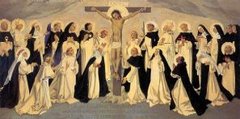
For Benedict, the words of the Psalm: "coram angelis psallam Tibi, Domine" – in the presence of the angels, I will sing your praise (cf. 138:1) – are the decisive rule governing the prayer and chant of the monks. What this expresses is the awareness that in communal prayer one is singing in the presence of the entire heavenly court, and is thereby measured according to the very highest standards: that one is praying and singing in such a way as to harmonize with the music of the noble spirits who were considered the originators of the harmony of the cosmos, the music of the spheres. From this perspective one can understand the seriousness of a remark by Saint Bernard of Clairvaux, who used an expression from the Platonic tradition handed down by Augustine, to pass judgement on the poor singing of monks, which for him was evidently very far from being a mishap of only minor importance. He describes the confusion resulting from a poorly executed chant as a falling into the “zone of dissimilarity” – the regio dissimilitudinis. Augustine had borrowed this phrase from Platonic philosophy, in order to designate his condition prior to conversion (cf. Confessions, VII, 10.16): man, who is created in God’s likeness, falls in his godforsakenness into the “zone of dissimilarity” – into a remoteness from God, in which he no longer reflects him, and so has become dissimilar not only to God, but to himself, to what being human truly is. Bernard is certainly putting it strongly when he uses this phrase, which indicates man’s falling away from himself, to describe bad singing by monks. But it shows how seriously he viewed the matter. It shows that the culture of singing is also the culture of being, and that the monks have to pray and sing in a manner commensurate with the grandeur of the word handed down to them, with its claim on true beauty. This intrinsic requirement of speaking with God and singing of him with words he himself has given, is what gave rise to the great tradition of Western music. It was not a form of private “creativity”, in which the individual leaves a memorial to himself and makes self-representation his essential criterion. Rather it is about vigilantly recognizing with the “ears of the heart” the inner laws of the music of creation, the archetypes of music that the Creator built into his world and into men, and thus discovering music that is worthy of God, and at the same time truly worthy of man, music whose worthiness resounds in purity.
Speaking of Western Monasticism, the Holy Father also had this to say:

First and foremost, it must be frankly admitted straight away that it was not their intention to create a culture nor even to preserve a culture from the past. Their motivation was much more basic. Their goal was: "quaerere Deum". Amid the confusion of the times, in which nothing seemed permanent, they wanted to do the essential – to make an effort to find what was perennially valid and lasting, life itself. They were searching for God. They wanted to go from the inessential to the essential, to the only truly important and reliable thing there is. It is sometimes said that they were “eschatologically” oriented. But this is not to be understood in a temporal sense, as if they were looking ahead to the end of the world or to their own death, but in an existential sense: they were seeking the definitive behind the provisional. "Quaerere Deum": because they were Christians, this was not an expedition into a trackless wilderness, a search leading them into total darkness. God himself had provided signposts, indeed he had marked out a path which was theirs to find and to follow. This path was his word, which had been disclosed to men in the books of the sacred Scriptures. Thus, by inner necessity, the search for God demands a culture of the word or – as Jean Leclercq put it: eschatology and grammar are intimately connected with one another in Western monasticism (cf. "L’amour des lettres et le désir de Dieu"). The longing for God, the désir de Dieu, includes amour des lettres, love of the word, exploration of all its dimensions.
(italics & bold not in original)


hat tip to Sandro Magister at Chiesa Online

Thursday, September 11, 2008

Ode to Sarah

Ode To Sarah, by Jay Boyd

Ode to Sarah

The candidate for whom we were prayin'
Has arrived and appears to be stayin'.
Pro-life she preaches
And lives what she teaches.
Her name is Sarah Palin.

Her opponents say Sarah's too green,
But her actions can clearly be seen.
She sent the big jet away
Via e-Bay,
And made government spending go lean.

Sarah tells us that she's a "goil"
Who knows about Alaskan oil.
She's more than willing
To do more drilling
To keep gas on American soil.

Her daughter is pregnant today,
But the girl isn't married, they say.
Abstinence defied?
No - just not tried.
Palin's values are still here to stay.

"But…the WAR!" the liberals cry.
"We don't want more soldiers to die!"
Her eldest son Track
Is assigned to Iraq;
Palin says we should still fight, and why

Sarah Palin puts down Obama
With the sweetness of somebody's mama.
She's after the leftists
As well as the terrorists:
You'd better watch out, Osama!


Dr. Jay Boyd is a convert to the Catholic faith, a Psychologist residing in Baker City, Oregon, and a frequent contributor to Homelitic and Pastoral Review who also enjoys writing limericks

Tuesday, September 09, 2008

The Church's Call to Peace & Justice

Does the concept of "social justice" require that government be the solution for every social problem? Probably not. Yet, many people who openly advocate what is called, "social justice," believe that government provides the best solutions to problems. In the end, do we trust each person, family, community, and nation to solve their own problems? Most problems seem overwhelming and too often these same folks look for global solutions. Go to the hotlink, and look at the article entitled: "Peace and Justice: Look to Freedom for Solutions."

Monday, September 08, 2008

back from travels

back home after several days of travel to Oregon and extremely brief family visits; what, 1200 miles in 4 days? Santiam Pass was lovely...


... and the beach at Coos Bay was cold and windy, but there is still sand in my shoes and a sand-dollar in my pocket.


Sea food on the coast? I'm staying home, and sticking to Winco & my BBQ!

Thursday, September 04, 2008

The seminal document for the “hermeneutic of rupture” for the Dominican Third Order (oh, excuse me, Dominican Laity) is The Dominican Third Order: Old and New Style - Schillebeeckx E, OP. In this the author explicitly sets out the blueprint for destroying the old and replacing it with the new. This has been the marching orders for the “sing a new church” crowd for many years.

When pointing out to the Schillebeeckx sycophants, that they are following the advice of someone who had gone off the rails sufficiently to earn the rebuke of the Congregation of the Doctrine of the faith, they typically respond that this is the finest Dominican tradition, pointing to the Angelic doctor as someone who caught the ire of his contemporaries, who accused him of treading at or across the line of orthodoxy. By extension, then, they exonerate themselves, styling themselves as the beacons of an expanded orthodoxy, rather than narrow minded souls clinging to the past and afraid of anything new.

The point must be called; are they really what they are claiming so shamelessly?

But I say: the angelic doctor never rejected any of the received doctrine of his time, he looked for ways to go deeper in understanding it. He was never censured for denial of the truths of our faith. On the contrary, the so called lights of our age, be they Teilhard de Chardin, Carl Rahner, Ed. Schillenbugger, or Matthew Fox, all have abandoned the received deposit of faith in one dogma or another, and sought to replace it with something anathama to that faith. I suspect that this is why their disciples are quick to criticize the church, and equally quick to provide apologetics to the hesiarchs of the protestant deformation. Follow the blind man, fall into the pit; I read that in a good book.

I bring this up because it is the charism of St. Dominic which brings one to want to be a Dominican. The Schillebeeckan 'vision' (or hot flash?) is what? conformity to the world? which offers... what?


I'm off to Oregon for a few days for my niece's wedding on Sunday.