Sunday, December 24, 2006

The coming of the Lord

Wisdom 18:14-15. For while all things were in quiet silence, and the night was in the midst of her course, Thy Almighty word leaped down from heaven from thy royal throne, as a fierce conqueror into the midst of the land of destruction


Let us consider the Nativity; here is the "Shepherd's Cave" in Bethlehem. It was in such a place that our Lord was born. A rough cave, a cleft in the limestone rock, where shepherds and their flocks found shelter. When one thinks of cracks in the rock, one thinks of Christ, The Rock. Moses asked to see God's face, and God said he could not, but He would allow Moses to see Him as He passed, from the cleft in the Rock.

Ezechiel spoke of hearts to; he prophesied that the Lord God would take away our stoney hearts, and give us hearts of flesh.


What does one find in a stoney heart? blackened by the fires of illicit passions, the source of a multitude of sins? Without grace, are not our passions like wild animals, subject to no law but their own?


And yet, Christ deigns to come to us. He comes to the cave of our heart to subdue all that is not true. He comes to a blackened cave that that which is wild will be subdued.


For, if there He finds "men of good will," He brings the blessing of peace.


Come, let us adore Him!
Te Deum

We praise You, O God; *
we acclaim You Lord and Master.
Everlasting Father, *
all the world bows down before You.
All the angels sing Your praise *
the hosts of heaven and all the angelic powers;
All the cherubim and seraphim *
call out to You in unending chorus:
Holy, Holy, Holy *
is the Lord God of angel hosts!
The heavens and the earth are filled, Lord, *
with Your majesty and glory.
Your praises are sung *
by the renowned apostles;
By all the prophets *
who themselves deserve our praise;
By that mighty white-robed army *
who shed their blood for Christ.
And to the ends of the earth, *
the holy Church proclaims her faith in You:
Father, *
whose majesty is boundless;
Your only Son, *
who is true God, and who it to be adored;
The Holy Ghost, *
sent to be our Advocate.
O Christ, the King of glory! *
You alone are the Father's eternal Son.
When You were to become man so as to save mankind, *
You did not shrink back from the chaste Virgin's womb.
When You triumphantly destroyed death's sting,
You opened up to believers the kingdom of heaven.
You are now enthroned at God's right hand, *
in the Father's glory.
We believe *
that You will come for judgement.

V. We therefore implore You to grant Your servants grace and aid, *
R. for you shed Your precious blood for their redemption.
V. Admit them all to the ranks of Your saints *
R. in everlasting glory.
V. Be the Savior of Your faithful people, Lord; *
R. grant them Your blessing, for they belong to You.
V. Be their Shepherd, Lord, *
R. uphold and exalt them forever and ever.
V. Day by day we praise You, *
R. daily we acclaim You.
V. We will confess and glorify Your holy Name, *
R. now and for all eternity.
V. In Your great mercy, Lord, throughout this day *
R. keep us free from sin by Your protection.
V. Have mercy on us, we humbly pray; *
R. Lord, have mercy on us.
V. May Your mercy, Lord, Your loving-kindness, always remain with us; *
R. for we have placed our confidence in You.
V. In you alone, Lord, I have hoped; *
R. may I not be disappointed.

(from A Short Breviary, The Liturgical Press, 1962)

Thursday, December 21, 2006

documentation

This from an entry at Zenit News Service, by Fr. McNamara (May 2, 2006 - ZE06050220). It seems to indicate a desire for something other than what we have here; although Fr. McNamara does make the observation that there is much flexibility permissible.

From the GIRM:

308. There is also to be a cross, with the figure of Christ crucified upon it, either on the altar or near it, where it is clearly visible to the assembled congregation. It is appropriate that such a cross, which calls to mind for the faithful the saving Passion of the Lord, remain near the altar even outside of liturgical celebrations.


I'm informed by a student at TAC that the old GIRM made no mention of a corpus. This is fascinating, because it is in miniature, an example of the Church seeing fit to define that which was once universally understood.

Wednesday, December 20, 2006

Seeking God in Love

From the same author:

"1. Faith 'is like the feet wherewith the soul journeys to God, and love is the guide that directs it'" (John of the Cross, Spiritual Cantical, 1,11)."

"2. The love which will lead us to God does not consist in sentiment; it is an act of the will. To love is to 'will the good'; to love God, is to 'will good to God.' the good which we can desire for God is that which Jesus Himself taught us to ask of our heavenly Father: 'Hallowed by Thy name; Thy will be done.' Since God is the infinite good upon which everthing depends, the good that He desires and that by which He is pleased is none other than His own glory and the accomplishment of His holy will."


This is worth repeating; it is a bit of Truth that can set one free:

The love which will lead us to God does not consist in sentiment

Tuesday, December 19, 2006

Seeking God Faith

This is from today's entry in Divine Intimacy, Father Gabriel of St. Mary Magdalen, O.C.D. Opening with the quote of St. Paul, "Faith is the substance of things to be hoped for, the evidence of things that appear not." (Hb 11:1) He goes on to explain, and adds a quote of St. John of the Cross from "Ascent of Mt. Carmel."

"Faith places us before God as He is; it does not make us see Him, but it makes us believe in Him, and thus puts our intellect in contact with Him. By means of faith, 'God mainfests Himself to the soul in divine light which passes all understanding. And therefore, the greater the faith of the soul, the more closely is it united with God' (J.C. AS II, 9,1). Faith unites the soul with God, even though it experiences no spiritual consolation; on the contrary, God often deprives the soul of all spiritual consolation taht it may exercise itself more in faith and grow in it.


The bolded proposition is pregnant with meaning.
God bless,
mark

Monday, December 18, 2006

Instruction, induction

Chapter meeting yesterday was such a delight and I am grateful to all who participated and who made it work so well. Especially to Bonnie Fitzpatrick OPL, for putting together a fine program for Marilyn Wylde OPL, our newest member, and to Stephanie DeNinno OPL for the wonderful St. Dominic cake for the 800th anniversary celebration. Thanks also to Ruth Robertson OPL for arranging for Nahum Jacobson to speak to the group about the movement generally known under the heading of "Messianic Jews." And also thanks to Maria Turner (wife of Mike Turner OPL) and the Schola Cantorum from Sacred Heart Parish, for coming at the close of our meeting to help us sing the Salve Regina; something we now will do after each meeting.

I was at the grocery store at about 8AM and ran into a coworker and his wife, who asked if I was buying food for a church event. You should have seen his eyebrows go up when I said "yes, for an 800 year anniversary celebration." "It's not everyone who celebrates 800 years of anything..." he replies. Sometimes we take for granted the depth of our history!

More on the ressurifix


This is the original(?) crucifix;


This is the previous ressurifix;


but it's ok to have an aborifix?


In answer to why it is not ok to have a crucifix in a Catholic Church, I was told by (one of the diocese's) Canon Lawyer; "why worry about such a little thing, is this the hill you wish to die on?" - which reminded me of another priest's adominition to "pick your battles carefully." I am not looking to die on a little hill, or even do battle; I just don't get it.

I pointed out to the Canon Lawyer that Mother Theresa observed that the efforts of man, measured against the immensity of God, are ALL LITTLE, to the point of being indistinguishable. That is why it is easier to become a saint in the little way...

Thus, if the Church says that a parish church will have a crucifix; and in my mind I can justify that a processional cross sporting a ressurifix (which is not a crucifix), an item that is not even present except during mass, fulfills the letter of the law, even if contravening the intent, then it seems that I am being rather legalistic, and not displaying much respect for the law of the church in its own right.

I normally stay away from these topics on this blog; and will not tarry here. I will only add that the crucifix plays an important role in the organic whole of a church, just as does the holy water in the font. When entering the church with a heavy heart, and finding rocks in the font during lent, the heart is not assisted, but hurt. When we enter a church and cannot find the crucifix, or even worse, cannot find the tabernacle, we cry out in the anguish of the profound devotion of Mary Magdalen, They have taken my Lord, and I don't know where they have laid him. This heartbreaking sorrow is why it is good to do justice, and render what is due to the faithful.

May the legalistic thinking that justifies injustice give way to charity.

Friday, December 15, 2006

Life of St. Dominic, by Henri Lacordaire

Written in French (1834), an English translation was published in 1880 by Burns and Oats. Dec 17th, 2006, marking the 800th anniversary of the opening of the first convent established by St. Dominic, I return to the Order and to the Church and her children this fine book.

http://dominicanidaho.org/books/lacordaire/vie_de_st_dominic.htm


Then, turning [to the Friars] again, bequeathed them the following legacy, saying: “My beloved brothers, this is the inheritance your Father leaves you; love on another, practice humility, and be faithful in the observance of voluntary poverty,”[8] And in order to give greater force to the last clause of this testament, whoever should dare to corrupt his Order by bringing into it any worldly possessions, he threatened with God’s malediction and his own.

The Friars did not yet despair of their Father’s recovery, neither did they believe that God would so soon deprive the Church and themselves of his presence. In compliance with medical advice, and thinking that change of air might prove beneficial, they moved him to Santa-Maria, a church situated on an eminence near Bologna. But prayers and remedies were of no avail. Dominic grew worse, and believing himself near death, summoned the Friars anew. Twenty of them came with Ventura, their Prior, and ranged themselves around the sick man. Nothing has been preserved of the nature of Dominic’s words on this occasion, save that never had more touching, heartfelt utterances issued from his lips. After this he received extreme unction. And learning from Friar Ventura that the monk appointed to the Church of Santa-Maria intended to bury him there, he said, “God forbid that I should be buried elsewhere than beneath the feet of my Friars. Carry me out into the vineyard, that I may die there and be interred in our own church.”[9] then the Friars took him back to Bologna, fearing every moment that he would expire in their arms. As he had no cell of his own, they placed him in that of Friar Moneta. They wished to change his garments, but having none save those which he word, Moneta gave one of his own tunics with which to cover him. Friar Rodolfo supported the Saint’s head, wiping the death-sweat from his brow, the rest of the Friars looking on, weeping. In order to comfort them, Dominic said, “Do not weep. I shall be of more use to you where I am going than I have been here.”[10] One of the Friars asked him where he desired to be interred. He replied, “Beneath the feet of my Friars.”[11] This was about an hour after their arrival in Bologna. Dominic observing that the Friars were so overwhelmed by grief that they were forgetting to pray for his departing soul, sent for Friar Ventura, telling him to “make ready.”[12] They did so at once, and ranged themselves in solemn order around the dying man. He told them to “wait a while;” and Ventura, embracing this last opportunity spoke thus to the Saint: “Father, you know in what grief and desolation you leave us; remember us in the presence of the Lord.”[13] Then Dominic, raising his eyes and hands to heaven, uttered this prayer: “Holy Father, I have accomplished Thy will, and those whom Thou hast given I have kept; I now commend them unto Thee. Do Thou preserve and keep them.”[14] And a moment later he told them to “begin.”[15] They then commenced the solemn prayers for the departing soul, in which, from the movement of his lips, Dominic appeared to take part. When they came to these words, “Let the holy angels of God come forth to meet him, and conduct him to the city of the Heavenly Jerusalem,” his lips moved for the last time; he raised his hands heavenwards, and God received his soul. This occurred at noon on Friday, 6th August 1221.

[8] The Blessed Jourdain de Saxe, Vie de St. Dominique, ch. iv. n. 68.
[9] Actes de Bologne, Friar Ventura’s deposition, n. 7.
[10] Ibid., Friar Rodolfo’s deposition, n. 4.
[11] Ibid., n. 7.
[12] Ibid.


O lumen Ecclesiae
Doctor veritatis,
Rosa patientiae,
Ebur castitatis,
Aquam sapientiae
propinasti gratis,
Praedicator gratiae,
nos junge beatis.


Light of the Church,
Teacher of truth,
Rose of patience,
Ivory of chastity,
You freely offered
The waters of wisdom,
Preacher of grace,
Unite us with the blessed.

Holy Father Dominic, pray for us!

Thursday, December 14, 2006

800 years

2 Pt 3:8. But of this one thing be not ignorant, my beloved,
that one day with the Lord is as a thousand years, and a
thousand years as one day.


Is the day of the Order passing?

Luke 24:29. But they constrained him, saying: Stay with us,
because it is towards evening and the day is now far spent.
And he went in with them.


Let us constrain the Lord. He will stay. But beg, beg with all your heart, for
the day is now far spent.

eia ergo, advocata nostra
Holy Father Dominic, pray for us.

Ressurifix

Theocoid reminded me that we had a discussion regarding the lack of a crucifix in our Cathedral parish, and that at a time in the recent past we had a huge hanging "swan dive" Jesus, the resurrected Lord replacing the crucified Lord on the cross. you've seen them, this sort of thing (currently in the basement parish hall).

I first encountered this after reception into the Church in 1996, and, after the bare crosses of protestantism, found this rather a curious item indeed. Was there a Catholic contigent that, like the protestants, wanted to bypass the cross and go straight to glory? "No greater love" is too great a love so let's all feel good instead? I have long called these things a ressurifix, and I have lost the memory of whether that term was one I received or coined, (I'm inclined to think it was a received term, as I'm not generally that clever).

The question to ponder, is what in scripture does this refer to? A crucifix (a cross with a crucified corpus of Christ) represents a real, historical event, and event that is made present at the mass. But the cross with a resurrected Christ, represents in scripture, well... what?

When reading St. Augustine's commentaries on the psalms, there was a controversy in the fourth century which since then even the Church has apparently conceded to her Jewish controversialists. The Septuagint, as received, contained the following, the second part of the strophe, the Church being accused of adding:

PSALM XCVI.

"O sing unto the Lord a new song; sing unto the Lord, all the earth,
the Lord hath reigned from the wood."


The one justification in scripture that the resurifix could point to, has been stricken. Personally, I find the ressurifix a symbol of fear of the cross, rather than instilling an adoration for the God who condescended to take our humanity and nail its failings and sins to the cross for our redemption. The traditional crucifix gives me strength, the other, sadness.

BTW, I did enlist the aid of a willing conscript to carry the extremely beautiful original crucifix (which is used to hold a window open in the robing room) and set it on a table next to the altar during the latter part of the Cathedral "Family of God" conference. As the agent provocateur, I accept full responsibility for failing to respect the rule of crufixphobia which is policy in the Cathedral: mea culpa, I was carried away by the spirit of Vatican II, a spirit of community, of support for my marginalized sisters and brothers, a spirit of disregard for legalistic thinking, and a desire for justice...

Origins of the Dominican Third Order

I have finished transcribing Chapter 16 (of 18) of Henri Lacordaire's Life of St. Dominic, which speaks of the creation of the Third Order.

Lacordaire's use of the term "Third Order" is not a relationship of hierarchy, but of time; it was the 3rd distinct "Order" established by St. Dominic!

With all the effort to do away with traditional language, this came as sort of a "duh" moment...

Sunday, December 10, 2006

Advent. Prepare the way of the Lord.

Friday and yesterday, I had the incredible gift to be able to listen to Rosalind Moss,Deacon Harold Burke-Sivers, and Jesse Romero at the Family of God conference that closed out the Cathedral of St. John the Evangelist Centennial Celebration.


I am very grateful to the speakers for coming, to Fr. Henry Carmona for his support, and to all the parish members who helped put this event together.

I had never heard Jesse Romero speak before, and he spoke of “the world needs a heart transplant;” “be a heart donor,” “give your heart to Jesus.” And Rosalind Moss, whom it seems so clear to me speaks from a heart united in love to Love Himself, the Living God, into whose hands it is a terrible thing to fall, and yet who gives Himself to us through His Son, and comes to us through His body the Church, to unite us to Him, that we who are sinners could be conformed to the image of His Son, because He loved us first. And Deacon Harold Burke-Sivers; the nuts and bolts of assembling a Christian life! Oh, build with gold and silver, not hay and stubble; and certainly not with mud! RTM! (Read The Manual!).

Last week at work, I was overcome by a pressing need, and had to write; here is what I found in my notebook as I was listening to Jesse speak:

Father grant my heart repose in Thee,
That my will conformed to Thine,
In Thy Son Jesus be set free,
By the Spirit now in time,
And for all eternity.


The desire of every heart; He was awaited; He came; He is with us; He will come again. Without Him, no possession can provide that which our heart desires; in Him we possess all things, as all things are held in being by Him, and have been pronounced good.

And preparing we prepare, yet to bring Christ to a waiting world, in all places and in manifold and different circumstances not expected. With a parishioner who was not at the conference and should have been, a most interesting discussion before even leaving the parish; a discussion in which I could hear the echo, in Rosalind’s Brooklyn accent, saying “Shame on him” in reference to Rabbi Fink’s support of abortion. I woke up this morning and my prayer for people like this is to give your whole heart and mind to Jesus.

For the mind, consider that all addictions, be they kleptomania, alcoholism, smoking, drugs, sex, pornography, are more than merely physiological, more than genetic determinism; all these play a part. They are primarily disorders in the moral order, disorders of a will no longer capable of saying no to a particular evil. Disease, yes indeed, but disease of body and soul. So to tell someone living this sort of life, that you accept them for who they are, and would leave them there, is to tell them a lie; it is not what they are, but what they do, and to fail to love them, for one has done nothing to help them. Oh, there may be sentimental support, but that it not the Love that we have a vocation to live, that it the world’s love. Thus to believe that we should do all we can to help people stop destructive behavior, such as smoking, alcoholism, drugs, and all the others, but to exclude those who are ensnared in the moral morass which St. Catherine tells us even the demons will not look upon, is one of two things; it is either the height of hypocrisy, or a person who has lost the sense of sin, for the gravity of this offense against God and self.

The prodigal son, when he came to his senses, got up from the pig pen and returned to his Father, who ran to meet him, with joy at the return of his son who had been lost. There is a school which seems intent on keeping the prodigal in the pig pen, because they are unaware of the nature of the Love of the Father, condemning these sons to extended suffering by their interdiction; even intercepting them on the road and sending them back to the pig pen.

It is now the hour for you to wake from sleep, for our salvation is closer than when we first believed. The night is far spent; the day draws near. Let us cast off deeds of darkness and put on the armor of light. Rm 13:11-12

Prepare the way of the Lord. It is a road from Jericho to Jerusalem; from the world, to heaven, and it is a two way street. Jesus said we need to set the desire of our hearts on heaven, for if we set them on the world, we will achieve nothing, but on heaven, ah! He will give us heaven and the world besides! And what is the way to heaven, this road from the Jericho to Jerusalem? This way has a name, the only name under heaven by which man can be saved, His name is Jesus, and He is the Way. Let us set out anew, and sing on the Way,

Salve Regina, Mater miserecordia…

Because when we (as Dominicans) sing the Salve Regina, here is what our Lady in Heaven revealed to St. Dominic in a vision:

From Henri Lacordaire’s Life of St. Dominic

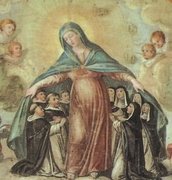
“One evening, Dominic was praying in the church until midnight, at which hour he entered the corridor where the Friars were asleep in their cells. Having finished his business, he resumed his prayers at the end of the corridor where the Friars were asleep in their cells. Having finished his business, he resumed his prayers at the end of the corridor, when chancing to turn his eyes to the other end, he beheld three women approaching, the center on being the most beautiful and venerable. One of her companions carried a magnificent vase, and the other an aspersorium, which she presented to her mistress, who sprinkled and blessed all the Friars save one. Dominic, after noting who the Friar was, advanced to meet the woman, who had already reached the middle of the corridor, near the lamp suspended in that spot. He prostrated himself at her feet, and although he had recognized her, entreated her to tell him her name. At that same time, the beautiful and devotional anthem of the Salve Regina was not yet sung in the monastery and nunnery of the Order in Rome, but only recited, kneeling, after Compline. The woman replied, ‘I am she whom you invoke every eve, and when you say, Eia ergo, advocata nostra, I prostrate myself before my Son, entreating Him to protect this Order.’ The blessed Dominic then asked who her two companions were, on which the Blessed Virgin said, ‘One is Cecilia, and the other Catherine.’ The blessed Dominic then inquired the reason for her omitting to bless one of the Friars, and she replied, ‘Because he was not in a becoming posture.’ Then having finished her round, and sprinkled and blessed the Friars, she disappeared. The blessed Dominic returned to the spot where he had been praying, and hardly had he recommenced his devotions when he was raised in spirit to the presence of God. He beheld the Lord, having at his right hand the Blessed Virgin, who seemed to Dominic to be robed in a sapphire-colored mantle. Looking around and discerning Religious of every Order but his own, he began to weep bitterly, not daring to approach our Lord or his Blessed Mother. Our Lady motioned him to draw near, but he dared not comply until encouraged by our Lord. Then he approached and prostrated himself weeping bitterly. The Lord said, ‘Why weepest thou so bitterly?’ and he replied, ‘Because I see members of every Order but my own.’ The Lord said to him, ‘Dost thou wish to see thy Order?’ He tremblingly replied, ‘Yes, Lord;’ and the Lord rested His hand on the shoulder of the Blessed Virgin, saying to Dominic, ‘I have confided thy Order to my mother.’ Then He added, ‘Wilt thou indeed see thy Order?’ to which Dominic replied, ‘Yes, Lord.’ Then the Blessed Virgin unfolding her mantle in Dominic’s sight, so that it covered the whole of the celestial abode, he beheld beneath it a multitude of his children. The blessed Father prostrated himself to render thanks to God and to our Lady, and the vision disappeared. As he recovered consciousness, the bell was ringing for Matins, and when they were ended, he convoked a chapter of his Friars, and discoursed to them on the love and veneration they ought to have to the Blessed Virgin, and among other things he related this vision. At the close of the chapter, he privately took aside the brother whom Our Lady had not blessed, and gently asked him if he had not kept back something in the general confession he had made. He replied, ‘Holy Father, my conscience accuses me of nothing, save that last night, when I awoke, I found I had been sleeping with no garments on.’ At Saint-Sixtus the blessed Dominic related his vision to Sister Cecilia and the others, as if it had been beheld by another person, but the Friars present made a sign to the sisters that it was Dominic who had seen it. It was on this occasion that the blessed Dominic enjoined that, wherever they slept, the Friars should wear their girdle and their sandals.”[3]

[3] Sister Cecilia’s Narrative, n. 7.

Friday, December 01, 2006

Blessings

This morning was the first day of the season with icy roads after a light snowfall; I had to take my daughter to school early, then off to Sacred Heart Parish for the first mass to be sung by the Schola Cantorum formed by Maria Turner, wife of Mike Turner OPL, of this chapter. This mass opened the "40 hours devotion" that Maria has organized. The choir, only recently deemed "not appropriate" for singing at mass, is singing at three masses this weekend. After mass, on the way to work, I was involved in an accident on the icy roads. Fortunately no one was injured, and I had the opportunity to meet and visit with several delightful people whom Providence had decided needed to do something quite different than what they had planned for that hour of this glorious day. In fact, in considering the collection of circumstances out of the ordinary that put me in that place at that time, any of which not taken, whould have enabled me to not have been hit, I had to pause and give thanks to God for all the times where the collections of circumstances which would have put me in a very bad place, did not happen. May He be ever praised.

which is a long introduction to something that Bill White posted back to me in a comment on my "Anniversary" entry, an item I'd sent him in 1998. It still touches my soul. Thanks, Bill!

Thank you, Oh gracious Lord,
for the love with which you created us;
Thank you, Oh gracious Lord,
for the justice with which you condemned us,
Thank you, Oh gracious Lord,
for the mercy with which you redeemed us.

St. Cyprian on the coming kingdom

This is from todays Office of Readings. St. Cyprian wrote from North Africa in the mid-third century.

From a sermon on man’s mortality by Saint Cyprian, bishop.


Our obligation is to do God’s will, and not our own. We must remember this if the prayer that our Lord commanded us to say daily is to have any meaning on our lips. How unreasonable it is to pray that God’s will be done, and then not promptly obey it when he calls us from this world! Instead we struggle and resist like self-willed slaves and are brought into the Lord’s presence with sorrow and lamentation, not freely consenting to our departure, but constrained by necessity. And yet we expect to be rewarded with heavenly honors by him to whom we come against our will! Why then do we pray for the kingdom of heaven to come if this earthly bondage pleases us? What is the point of praying so often for its early arrival if we would rather serve the devil here than reign with Christ?

The world hates Christians, so why give your love to it instead of following Christ, who loves you and has redeemed you? John is most urgent in his epistle when he tells us not to love the world by yielding to sensual desires. “Never give your love to the world,” he warns, “or to anything in it. A man cannot love the Father and love the world at the same time. All that the world offers is the lust of the flesh, and the lust of the eyes and earthly ambition. The world and its allurements will pass away, but the man who has done the will of God shall live for ever.” Our part, my dear brothers, is to be single-minded, firm in faith, and steadfast in courage, ready for God’s will, whatever it may be. Banish the fear of death and think of the eternal life that follows it. That will show people that we really live our faith.

We ought never to forget, beloved, that we have renounced the world. We are living here now as aliens and only for a time. When the day of our homecoming puts and end to our exile, frees us from the bonds of the world, and restores us to paradise and to a kingdom, we should welcome it. What man, stationed in a foreign land, would not want to return to his own country as soon as possible? Well, we look upon paradise as our country, and a great crowd of our loved ones awaits us there, a countless throng of parents, brothers and children longs for us to join them. Assured though they are of their own salvation, they are still concerned about ours. What joy both for them and for us to see one another and embrace! O the delight of that heavenly kingdom where there is no fear of death! O the supreme and endless bliss of everlasting life!

There, is the glorious band of apostles, there, the exultant assembly of prophets, there, the innumerable host of martyrs, crowned for their glorious victory in combat and in death. There, in triumph, are the virgins who subdued their passions by the strength of continence. There, the merciful are rewarded, those who fulfilled the demands of justice by providing for the poor. In obedience to the Lord’s command, they turned their earthly patrimony into heavenly treasure.

My dear brothers, let all our longing be to join them as soon as we may. May God see our desire, may Christ see this resolve that springs from faith, for he will give the rewards of his love more abundantly to those who have longed for him more fervently.

Wednesday, November 22, 2006

A Reflection by Fr. Giles Dimock, OP, STD

An interesting thought:

Through time, I have come to see clearly the urgent need for women religious in the world. While some groups of sisters were embracing a secular view of religious life and loosing their numbers, I never realized that a corresponding drop in priestly vocations would also be coming. Since those days, I have come to realize that John Paul II's teaching on the complimentarity between men and women holds also in the suprenatural realm; numbers of vocations among men tot he priesthood are proportionate to those women religious who support them in prayer and friendship


Taken from "Community Prepares to Celebrate a Decade of Blessings, 1997-2007,
A reflection by one who was there...
Fr. Giles Dimock, OP, STD,
Adjunct Professor of Theology,
Franciscan University of Steubenville

In
"Mater Eucharistiae" Vol. 10 Issue 2, Dec 2006
A publication of the Dominican Sisters of Mary, Mother of the Eucharist
http://www.sistersofmary.org

Tuesday, November 21, 2006

Humble Beginnings; 800th Anniversary Celebration

On December 17, 1206, Notre Dame de Prouille opened its doors to the first vocations. On December 22, 1216, pope Honorious III established the Order of Friar Preachers (Dominicans). To celebrate these events, Bro. Carlos A. Azpiroz Costa OP, Master of the Order, has announced a Jubilee and a “Novena of Years” to celebrate these events. Addressing the Order from Prouille, the Master General said:

May all of us, the sons and daughters of Saint Dominic, prepare ourselves [to return to our foundation] joyfully; let us there drink of the fresh simplicity of the "love we had at first", feeling ourselves at the feet of Jesus, that we may be with Him and listen to Him. Let us live this time with intensity and grace, sharing with our contemplative communities the joy of their consecration, the fruitfulness of their silence, the beauty of their liturgy, their special love for the Word.


The Dominican Laity of Idaho extends a warm welcome to all, to join us on Dec 17, 2006, at our regular chapter meeting at St. John’s Cathedral (parish office building) to celebrate with us these providential events. Further information may be obtained by calling Bonnie Fitzpatrick (442-7139) or at http://dominicanidaho.org.

Monday, November 20, 2006

Lacordaire on St. Dominic meeting St. Francis

Yet these two men, whose destinies were so harmonious in the sight of heaven and earth, were strangers to one another, and although both were in Rome during the fourth Lateran Council, it does not appear that they ever heard of each other. One night when Dominic was praying, he beheld Jesus Christ filled with wrath against the world, and His blessed Mother presenting to Him two men, in order to appease Him. He recognized himself as one, but did not know the other, whom he regarded so attentively that the face was ever present to him. On the morrow, in a church, we know not which, he beheld, in the dress of a mendicant, the face seen by him the preceding night, and running to the poor man, embraced him with holy effusion, uttering these words, “You are my companion; you will walk with me; let us keep together and none shall prevail against us.” He then related his vision, and thus were their hearts blended in one.

Friday, November 17, 2006

Either Peace or Life – Benedict XVI Debunks a False Dilemma

From www.chiesa

Speaking to the Swiss bishops, the pope replies to the main objection directed against the Church’s hierarchy by the progressive Catholics. And to the German bishops, he says...

by Sandro Magister


full story here:

Friday, November 10, 2006

Life of Saint Dominic, by Henri Lacordaire

I've begun the task of transcribing this wonderfully written book. Here is Lacordaire's recounting of the famous night in the inn, which resulted in the resolve to found Order of Friar Preachers.


CHAPTER III.
St. Dominic arrives in France

At that time, Alphonso III., king of Castile, was meditating a marriage between his son and a Danish princess, and entrusted the negotiation of the affair to the Bishop of Osma, who, taking with him Dominic, set out for the North of Germany towards the close of the year 1203. In passing through Languedoc, both were deeply grieved at beholding the alarming success of the Albigenses. On reaching Toulouse, where they had to pass the night, Dominic perceived that their host was a heretic; and although time pressed, he was anxious to be of service to the poor deluded man under whose roof they then were. Jesus Christ has said to His Apostles, When you come into a house, salute it, saying, Peace be to this house. And if that house be worthy, your peace shall come upon it; but if it be not worthy, your peace shall return to you.[Mt. 10:12-13] The Saints, to whose minds all the words of Jesus Christ are ever present, and who know the power of a benediction given even in secret, regard themselves as God’s ambassadors to every creature whom they meet, and strive to part from none until they have implanted in his heart some germ of grace. Dominic did not rest content with merely praying for his host, but passed the night in converse with him; and the ready eloquence of the stranger made so deep an impression on the heretic, that he returned to the faith before the dawn of day. Then another wonder occurred; touched by the conquest he had just effected in the cause of truth, and also by the sad spectacle of he ravages made by false doctrine, Dominic then first conceived the idea of founding an Order in defense of the Church, the mission of which should consist in preaching. This sudden resolve took lasting possession of his mind; and now that the secret of his future career was revealed to him, he quitted France, as if that land, jealous that this great man owed her not his birth, had nevertheless obtained from God this favor, that he should not tread her soil in vain, and that to her he should be indebted for the decisive counsel of his life.


It is good to remember the purpose to which the Order was founded, a purpose as necessary today as in 1203.

Thursday, November 02, 2006

Next Chapter Meeting

Will be on Sunday, November 19, 2006

For meeting syllabus, click here

Wednesday, November 01, 2006

Burnett on the real presence

I'm about half way through Burnett's treatment of the Protestant objections to Transubstantiation. Starting with John 6, he makes the following observations:

1. If Jesus did not mean literally to eat his flesh and drink his blood, what is the metaphorical meaning which the Jews of his time would have understood? There are 4 occurances in the OT, and two in the NT. Metaphorically it is always ill will wished upon a person; Ill will to Jesus earns eternal life? The metaphorical meaning is out of the question.

2. When Jesus is missunderstood in other passages, He always corrects, or the apostolic author provides correction. No speaker delivering something important leaves His audience in error, otherwise he does an idle thing.

3. When the liseners understand and object, Jesus always repeats himself more emphatically (for example, Peter's response to the foot washing), as he does repeatedly here.

4. Jesus says those who object do so for their lack of faith. How can you be condemned for not believing something that is not what you are meant to believe?

5. The apostles clearly understood Jesus' words in a literal fashion, even if they did not comprehend. Since at this point they clearly understand it literally (you must eat my flesh and drink my blood), the protestant is constrained to show where scripture clearly says they changed their belief, otherwise he has no justification to offer a different understanding as the apostolic understanding. Search in vain...

Thursday, October 26, 2006

Anniversary of entering a Catholic Church

11 years ago today, I received the email below from a member of the now defunct ListServer (remember those?) ROMCATHL. It came at a time of extreme trial, and after reading it, I sought out a Catholic priest for the very first time.

On this day I share it again to give thanks to God who gave us his son, who gave us so many through the ages who have worked so tirelessly that those in darkness would see a great light.

May God's blessings be upon you.
Mark

Date: Thursday, October 26, 1995 3:16 pm
Subject: We do not know what is right to pray for

Today while praying the Office of Readings, the second taught me a thing or two about the nature of prayer and answered some questions that, I think, all of us have from time to time: Why does it seem that many times our prayers go unanswered? Doesn't God hear us? I thought that the answer supplied by Saint Augustine was inspired and I wanted to share it with all of you.

From the Office of the Reading for Thursday in the 29th week in
Ordinary Time:

From a letter to Proba by Saint Augustine, bishop
(We do not know what is right to pray for)

You may still want to ask why the Apostle said: "We do not know what is right to pray for", because, surely, we can not believe that he or those to whom he wrote did not know the Lords Prayer.

He showed that he himself shared this uncertainty. Did he know what it was right to pray for when he was given a thorn in the flesh, an angel of Satan to bruise him, so that he might not be puffed up by the greatness of what was revealed to him? Three times he asked the Lord to take it away from him, which showed that he did not know what he should ask for in prayer. At last, he heard the Lord's answer, explaining why the prayer of so great a man was not granted, and why it was not expedient for it to be granted: "My grace is sufficient for you, for power shines forth more perfectly in weakness."

In the kind of affliction, then, which can bring either good or ill, we do not know what it is right to pray for; yet, because it is difficult, troublesome and against the grain for us, weak as we are, we do what every human would do, we pray that it might be taken away from us. We owe, however, at least this much in our duty to God: if he does not take it away, we must not imagine that we are being forgotten by him but, because of our loving endurance of evil, must await greater blessings in its place. In this way, "power shines forth more perfectly in weakness." These words are written to prevent us from having too great an opinion of ourselves if our prayer is granted, when we are impatient in asking for something that it would be better not to receive; and to prevent us from being dejected, and distrustfull of God's mercy towards us, if our prayer is not granted, when we ask for somthing that would bring us greater affliction, or completely ruin us through the corrupting influence of prosperity. In these cases we do not know what it is right to ask for in prayer.

Therefore, if somthing happens that we did not pray for, we must have no doubt that all that what God wants is more expedient than what we wanted ourselves. Our great Mediator gave us an example of this. After he said: "Father, if it is possible, let this cup be taken away from me", he immediately added, "Yet not what I will, but what you will, Father", so transforming the human will that was his through his taking of human nature. As a consequence, and rightly so, "through the obedience of one man the many are made righteous."

Tuesday, October 24, 2006

The crux of the matter

I've finished book one of Burnett's "The True Church", which I've posted on previously, and have begun book two (both are bound as one volume). Book two answers particular questions raised by Protestants.

It has been my observation that Burnett is quite the gentlemanly scholar and debator, never descending to personal attacks, always following the arguments to their logical conclusions in the interest of truth, and with the greatest respect for the parties of the other part.

Here follows an interesting observation of his regarding Martin Luther and the reformation. It is, to say the least, interesting!

Burnett wrote:

The principal of private interpretation in the last resort, was, therefore, forced upon Luther. It was either that or no Reformation. There was no possible middle course. Either the right to construe the law in the last resort resided in the Church, or with each individual. It could not be divided between them. Two supreme tribunals to execute the same law over the same persons could not exist under the same system of government. We could just as readily conceive of two Supreme Deities, creating and governing the same universe.

The authority of the Church was the last restraint that Luther cast aside. It cost him much pain, as he himself relates. “After,” says he,

I had gotten the better of all the arguments which were opposed to me, one remained still, which, with extreme difficulty and great anguish, I could scarce conquer, even with the assistance of Jesus Christ; namely, that we ought to hear the Church.

But it must be conceded that Luther may have been mistaken in the supposed assistance of Jesus Christ. He may have mistaken Christ’s abandonment of him for His assistance. Whether this be true or not, there was a very remarkable circumstance connected with his rejection of the authority of the Church.

After having prevailed over his scruples, and in his last struggle to shake off the authority of the Church, “he cries out,” says Boussuet,

Like one set free from some irksome bondage, “Let us break their bands asunder, and cast their yoke from us,”

This quotation, made by Luther, is from the third verse of the second chapter of Psalms, where it stands in this connection:

2. The kings of the earth set themselves, and the rulers take counsel together against the Lord, and against his anointed, saying, 3 Let us break their bands asunder, and cast their yoke from us.
4. He that sitteth in the Heavens shall laugh: the Lord shall have them in derision.

The Catholic thinks that Luther made a quotation precisely suited to his position and the effort he was making.

Monday, October 16, 2006

Lettter to the Order from the Master General

In Preparation for the 800th Anniverary of the Foundation of the Monastery in Prouilhe

Letter to the whole Order announcing the Jubilee Year for the 800th anniversary of the foundation of the first community of contemplative nuns.

Dear brothers and sisters:

I send you this letter from the Monastery of Blessed Mary in Prouille, the first monastery of the Order, on the Feast of Saint Catherine of Siena, our older sister, "into whom, it seems, ‘the whole soul of Dominic passed (as indeed into Blessed Jordan of Saxony)'".[1]

In our history there are many events that encourage us to renew our faithfulness to our vocation as sons and daughters of Saint Dominic: "to contemplate and share the fruits of our contemplation".


Read the rest of the letter here

Monday, October 09, 2006

Retreat


More pictures and a summary here

Our warmest and emphatic thanks to,
Bishop Michael Driscoll, for ordaining Carlos Enrique to the priesthood,
Fr. Flores, Our Lady of the Valley, for the monstrance,
Fr. Donoghue, for initiating adoration,
Deacon Collins, St. Paul's, for assistance with benediction and communion service,
The Catholic Chaplains Association of Fr. Bragg, NC, for the altar, tabernacle, lecturn, and baptistry.
and to our Lord, who loved us first, that we might love in turn, for permitting us to have His presence in our community for 55 hours.

Click here for a meditation on Jesus' words.

Thursday, October 05, 2006

Retreat schedule

Here is an approximation of the schedule for the retreat.

The text for the retreat is:

DIVINE INTIMACY
Meditations on the Interior Life
for Every Day of the Liturgical Year
by Father Gabriel of St. Mary Magdalene, O.C.D.

(copies of readings will be provided)

The beginning and end will happen on schedule,
the rest, well, may the Holy Spirit Guide us!

-------------------------------------------
Friday October 6, 2006:

9:00 – 10:00 Exposition of Blessed Sacrament, opening of retreat
10:00 – 10:45 1. The gift of Fear
10:45 – 11:30 2. Blessed are the Poor in Spirit
11:30 – 1:00 Lunch
10:0 – 1:45 3. The gift of Fortitude
1:45 – 2:30 4. Blessed are they that Hunger and Thirst after Righteousness
2:30 – 3:15 Daily wrap up
3:15 – 4:00 Free time
4:00 - Depart for mass at Our Lady of the Valley


Saturday October 7, 2006

10:00 – 10:45 5. The gift of Piety
10:45 – 11:30 6. Blessed are the Meek
11:30 – 1:00 Lunch
1:00 – 1:45 7. The gift of Counsel
1:45 – 2:30 8. Blessed are the Merciful
2:00 – 2:30 9. The gift of Knowledge
2:30 – 3:45 10. Blessed are they that Mourn
3:45 – 4:30 Daily wrap up
4:30 – 5:00 Free time
5:00 Dinner
7:00 Discussion


Sunday October 8, 2006

10:00 – 10:45 11. The gift of Understanding
10:45 – 11:30 12. Blessed are the Clean of Heart
11:30 – 1:00 Lunch
1:00 – 1:45 13. The gift of Wisdom
1:45 – 2:30 14. Blessed are the Peacemakers
2:00 – 2:30 15. Our meeting with the Holy Spirit
2:30 – 3:30 Wrap up discussion
3:30 – 4:30 Free time
4:30 Ending Benediction, close of retreat

Wednesday, October 04, 2006

Our prayers

The news of the tragic death of Helen Chenowith-Hage, mother in law of our Formation Director John Keenan, has left us all stunned. We offer our prayers to John, Meg, their children, and the extended family, and may the souls of the faithful departed, through the mercy of God, rest in peace.

May light perpetual shine upon them. AMEN.

Gift received

Our thanks to the Catholic Chaplains' Association of Ft. Bragg, NC, for the gifts shown here which arrived Sept 29. Thanks also to Paul O'Leary, OPL, for obtaining and shipping.

Sunday, October 01, 2006

Pithy thought

This perhaps summarizes Burnett's approach:

"The infirmities of human legislation are not in God's Law."
- Peter H. Burnett, "The True Church, The path which lead a Protestant lawyer to the Catholic Church"

Friday, September 29, 2006

Upcoming retreat

You have heard it said...


But I say unto you...

More impressions from Burnett

Burnett expresses the need for a judicary as the court of last appeal, and that judiciary, in the civil arena, is by definition, infallible, as there is no recourse beyond it. Although it is admitted that the supreme judiciary can err, it is a judicial infallibility by the very fact that there is no further recourse after its decision is rendered.

Now this applies to the laws of this world, but what of the laws of God? There is a whole exploration of the fact that all civil law, in order to even be law, must be derived from the law of God (ie: the natural law). Thus, if a judiciary must be infallible in judging acts (the external forum) alone without regard to belief or assent (the internal forum), then the laws of God, which require both belief and assent as well as acts (internal and external forum), it is even more essential and necessary to have a judiciary posessing actual infallibility, empowered and capable to construe the Divine Law, as the consequences in this realm are of such a higher order than in the merely civil realm.

The thesis, which Burnett wishes us to consider, is: would God create a system inferior to the systems of merely human construction?

Let’s see if I can paraphrase Burnett and get his point across.

Suppose God, the Supreme Lawgiver, had created a system which did not include a judiciary as the final court of appeal, capable of construing the intent of His Law. Then, when appearing before the tribunal of the final Judge for the disposition of one’s life, to the charge of violation, the individual would answer, “How did I know I was supposed to do this, and not do that? Where was I supposed to find out?” To the retort, “from the plain words of scripture,” the defendant again could honestly answer, “Plain to you perhaps, because it was you who wrote it, but to me, an unlearned man who cannot even read the law in the language of promulgation, there is nothing plain at all about it. In fact, there are many learned men as well who claim it is plain, yet cannot come to agreement about the meaning of that which is supposed to be plain. So therefore I have done whatever I thought was right, since you left me without sure guidance.”