According to our sources on Capitol Hill, the Senate Foreign Relations Committee will consider the International Violence Against Women Act (IVAWA) at 2:15 pm ET on Wednesday.
Your Senator is a member of the Foreign Relations Committee.
In order to ensure that a pro-life amendment is added to the bill or, in the alternative, that this bill is stopped from advancing altogether, we need you to contact your Senator James Risch right now.
AUL Action has already set up a web page so you can easily tell Senator Risch
https://secure3.convio.net/aulact/site/Advocacy?cmd=display&page=UserAction&id=476
to ensure that federal tax dollars are not provided to organizations advancing a pro-abortion agenda around the world under the guise of preventing violence against women.
After you contact your Senator, ask your friends and family to do so too by forwarding them this email.
Women around the world deserve to be protected against violence - including women in the womb.
Thank you for helping defend human life.
Yours for Life,
Charmaine Yoest
Charmaine Yoest, Ph.D.
President & CEO
Americans United for Life Action
Tuesday, September 28, 2010
Legislative action, Americans United for Life request


URGENT Prayer at 2 p.m. Tuesday for Joe Sobran's healing through the intercession of Ven. Solanus Casey
The following is from Fran Griffin, Third Order Dominican and publicist for Joe Sobran:
Please pray for pro-life journalist, Joe Sobran, who is extremely ill and may not be able to recover. Tomorrow at 2 p.m., Harry Veryser of Michigan will be visiting the tomb of Ven. Solanus Casey to pray for Joe's recovery.
Please join Harry and I in prayer for Joe at 2 p.m. Eastern time.
You may use the following prayer or any or your own devising:
Prayer for the intercession of Ven. Solanus Casey for the healing of Joe Sobran:
(to be said on Tuesday, Sept. 28):
=============================================
O God, I adore You. I give myself to You. May I be the person You want me to be, and may Your will be done in my life today.
I thank You for the gifts You gave to Father Solanus. If it is Your Will, bless us with the beatification of
Venerable Solanus so that others may imitate and carry on his love for all the poor and suffering of our world.
As he joyfully accepted Your divine plans, I ask You, according to Your Will, to hear my prayer for the restoration to health of Joe Sobran through Jesus Christ our Lord.
Amen.
"Blessed be God in all His designs."
Imprimatur: Adam Cardinal Maida, Archbishop of Detroit
March 31, 2007 © F.S.G. 3/07
==================================================
Joe Sobran is devoted to Solanus Casey, a holy Franciscan Friar who died in Joe's hometown of Detroit in 1957. Fr. Solanus needs a miracle to be canonized. Joe needs a miracle, too, to be healed.
Please pray at 2 p.m. on Tuesday, Sept. 28.
Thanks very much. See more info at
http://www.solanuscasey.org/english.shtml.
--Fran Griffin
--
Fran Griffin
President
Fitzgerald Griffin Foundation
713 Park St., SE
Vienna, VA 22180
703-242-0058
703-281-6617 (fax)
FGF@fgfBooks.com
http://www.fgfBooks.com
~~~~+~~~~
The Fitzgerald Griffin Foundation is
a tax-exempt organization under the 501(c)(3)
tax code of the Internal Revenue Service.
Contributions to the foundation are tax-deductible.
Wednesday, September 22, 2010
Rachael's Vineyard retreat
The flier for the November Rachael's Vineyard retreat is here:
http://dominicanidaho.org/RachaelsVineyard.pdf
This is a retreat for the healing of post-abortion trauma.
http://dominicanidaho.org/RachaelsVineyard.pdf
This is a retreat for the healing of post-abortion trauma.
Saturday, September 18, 2010
Benedict XVI in England
Yesterday, the Holy Father, speaking to the British Parliment, said:
"There are those who would advocate that the voice of religion be silenced, or at least relegated to the purely private sphere."
who would advocate such a thing? Well, on Thursday, addressing the Holy Father, Her Majesty Queen Elizabeth II said:
"Your Holiness, in recent times you have said that "religions can never become vehicles of hatred, that never by invoking the name of God can evil and violence be justified". Today, in this country, we stand united in that conviction. We hold that freedom to worship is at the core of our tolerant and democratic society."
Did the Queen know that she was saying that the United Kingdom holds the same attitude towards faith as that of the Soviet era Communist constitution? Freedom of worship is not freedom of religion, it relegates faith to the private sphere, removing it from public life. Only evil can be tolerated, not good. To her credit, I will assume she read a prepared speach without realizing the import of the words. I have no doubt that His Holiness Benedict XVI understood them for what they are.
"There are those who would advocate that the voice of religion be silenced, or at least relegated to the purely private sphere."
who would advocate such a thing? Well, on Thursday, addressing the Holy Father, Her Majesty Queen Elizabeth II said:
"Your Holiness, in recent times you have said that "religions can never become vehicles of hatred, that never by invoking the name of God can evil and violence be justified". Today, in this country, we stand united in that conviction. We hold that freedom to worship is at the core of our tolerant and democratic society."
Did the Queen know that she was saying that the United Kingdom holds the same attitude towards faith as that of the Soviet era Communist constitution? Freedom of worship is not freedom of religion, it relegates faith to the private sphere, removing it from public life. Only evil can be tolerated, not good. To her credit, I will assume she read a prepared speach without realizing the import of the words. I have no doubt that His Holiness Benedict XVI understood them for what they are.
Thursday, September 16, 2010
On the eve of Constitution Day, USA.
Tomorrow is Constitution Day in the United States marking the 223rd anniversary of the signing of the U.S. Constitution on September 17, 1787. The unique thought behind the Constitution was the Founding Fathers understanding of human nature and its impact on government. Humanity falls short but mankind still understands the character and quality of perfection because the soul has the character of understanding spiritual things; yet we all fall short of perfection and the glory of God. The genuis of the Constitution is the understanding of this fallen nature in the unique balance in the Constitution's framework: power sharing, delegated powers, separated powers and divided departments, limited government, recognition of economic freedom and private prpoerty rights, guarantees and recognition of God-given rights that arise from nature, and on and on.
When reflecting on the proper checks and balances that created a limited government, it was James Madison who said in Federalist Paper No. 51, that,
"The interest of man must be connected with the constitutional rights of the place. It may be a reflection on human nature, that such devices should be necessary to control the abuses of government. But what is government, but the greatest of all reflections on human nature? If men were angels, no government would be necessary. If angels were to govern men, neither external or internal controls on government would be necessary. In framing a government to be administered by men over men, the great difficulty lies in this: you must first enable the government to control the governed; and in the next place oblige it to control itself."
Compare this wisdom with that of modern Justices to the U.S. Supreme Court that have brought us modern jurisprudence of the last 70 years: no prayer in schools, no prayers at commencement, murder of innocent people, and on and on.
Yesterday, Justice Stephen Breyer, who current holds a seat on the U.S. Supreme Court noted or suggested that a foolish pastor in a small church community in Florida may not have the right to burn the Quran under the First Amendment. This could open the doors to hate-speech laws pushed by international Islamic organizations to prevent what they call "religious hatred." That type of hatred can become like beauty, whatever is in the eyes of the beholder. [I am not yielding to the point made elsewhere that beauty is objective and not subjective!!]. In other words, hatred becomes defined by the ruler; a subjective standard for oppression. What about burning the Holy Bible? What about the U.S. flag?
With this type of legal analysis on the Supreme Court bench, who needs a Supreme Court? It just proves that the men and women on the bench are not all that bright at times. You can check out his statement here: http://www.jihadwatch.org/2010/09/justice-breyer-quran-burning-might-not-be-protected-by-first-amendment.html.
St. Paul urged us to pray for those in authority so that we may have, and live in, peace.
Tuesday, September 14, 2010
Humble service anyone?
It is easier to demonstrate for the rights and freedom of one’s own group than to practice in everyday life the discipline of freedom and the patience of love for those who suffer, or to bind oneself for all of life to such service with the sacrifice of the greater part of one’s individual freedoms. It is astonishing that the desire to serve has been visibly and decisively weakened in the Church too: religious communities, dedicated to the care of the sick and elderly, attract hardly any new vocations. The preference is to engage in more ambitious "pastoral" ministries. But what is really more "pastoral" than an unpretentious life lived in service to those who are suffering?
Joseph Cardinal Ratzinger, 1988, Cambridge
The above quote is from a 1988 address of Joseph Cardinal Ratzinger at Cambridge, England, as reported by Robert Moynihan in The Moynihan Report which I recommend reading. Unfortunately, Robert's web site is currently undergoing revision, so email me if you'd like a copy and I'll forward it to you.

Monday, September 13, 2010
Truth Be Told issue #12 - Newsletter of the Laity of the Province of the Most Holy Name of Jesus
 The twelfth issue of "Truth Be Told," the newsletter of the Laity of the Province of the Holy Name of Jesus has been posted to the web.
The newsletter is available for download at the provincial web page here:
http://laydominicanswest.org/newsletter/
Thursday, September 09, 2010

Tuesday, September 07, 2010
Retreat with Fr. Vincent Serpa, O.P.
Press Release
Re: Vincent Serpa, OP, Catholic Answers chaplain and frequent guest of Catholic Answers Live radio program, will hold Retreat with Lay Dominicans at St. John’s Cathedral in Boise, Idaho commencing at 9:00 a.m., Saturday, October 16, 2010.
 The Lay Dominicans in Idaho will be holding a retreat this coming October 16, 2010. The Retreat Master will be Fr. Vincent Serpa, O.P., chaplain of Catholic Answers Live, a nationally syndicated Catholic radio program. The focus of the retreat will be on the importance of living your Catholic Faith. The Idaho-based Dominicans are affiliated with the Western Dominican Province at St. Albert’s Priory in Oakland, California. The local chapter, whose namesake is the 14th Century severely disabled saint, Margaret of Castello, meets on the third Saturday of each month at 11:00 a.m. at Our Lady of the Valley Catholic Church in Caldwell, Idaho. At their regular meetings, the Lay Dominicans meet in fellowship and prayer and study.

updated 9/28/10
Re: Vincent Serpa, OP, Catholic Answers chaplain and frequent guest of Catholic Answers Live radio program, will hold Retreat with Lay Dominicans at St. John’s Cathedral in Boise, Idaho commencing at 9:00 a.m., Saturday, October 16, 2010.

On October, October 16, 2010, the Idaho-based Lay Dominicans will be holding the retreat at St. John’s Cathedral in Boise, Idaho, with Fr. Serpa as retreat master, starting at 9:00 a.m. with Mass to follow. The retreat will include members who are making their professions into the Order of Preachers. For more information, check only at http://www.dominicanidaho.org/ or call (208)375-2532.

updated 9/28/10
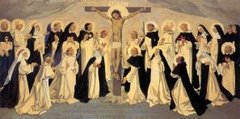
At the Foot of the Cross
With Saint Dominic
Oct 16, 2010

With Saint Dominic
Oct 16, 2010

Why do we suffer?
What can we do about it?
What is the response in Faith to our suffering?
On Saturday, October 16th at 9AM at the Cathedral of St. John in Boise,
join Fr. Vincent Serpa, O.P., for the day to explore the life of faith
and the Catholic response to the cross through the eyes of St. Dominic.
Fr. Serpa is the Chaplain of Catholic Answers, and a regular guest
on Catholic Answers Live radio program.
The Freedom of Authority
The Freedom of Authority(*) Romantic, in this context, refers to “Adventurous”
Stevenson once said that not on bread alone doth man live, but principally on catchwords. High-sounding phrases often go rattling by like express-trains, carrying the burden of those who are too lazy to think for themselves. Among these phrases or catchwords there is none in the field of religion which has greater modern appeal than this one: The modern man wants a religion of the spirit, and not a religion of authority.” Years ago its popular expression was that “we must be free from the slavery of Rome.” Today it is more direct: “No Catholic can be free because he is bound down by law and authority.”
There is no doubting the sincerity of those who accept such catchwords: hence there can be no doubt that they will accept a sincere explanation of the teaching of the church concerning authority, law, and freedom which for the sake of clearness may be set down in these three following propositions: First, the necessity of law and authority; secondly, obedience to the highest law and authority constitutes freedom; thirdly, the obedience to the law and authority of the Church is thrilling and romantic(*).
First: It is false to say that we can be absolutely free from law and authority, for freedom from law and authority is an illusion. The real problem is not whether we will accept law and authority, but rather, which law and authority we will accept. Even though this is a free country, I find that if I do not obey the authority of my government, then I shall have to accept the authority of a warden; if I do not accept the authority of the pure-food commission, then I shall have to accept the authority of the undertaker; if I do not accept the authority of the traffic lights, I shall have to accept the authority of the jailer. In religious matters, if I do not accept the authority of the Church, then I must accept the authority of public opinion. Public opinion is the common stalk of thought and sentiment created by human society, and in the realm of religion outside the Church it is practically always a compromise.
Modern religion affirms just as much spiritual and moral truth as in a given condition will keep society together – just so much and no more. It affirms not the whole law of God, but extracts from it, and only those extracts which seem to be the most useful for social purposes, and of which society itself will approve. For example, at the present time it dilates on the Sermon on the Mount, but says absolutely nothing about the Last judgment. It quotes, “Behold the lilies of the field,” but never the text, “What exchange shall a man give for his soul?” Again, modern religion has approved on aspect of the Divine Law concerning murder, and disapproved another, concerning divorce. The reason it does this is because public opinion believes murder to be destructive of society, but does not believe that divorce can be equally destructive of it in the long run. Religion thus compromises, or strikes and average between what is good and what is bad. It approves Christ only inasmuch as Christ approves it. It accepts His teachings and His authority only inasmuch as its maxims and its opinions approve those teachings.
Hence, the problem confronting the religious man of today is not whether he will obey of disobey law and authority; but which of the two he will obey, namely, the authority of public opinion, or the authority of Christ and tradition. And all thinking men, as a celebrated English essayist has put it, want a religion which is right, not when the world is right, but is right when the world is wrong, and by this he meant authority of the Church which holds to the teachings of Christ, even thought public opinion should cry out for the liberation of Barabbas, for the Church is built solidly upon the conviction that right is right if nobody’s right, and wrong is wrong if everybody’s wrong.
Furthermore, and here we pass to the second point, only by obedience to the highest law and authority does a man become free. Let me give a few examples to prove this point. A dictionary represents a standard in the use of words. It is a court of appeal, or an authority concerning their meaning. Now it is only by submitting to authority that I ever become free to use words. I may use the word “moon” and by it mean “cabbage”; I may use the word “cow,” and by it mean “cowslip.” I soon find, however, that I am no longer free to tell my fellow-man the story that the cow jumped over the moon. It is only by submission to law and authority that we ever become free.
Or, to take an example from the realm of arts. If an artist, in a fever of broadmindedness and a desire to be free, chooses to paint a giraffe with a short neck, he will soon discover that he will not be free to paint a giraffe at all. If in a feverish love for the new art of self-expression which obeys no law, he decides to paint a zebra without stripes, and a leopard without spots, and a triangle with four sides, he will soon discover that he is not free at all to paint even zebras, leopards, or triangles. It is only by obedience to law and authority and the inherent nature of things that we ever become free. Now man has a rational nature which means that the law of his being is practical reason of conscience. Only inasmuch as man obeys the dictates of his conscience is he free to be a man. He may choose to disobey his conscience, and he is free to become an animal, but he is not free to be a man.
A final example in the field of science: imagine a railroad locomotive, endowed with consciousness, so that it is able to read, to think, to speak. And supposing that one day it picked up with its cow-catcher one of the modern books on the morality of self-expression, such as one of Mr. Bertrand Russell’s, in which he rebels against obedience to traditional moral laws, and the authority of Christian teaching. And suppose, with its great single Cyclops eye, it reads the pages of this liberal thinker, and becomes so impressed with its fine sophistic idioms that it whistles to itself, “Mr. Russell is right. What do the engineers who designed me and imposed their laws upon me know about my inner impulses? Why should I even obey the authority of an engineer who is constantly limiting my steam pressure to one hundred pounds a square inch, when I have the vital Freudian urge to make it on hundred and fifty pounds? And, furthermore, why should I submit myself to the authority of railroad officials who, fifty years back. Laid out the tracks upon which I should run? Why should I take this curve, that straightaway, this bridge, simply because they decided over two score years ago that I should? Why should I not be permitted to choose my own directions, and to make my own tracks? From now on, I am going to be self-expressive!”
Suppose the locomotive did become so self-expressive. In refusing to obey the laws concerning steam pressure, it would discover it was no longer free to be a locomotive, because in asserting its pressure beyond the normal, it would burst its entrails; secondly, by refusing to keep on the track it would no longer be free to run. And if the locomotive did jump the track, and burst its boilers, it would not hurt the engineer who designed the track; it would hurt only itself. And so, too, if a man disobeys God’s laws, and dashes his head against them, as against an eternal rock, the rock toes not suffer – it is only the head of the man that suffers.
Finally, it is only by obedience to the laws of Christ and His Church that we ever become free. And obedience to this authority is positively thrilling, for all orthodoxy is romantic. If there is any vision or mental picture to be had at all of the condition of the world a few centuries ago and now, it might be the vision of a great rocky island in the very center of a stormy and raging sea. Previous to the breakup of Christian unity three centuries ago, this island may be represented as surrounded by a great stone wall against which the waves spent their fury, but never broke it down. Inside the wall were thousand and thousands of the children of God playing games, singing songs, and enjoying life, to the utter oblivion of the great devouring sea outside. With the dawning of the day of False Freedom, there came to the island a group of men who argued with the children in some such language as this: “Why have you permitted the Church of Rome to surround you with all her laws and dogmas? Can you not see that she has encompassed you, and has not permitted you to think for yourself or to be free and captains of your own fate? Tear down the walls! Break down the barriers! Throw off the obstacles and learn to be free!” And the children tore down the walls. One day I went back and I saw all the children huddled together in the center of the island, afraid to move, afraid to play, afraid to dance, afraid of falling into the sea.
We who, by the Grace of God, have been blessed with the protection of the Church’s law and authority, can never quite understand why any one can ever think that obedience to that law and authority is enslaving. On the contrary, it is positively romantic. The laws and doctrines of the Church are not dams which stop up the river of Thought; they are levees which prevent that river from overflowing the countryside. They are not wrenches thrown into the machinery of life, but oils which make it run more smoothly. It is easy to fall into the excesses of the modern world, just as it is easy to fall off a log. It is easy to flat down stream with the popular fancies – even dead bodies can float down stream. But it is exhilarating to fight against the current.
It is easy to be an atheist, and to say the world does not require a God, just as it is easy to be a pantheist, and say that the world is God; but it is thrilling to walk between those two abysses and hold that God is in the world, but not of it – and such is the Incarnation. It would be easy to fall into the extreme of the Stoics, and say that pain is the law of life, or to fall into the equally stupid extreme of saying pleasure is the law of life, but it is romantic to escape the pitfalls and hold that pain is the prelude to life – and such is the lesson of Easter.
It would be easy to say with Gandhi that life should be a fast, just as it would be easy to say with the pagan that it should be a feast; but it is thrilling to avoid both extremes, and hold that the fast should precede the feast. Every heresy in the history of the Church has been either a truth exaggerated to an excess, or diminished to a defect. Calvinism, for example, had a very good first principle, which is a sound Catholic principle, namely, the absolute Sovereignty of God; but Calvin carried it so far as to rule out human merit. Bolshevism, too, is grounded on a very sound Catholic principle, which is the Brotherhood of Man, but it has exaggerated it so far as to leave no room for the Sovereignty of God. And so it is easy to fall into any of these extremes, and to lose one’s intellectual balance. The thrill is in keeping it.
In other words, the Church is not so much to be compared with the Niagara Falls, as it is to be compared with a great and tremendous Rock weighing ten thousand tons, which is poised on another rock by the delicate balance of no more than six inches of a base. Niagara is a falls, simply because it cannot help falling; it is the easiest thing to do; it is simply letting things go. But that great Rock, which is pitched on a base no bigger than one’s hand, has a thousand angles at which it will fall, but there is only one on which it will stand, and it is that which makes falling a far more serious thing than the falling and churning of all of Niagara’s waters. And so with the Church. All through her history she has been like that great Rock, poised on the brink of an abyss, and it is that which has made her romantic; for danger is the rood and foundation of all romance in drama.
Why do children like to play robber, walk picket fences, tramp into thick woods, play along banks of deep rivers, throw stones at vicious dogs, listen to blood-curdling ghost stories, walk on roofs? Is it not because each and every child has deep-rooted in his heart as the foundation of his manhood, and as the very condition for his enjoying life, the love of danger and the thrill of being near it, and yet never falling completely into it? Why do children, when they grow up into man’s estate, love to play games of chance, hunt wild beasts, explore the icy extremities of the earth, fly over trackless seas, speed at the rate of four mils a minute of land, five miles a minute in the air; if it is not because they, too, love the thrill that comes with danger, and love still more the glorious escape from that to which they have so often exposed themselves? And what is true of children and true of men, is true of the Church. It is extremely thrilling to belong to the Church. It is exhilarating to be orthodox. It is romantic to be poised on the Rock of Peter that could fall into a thousand pitfalls, and yet never does.
Every person has an instinctive desire to witness a storm at sea, provided he could be sure of reaching port. We who ride in Peter’s bark witness such a storm, and know we will reach port. For twenty centuries the bark of Peter has been riding, riding the seas, and for twenty centuries we who have been on board know the romance of the seas and its dangers, but also the romance of a port. Sometimes that bark has come within a hair’s breath of dashing against the rocks, of saying that Christ was man and not God, and then again it has suddenly to swerve to avoid crashing into the opposite rock and saying that Christ is God but not man. At other moments in her voyage, Peter’s bark has come within a razor’s edge of being stranded on the sands of humanism and saying that man does everything, and God does nothing. And then, by and equally dexterous move, she saves herself from the sand-bars of declaring with the oriental mystics that God does everything and man does nothing. It would have been extremely easy for Peter and his successors to have sunk their ship in the depths of determinism, just as it would have been very easy for the ship to have capsized in the shallow waters of sentimentalism in the twentieth century. But it is wonderfully thrilling to have avoided both. It would have been very easy for the bark of Peter to have been lost in the fogs of Modernism, just as it would have been easy for it to have lost its course in the mists of Fundamentalism. But to have avoided both of these snares, not by mere chance, but by intellectual direction, is thrilling. If one small blunder, concerning the doctrine of original sin, were made in her twenty centuries of charting the course of men to God, huge blunders would have been made in human happiness. A mistranslation of a single word a thousand years ago, might have smashed all the statues of Europe. A false move at the Council of the Vatican might have impoverished reason. By one single slip, the Church might have stopped all the dances, withered all the Christmas trees, and broken all the Easter eggs.
But the Church has avoided all these pitfalls and all these errors, and as the bark of Peter, with sails flying high, cuts the waters of the sea, she looks before and aft. Behind her she can see the shriveled hulks of a thousand heresies and mental fashions that were suited to their times and died because hat is all they were suited for – their times. Before her she can see the shipwrecked rafts of Masterless men looking for the Master Peter who is not for one time but for all time. And now its future will be just as thrilling as the past. Always in danger, always escaping it; always threatened, always conquering; always enjoying the romance of avoiding extremes, the bark is destined to go on through all the storms and tempests of the world, until one day it checks pace at the hid battlements of eternity, and there as the children disembark from the ship of Peter, they will understand why it avoided the snares and pitfalls – because Peter stood at the helm of his bark, there rested on his hands the invisible, eternal hands of Christ, whom the winds and the seas obey; Christ, who steers the sun and moon and stars in their courses.
-Fulton J. Sheen, “Moods and Truths”, 1932
Monday, September 06, 2010
New Master General elected Sunday

Fr. Bruno Cadoré,O.P.
From the Elmira Dominican Contemplative nuns:
Today, September 5, the delegates gathered at the General Chapter of the Dominicans (Order of Preachers) have elected Fr. Bruno Cadoré,O.P., until now Prior of the Province of France, and a specialist in Bio-medical ethics (Bioethics), as Master of the Order.
Before Provincial Superior, Fr Cadoré was for many years Master of Dominican students in Lille, while being physician and professor of biomedical ethics at the Catholic University of that city in northeastern France.
In recognition of his worth in the field of bioethics, he was appointed in 2008 as a member of the National AIDS Council by the President of the Republic.
Wednesday, September 01, 2010
Duc in altum
From: Luke 5:1-11
The Miraculous Catch of Fish and the Calling of the First Disciples
While the people pressed upon Him (Jesus) to hear the word of God, He was standing by the Lake of Gennesaret. And He saw two boats by the lake, but the fishermen had gone out of them and were washing their nets. Getting into one of the boats, which was Simon's, He asked him to put out a little from the land. And He sat down and taught the people from the boat. And when He had ceased speaking, He said to Simon, "Put out into the deep and let down your nets for a catch." And Simon answered, "Master, we toiled all night and took nothing! But at your word I will let down the nets." And when they had done this, they enclosed a great shoal of fish; and as their nets were breaking, they beckoned to their partners in the other boat to come and help them. And they came and filled both the boats, so that they began to sink. But when Simon Peter saw it, he fell down at Jesus' knees, saying, "Depart from me, for I am a sinful man, O Lord." For he was astonished, and all that were with Him, at the catch of fish which they had taken; And so also were James and John, sons of Zebedee, who were partners with Simon. And Jesus said to Simon, "Do not be afraid; henceforth you will be catching men." And when they had brought their boats to land, they left everything and followed Him.
I have been told again and again by Catholics, even Dominicans, that the path to peace is not through preaching the Gospel of Jesus Christ, the Prince of Peace, but through the world’s political organs and processes. And with this, we wonder why we do not obtain peace. We do not produce a catch because we are fishing in the wrong waters! Those who put their trust in the political systems of men, have forgotten that man is a fallen creature, that no system, no matter how perfect, will produce the just society because in the end society is but the fellowship of men. Bring men to grace, on the other hand, and regardless of the system, their society will increasingly reflect the justice of God. Thus, we produce no catch because we are fishing in the dark of night. Fish in the light, the Light of Christ, and the catch will surprise you.
The Miraculous Catch of Fish and the Calling of the First Disciples
While the people pressed upon Him (Jesus) to hear the word of God, He was standing by the Lake of Gennesaret. And He saw two boats by the lake, but the fishermen had gone out of them and were washing their nets. Getting into one of the boats, which was Simon's, He asked him to put out a little from the land. And He sat down and taught the people from the boat. And when He had ceased speaking, He said to Simon, "Put out into the deep and let down your nets for a catch." And Simon answered, "Master, we toiled all night and took nothing! But at your word I will let down the nets." And when they had done this, they enclosed a great shoal of fish; and as their nets were breaking, they beckoned to their partners in the other boat to come and help them. And they came and filled both the boats, so that they began to sink. But when Simon Peter saw it, he fell down at Jesus' knees, saying, "Depart from me, for I am a sinful man, O Lord." For he was astonished, and all that were with Him, at the catch of fish which they had taken; And so also were James and John, sons of Zebedee, who were partners with Simon. And Jesus said to Simon, "Do not be afraid; henceforth you will be catching men." And when they had brought their boats to land, they left everything and followed Him.
I have been told again and again by Catholics, even Dominicans, that the path to peace is not through preaching the Gospel of Jesus Christ, the Prince of Peace, but through the world’s political organs and processes. And with this, we wonder why we do not obtain peace. We do not produce a catch because we are fishing in the wrong waters! Those who put their trust in the political systems of men, have forgotten that man is a fallen creature, that no system, no matter how perfect, will produce the just society because in the end society is but the fellowship of men. Bring men to grace, on the other hand, and regardless of the system, their society will increasingly reflect the justice of God. Thus, we produce no catch because we are fishing in the dark of night. Fish in the light, the Light of Christ, and the catch will surprise you.
Saturday, August 28, 2010
Happy Feast Day of St Augustine
I am working on moving today, so I don't have a lot to offer here other than to thank the Lord for St. Augustine, whose "Confessions" led me to the Catholic Church. That which the heart desires he found, as so many have, and he so eloquently pointed out the narrow way.

St. Augustine, pray for us!
God bless you today.
mark

St. Augustine, pray for us!
God bless you today.
mark
Tuesday, August 24, 2010
Lies, lies, and damn lies
Where goes truth?
Human Rights Watch Incorrectly Charges Argentina with Treaty Violations over Abortion
By Seana Cranston, J.D.
NEW YORK, August 19 (C-FAM) A report released last week by the human rights advocacy group Human Rights Watch promotes abortion in Argentina and criticizes Argentina for not complying with international law. The report, “Illusions of Care: Lack of Accountability for Reproductive Rights in Argentina,” charges that “[i]n Argentina, nationalistic interests combined with an orthodox Catholic discourse on ‘family values’ have historically underpinned some of the most anti-contraception and pro-population-growth policies in the region.”
The report erroneously cites several international human rights treaties and committees, including the Committee on the Elimination of Discrimination against Women (CEDAW), and the International Covenant on Civil and Political Rights (ICCPR), for its claim that international law requires Argentina to provide abortion-on-demand. In fact, no international human rights treaty contains a right to abortion. When CEDAW and ICCPR were negotiated, many of the negotiating countries had pro-life laws on the books that still remain in place today.
“Illusions of Care” further suggests that two other international treaties—the Convention on the Rights of the Child (CRC), and the International Covenant on Economic, Social and Cultural Rights (ICESCR)—require that Argentina allow adolescents the right to contraception or an abortion without the consent of their parents. These two treaties do not mention abortion or contraception, and while the committees that oversee them can issue advisory opinions, they do not have the authority to make binding interpretations of treaty provisions.
The CRC specifically contains a “right to life” provision, which states that “every child has the inherent right to life . . . . States Parties shall ensure . . . the survival and development of the child.” The preamble of the CRC calls for “appropriate legal protection, before as well as after birth” for the child. The ICCPR states, “every human being has the inherent right to life. This right shall be protected by law. No one shall be arbitrarily deprived of his life.”
“Illusions of Care” also appears to suggest that one of the newest international treaties ratified by Argentina, the Convention on the Rights of Persons with Disabilities (CRPD), requires Argentina to allow abortion-on-demand for its citizens with disabilities. For example, the report cites language in CRPD that states that persons with disabilities are entitled to the same standard of health care as provided to other persons, “including in the area of sexual and reproductive health.” The word abortion is not mentioned in the CRPD, however, and more than a dozen countries made explicit statements upon the adoption of CRPD by the UN General Assembly that nothing in the treaty could be interpreted to establish any new rights, including a right to abortion.
Monday, August 23, 2010
Peter Simon visits St. Dominic
Boise's own Peter Simon visited St. Dominic's Basilica in Bologna, Italy. He attended the August Chapter meeting and presented pictures he took, along with a brief presentation. Following are his pictures, and below that his written presentation.
Thank you Peter, well done!
Bologna, Italy.

Front of St. Dominic Basilica.

Exterior of St. Dominic Basilica.

Exterior of St. Dominic Basilica.

Exterior of St. Dominic Basilica.

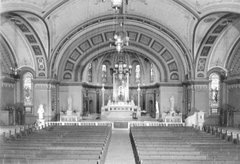
High altar of St. Dominic Basilica. Note the white interior - "Lily of Purity."

Another view.

Mysteries of the Rosary side altar

Sacred Heart side altar

Mysteries of the Rosary


Page from St. Dominic's breviary(?)

Papal bull establishing the Order of Preachers

table (altar?) on which miracle of loaves occurred. plus two unidentified relics in case.

Thank you Peter, well done!
Bologna, Italy.

Front of St. Dominic Basilica.

Exterior of St. Dominic Basilica.

Exterior of St. Dominic Basilica.

Exterior of St. Dominic Basilica.

High altar of St. Dominic Basilica. Note the white interior - "Lily of Purity."

Another view.

Mysteries of the Rosary side altar

Sacred Heart side altar

Mysteries of the Rosary

Tomb of St. Dominic/altar & ceiling

Ceiling above tomb


Tomb/altar. Carving by MichaelAngelo

Reliquary containing head of St Dominic located behind tomb

Photos in original church during visit of John Paul II. Basilica is built over original church which is preserved within and accessed from main church

In original church are various relics and items of historical note:

Bull of canonization of St. Dominic, bearing papal seal

Page from St. Dominic's breviary(?)

Papal bull establishing the Order of Preachers

table (altar?) on which miracle of loaves occurred. plus two unidentified relics in case.

St. Dominic
Founder of the Order of Preachers, commonly known as the Dominican Order; born at Calaroga, in Old Castile, c. 1170; died 6 August, 1221.
That Dominic and his companions might possess a fixed source of revenue Foulques made him chaplain of Fanjeaux and in July, 1215, canonically established the community as a religious congregation of his diocese, whose mission was the propagation of true doctrine and good morals, and the extirpation of heresy. During this same year Pierre Seilan, a wealthy citizen of Toulouse, who had placed himself under the direction of Saint Dominic, put at their disposal his own commodious dwelling. In this way the first convent of the Order of Preachers was founded on 25 April, 1215.
In November, 1215, an ecumenical council was to meet at Rome (The Fourth Lateran Council) "to deliberate on the improvement of morals, the extinction of heresy, and the strengthening of the faith". This was identically the mission Saint Dominic had determined on for his order. With the Bishop of Toulouse, he was present at the deliberations of this council. From the very first session it seemed that events conspired to bring his plans to a successful issue. The council bitterly arraigned the bishops for their neglect of preaching. In canon X they were directed to delegate capable men to preach the word of God to the people. Under these circumstances, it would reasonably appear that Dominic's request for confirmation of an order designed to carry out the mandates of the council would be joyfully granted.
Returning to Languedoc at the close of the council in December, 1215, the founder gathered about him his little band of followers and informed them of the wish of the council that there should be no new rules for religious orders.
This done, Saint Dominic again appeared before the pope in the month of August, 1216, and again solicited the confirmation of his order. This time he was received more favourably, and on 22 December, 1216, the Bull of confirmation was issued.
(St. Dominic arrived at Rome with a copy of his rules in September, 1216. He found access to his Holiness difficult for some time but was encouraged by a vision recorded by Theodoric, and copied by Fleury. * Pope Honorius III confirmed his Order and its constitutions by two bulls, both dated on the 26th of December, the same year.)
St. Dominic went again to Rome in 1217 and the Pope desiring that his Order should have a house in that city, gave him the church of St. Sixtus.
On his return to Rome, towards the end of December of 1219, Dominic sent out letters to all the convents announcing the first general chapter of the order, to be held at Bologna on the feast of the following Pentecost. In December of 1219 Pope Honorius III, by a special Brief , had conferred upon the founder the title of Master General, which till then he had held only by tacit consent.
Towards the end of 1221 Saint Dominic returned to Rome for the sixth and last time. Here he received many new and valuable concessions for the order. In January, February, and March of 1221 three consecutive Bulls were issued commending the order to all the prelates of the Church. The thirtieth of May, 1221, found him again at Bologna presiding over the second general chapter of the order. At the close of the chapter he set out for Venice to visit Cardinal Ugolino, to whom he was especially indebted for many substantial acts of kindness. He had scarcely returned to Bologna when a fatal illness attacked him. He died after three weeks of sickness, the many trials of which he bore with heroic patience. In a Bull dated at Spoleto, 13 July, 1234, Gregory IX made his cult obligatory throughout the Church.
On August 6, 1221, Dominic died, only fifty-one years old.
We are not surprised, therefore, that, after signing the Bull of canonization on 13 July, 1234, Pope Gregory IX declared that he no more doubted the saintliness of Saint Dominic than he did that of Saint Peter and Saint Paul.
Tuesday, August 10, 2010
Getting real
This is some remarkable footage from the Center for Bio-Ethical Reform. One needs to confront the reality of what is going on.

Friday, August 06, 2010
The Message of Fatima
Copied from Friar's blog:
A New Documentary about the Jesuits at Hiroshimahat tip to the Dominican Friars of the Eastern Province
Finding Fatima is a documentary that opens on Hiroshima August 6, 1945. Eight Jesuit priests living just a few blocks from the blast site not only miraculously survived but had no effects of the radiation. Everyone else within a radius of roughly 1.5 Kilometres was reportedly killed instantly, and those outside the range died of radiation within days. However, the only physical harm to Fr. Shiffer, S.J., was that he could feel a few pieces of glass in the back of his neck. the priests have been examined over 200 times by scientists. Each time the priests repeated the same explanation for their survival: "We believe that we survived because we were living the message of Fatima."
Click here for to for more information.
Sheen on peace
I remember in preparation for an Easter broadcast writing into the text, "Poland was crucified by two thieves; the two thieves being the Nazis and the Soviets." I received a telegram from one of me censors telling me that I would not be permitted to say that over the readio. I sent the censor a telegram saying, "Would it be all right to call Russia the good thief?" He did not think it a bit funny.
If true peace is to be won, it must first be won in our own hearts. Let us turn back to God and establish justice in our souls. Russia will perish because it is anti-God; but we shall not survive if [] we are Godless. If we put ourselves on God's side, then who shall be against us? May God keep our minds clear and our hearts pure, that we may never be deceived by the false peace []. as Dante put it, "In Thy Will, God, is our peace."
"Life Is Worth Living", Fulton J. Sheen, 1953
Thursday, August 05, 2010
O.P.L. defined
Thank you Christopher, for the lovely definition I found at your link
Ite ad Thomam
O.P.L. = "Out of Print Library"
I suppose a Lay Dominican of the faith is a walking out-of-print library today.
Now I thought that was fairly humorous, and figured you might need a humor-check today!
Ite ad Thomam
O.P.L. = "Out of Print Library"
I suppose a Lay Dominican of the faith is a walking out-of-print library today.
Now I thought that was fairly humorous, and figured you might need a humor-check today!
Quotable Alice Von Hildebrand
"God has set limits on man's intelligence, none on his stupidity.."
from the essay which follows below
from the essay which follows below
Wednesday, August 04, 2010
Clash of the Titan
From "The Moynihan Report" - Dr. Alice Von Hildebrand takes on Christopher West and the serious problems in the way he presents "Theology of the Body." Since "The Moynihan Report" is currently offline, I've provided a link to the article. Dr. Moynihan has done an excellent job of providing background for this sensitive discussion.
and yes, I know that the movie title is "Clash of the Titans" but there is only one deserving the title here. not to give away my position, but her initials are Alice Von Hildebrand.
A Theological Debate Heats Up
By Robert Moynihan
What is the right relationship between sex and sanctity? That's what many Catholics in the US are asking as a simmering theological debate over the "Theology of the Body" threatens to boil over and further test the unity of the Church in the US. The debate touches on issues ranging from the doctrine of original sin to the legacy of Pope John Paul II. And the hierarchy itself seems divided...
Click to read full article.
and yes, I know that the movie title is "Clash of the Titans" but there is only one deserving the title here. not to give away my position, but her initials are Alice Von Hildebrand.
Tuesday, August 03, 2010


Subscribe to:
Posts (Atom)