SAPIENTIAE CHRISTIANAE
ON CHRISTIANS AS CITIZENS
ENCYCLICAL OF POPE LEO XIII JANUARY 10, 1890
20. In the case of those who profess to take reason as their sole guide, there would hardly be found, if, indeed, there ever could be found, unity of doctrine. Indeed, the art of knowing things as they really are is exceedingly difficult; moreover, the mind of man is by nature feeble and drawn this way and that by a variety of opinions, and not seldom led astray by impressions coming from without; and, furthermore, the influence of the passions oftentimes takes away, or certainly at least diminishes, the capacity for grasping the truth. On this account, in controlling State affairs means are often used to keep those together by force who cannot agree in their way of thinking.
Wednesday, January 25, 2006


Saturday, January 21, 2006
Leo XIII: ON THE ABOLITION OF SLAVERY (abortion)
Read the following:
++++++++++++++++++++++++++++
ON THE ABOLITION OF SLAVERY
IN PLURIMIS
Encyclical of Pope Leo XIII promulgated on May 5, 1888.
5. The system flourished even among the most civilized peoples, among the Greeks and among the Romans, with whom the few imposed their will upon the many; and this power was exercised so unjustly and with such haughtiness that a crowd of slaves was regarded merely as so many chattels -- not as persons, but as things. They were held to be outside the sphere of law, and without even the claim to retain and enjoy life. "Slaves are in the power of their masters, and this power is derived from the law of nations; for we find that among all nations masters have the power of life and death over their slaves, and whatever a slave earns belongs to his master."[6] Owing to this state of moral confusion it became lawful for men to sell their slaves, to give them in exchange, to dispose of them by will, to beat them, to kill them, to abuse them by forcing them to serve for the gratification of evil passions and cruel superstitions; these things could be done, legally, with impunity, and in the light of heaven. Even those who were wisest in the pagan world, illustrious philosophers and learned jurisconsults, outraging the common feeling of mankind, succeeded in persuading themselves and others that slavery was simply a necessary condition of nature. Nor did they hesitate to assert that the slave class was very inferior to the freemen both in intelligence and perfection of bodily development, and therefore that slaves, as things wanting in reason and sense, ought in all things to be the instruments of the will, however rash and unworthy, of their masters. Such inhuman and wicked doctrines are to be specially detested; for, when once they are accepted, there is no form of oppression so wicked but that it will defend itself beneath some color of legality and justice.
http://www.papalencyclicals.net/Leo13/l13abl.htm
++++++++++++++++++++++++++++++++++++++++++++
Now read it again, substituting "unborn" for "slave" ...
++++++++++++++++++++++++++++
ON THE ABOLITION OF SLAVERY
IN PLURIMIS
Encyclical of Pope Leo XIII promulgated on May 5, 1888.
5. The system flourished even among the most civilized peoples, among the Greeks and among the Romans, with whom the few imposed their will upon the many; and this power was exercised so unjustly and with such haughtiness that a crowd of slaves was regarded merely as so many chattels -- not as persons, but as things. They were held to be outside the sphere of law, and without even the claim to retain and enjoy life. "Slaves are in the power of their masters, and this power is derived from the law of nations; for we find that among all nations masters have the power of life and death over their slaves, and whatever a slave earns belongs to his master."[6] Owing to this state of moral confusion it became lawful for men to sell their slaves, to give them in exchange, to dispose of them by will, to beat them, to kill them, to abuse them by forcing them to serve for the gratification of evil passions and cruel superstitions; these things could be done, legally, with impunity, and in the light of heaven. Even those who were wisest in the pagan world, illustrious philosophers and learned jurisconsults, outraging the common feeling of mankind, succeeded in persuading themselves and others that slavery was simply a necessary condition of nature. Nor did they hesitate to assert that the slave class was very inferior to the freemen both in intelligence and perfection of bodily development, and therefore that slaves, as things wanting in reason and sense, ought in all things to be the instruments of the will, however rash and unworthy, of their masters. Such inhuman and wicked doctrines are to be specially detested; for, when once they are accepted, there is no form of oppression so wicked but that it will defend itself beneath some color of legality and justice.
http://www.papalencyclicals.net/Leo13/l13abl.htm
++++++++++++++++++++++++++++++++++++++++++++
Now read it again, substituting "unborn" for "slave" ...
Thursday, January 12, 2006
Will the real Vatican II please stand up?
As we enter a new year, we remember that is has been 40 years since the council. On Dec 22, Benedict XVI pointed out that there are two conflicting views of what that council was and what it did. The pope points out that there are two conflicting views of the council. That which he calls the "hermeneutics of discontinuity and rupture" "between the pre-conciliar and post-conciliar Church" is set in opposition to what he calls "the hermeneutics of reform."
It is my observation that the underlying error that motivates the "hermeneutics of discontinuity and rupture" is materialism, a loss of effective belief in the supernatural; perhaps what John Paul II meant by "a loss of the sense of the sacred." The quote from Newman in the previous post I think expresses it well. The mission of the Church is the salvation of souls. A materialist view cannot agree with what Newman has written, and so will write it off, placing work for material ends above our supernatural end.
The materialist today likes to pretend that they have a corner on compassion, and that the pre-conciliar church was somehow less compassionate. I find this to be contradictory to the historical reality. The Church has brought us hospitals, schools, universities; it is the religious materialists who have abandoned those institutions of humble service to the material needs of others, and then they calumniate others for lack of compassion?
The full text from the pope is here:
http://www.chiesa.espressonline.it/dettaglio.jsp?id=44072&eng=y
It is my observation that the underlying error that motivates the "hermeneutics of discontinuity and rupture" is materialism, a loss of effective belief in the supernatural; perhaps what John Paul II meant by "a loss of the sense of the sacred." The quote from Newman in the previous post I think expresses it well. The mission of the Church is the salvation of souls. A materialist view cannot agree with what Newman has written, and so will write it off, placing work for material ends above our supernatural end.
The materialist today likes to pretend that they have a corner on compassion, and that the pre-conciliar church was somehow less compassionate. I find this to be contradictory to the historical reality. The Church has brought us hospitals, schools, universities; it is the religious materialists who have abandoned those institutions of humble service to the material needs of others, and then they calumniate others for lack of compassion?
The full text from the pope is here:
http://www.chiesa.espressonline.it/dettaglio.jsp?id=44072&eng=y
An Observation from Newman
The Church aims, not at making a show, but at doing a work. She regards this world, and all that is in it, as a mere shadow, as dust and ashes, compared with the value of one single soul. She holds that, unless she can, in her own way, do good to souls, it is no use her doing anything; she holds that it were better for sun and moon to drop from heaven, for the earth to fail, and for all the many millions who are upon it to die of starvation in extremest agony, so far as temporal affliction goes, than that one soul, I will not say, should be lost, but should commit one single venial sin, should tell one wilful untruth, though it harmed no one, or steal one poor farthing without excuse. She considers the action of this world and the action of the soul simply incommensurate, viewed in their respective spheres; she would rather save the soul of one single wild bandit of Calabria, or whining beggar of Palermo, than draw a hundred lines of railroad through the length and breadth of Italy, or carry out a sanitary reform, in its fullest details, in every city of Sicily, except so far as these great national works tended to some spiritual good beyond them. (Lectures on Anglican Difficulties, #8)
Tuesday, January 03, 2006
sola scriptura = human reason alone
This remarkable set of paragraphs point out something interesting. Although it speaks to the so-called "rationalist" and compares this to the faith of the Church, I think it also reveals something else, perhaps beyond what was intended, but true none the less.
Leo XIII
SAPIENTIAE CHRISTIANAE
ON CHRISTIANS AS CITIZENS
http://www.papalencyclicals.net/Leo13/l13sapie.htm
20. In the case of those who profess to take reason as their sole guide, there would hardly be found, if, indeed, there ever could be found, unity of doctrine. Indeed, the art of knowing things as they really are is exceedingly difficult; moreover, the mind of man is by nature feeble and drawn this way and that by a variety of opinions, and not seldom led astray by impressions coming from without; and, furthermore, the influence of the passions oftentimes takes away, or certainly at least diminishes, the capacity for grasping the truth. On this account, in controlling State affairs means are often used to keep those together by force who cannot agree in their way of thinking.
21. It happens far otherwise with Christians; they receive their rule of faith from the Church, by whose authority and under whose guidance they are conscious that they have beyond question attained to truth. Consequently, as the Church is one, because Jesus Christ is one, so throughout the whole Christian world there is, and ought to be, but one doctrine: "One Lord, one faith;"[22] "but having the same spirit of faith,"[23] they possess the saving principle whence proceed spontaneously one and the same will in all, and one and the same tenor of action.
22. Now, as the Apostle Paul urges, this unanimity ought to be perfect. Christian faith reposes not on human but on divine authority, for what God has revealed "we believe not on account of the intrinsic evidence of the truth perceived by the natural light of our reason, but on account of the authority of God revealing, who cannot be deceived nor Himself deceive."[24] It follows as a consequence that whatever things are manifestly revealed by God we must receive with a similar and equal assent. To refuse to believe any one of them is equivalent to rejecting them all, for those at once destroy the very groundwork of faith who deny that God has spoken to men, or who bring into doubt His infinite truth and wisdom. To determine, however, which are the doctrines divinely revealed belongs to the teaching Church, to whom God has entrusted the safekeeping and interpretation of His utterances. But the supreme teacher in the Church is the Roman Pontiff. Union of minds, therefore, requires, together with a perfect accord in the one faith, complete submission and obedience of will to the Church and to the Roman Pontiff, as to God Himself. This obedience should, however, be perfect, because it is enjoined by faith itself, and has this in common with faith, that it cannot be given in shreds; nay, were it not absolute and perfect in every particular, it might wear the name of obedience, but its essence would disappear. Christian usage attaches such value to this perfection of obedience that it has been, and will ever be, accounted the distinguishing mark by which we are able to recognize Catholics. Admirably does the following passage from St. Thomas Aquinas set before us the right view: "The formal object of faith is primary truth, as it is shown forth in the holy Scriptures, and in the teaching of the Church, which proceeds from the fountainhead of truth. It follows, therefore, that he who does not adhere, as to an infallible divine rule, to the teaching of the Church, which proceeds from the primary truth manifested in the holy Scriptures, possesses not the habit of faith; but matters of faith he holds otherwise than true faith. Now, it is evident that he who clings to the doctrines of the Church as to an infallible rule yields his assent to everything the Church teaches; but otherwise, if with reference to what the Church teaches he holds what he likes but does not hold what he does not like, he adheres not to the teaching of the Church as to an infallible rule, but to his own will."[25]
23. "The faith of the whole Church should be one, according to the precept (1 Cor. 1:10): "Let all speak the same thing, and let there be no schisms among you"; and this cannot be observed save on condition that questions which arise touching faith should be determined by him who presides over the whole Church, whose sentence must consequently be accepted without wavering. And hence to the sole authority of the supreme Pontiff does it pertain to publish a new revision of the symbol, as also to decree all other matters that concern the universal Church."[26]
-----------------------------------
Now that you've read it, go back and read the first bolded sentence, and replace "reason" with "the bible" . . .
At least the rationalist is honest in claiming human reason alone. The sola-scripturist is using the same tool, but not admitting it. The proof is the resulting dis-unity of doctrine.
Leo XIII
SAPIENTIAE CHRISTIANAE
ON CHRISTIANS AS CITIZENS
http://www.papalencyclicals.net/Leo13/l13sapie.htm
20. In the case of those who profess to take reason as their sole guide, there would hardly be found, if, indeed, there ever could be found, unity of doctrine. Indeed, the art of knowing things as they really are is exceedingly difficult; moreover, the mind of man is by nature feeble and drawn this way and that by a variety of opinions, and not seldom led astray by impressions coming from without; and, furthermore, the influence of the passions oftentimes takes away, or certainly at least diminishes, the capacity for grasping the truth. On this account, in controlling State affairs means are often used to keep those together by force who cannot agree in their way of thinking.
21. It happens far otherwise with Christians; they receive their rule of faith from the Church, by whose authority and under whose guidance they are conscious that they have beyond question attained to truth. Consequently, as the Church is one, because Jesus Christ is one, so throughout the whole Christian world there is, and ought to be, but one doctrine: "One Lord, one faith;"[22] "but having the same spirit of faith,"[23] they possess the saving principle whence proceed spontaneously one and the same will in all, and one and the same tenor of action.
22. Now, as the Apostle Paul urges, this unanimity ought to be perfect. Christian faith reposes not on human but on divine authority, for what God has revealed "we believe not on account of the intrinsic evidence of the truth perceived by the natural light of our reason, but on account of the authority of God revealing, who cannot be deceived nor Himself deceive."[24] It follows as a consequence that whatever things are manifestly revealed by God we must receive with a similar and equal assent. To refuse to believe any one of them is equivalent to rejecting them all, for those at once destroy the very groundwork of faith who deny that God has spoken to men, or who bring into doubt His infinite truth and wisdom. To determine, however, which are the doctrines divinely revealed belongs to the teaching Church, to whom God has entrusted the safekeeping and interpretation of His utterances. But the supreme teacher in the Church is the Roman Pontiff. Union of minds, therefore, requires, together with a perfect accord in the one faith, complete submission and obedience of will to the Church and to the Roman Pontiff, as to God Himself. This obedience should, however, be perfect, because it is enjoined by faith itself, and has this in common with faith, that it cannot be given in shreds; nay, were it not absolute and perfect in every particular, it might wear the name of obedience, but its essence would disappear. Christian usage attaches such value to this perfection of obedience that it has been, and will ever be, accounted the distinguishing mark by which we are able to recognize Catholics. Admirably does the following passage from St. Thomas Aquinas set before us the right view: "The formal object of faith is primary truth, as it is shown forth in the holy Scriptures, and in the teaching of the Church, which proceeds from the fountainhead of truth. It follows, therefore, that he who does not adhere, as to an infallible divine rule, to the teaching of the Church, which proceeds from the primary truth manifested in the holy Scriptures, possesses not the habit of faith; but matters of faith he holds otherwise than true faith. Now, it is evident that he who clings to the doctrines of the Church as to an infallible rule yields his assent to everything the Church teaches; but otherwise, if with reference to what the Church teaches he holds what he likes but does not hold what he does not like, he adheres not to the teaching of the Church as to an infallible rule, but to his own will."[25]
23. "The faith of the whole Church should be one, according to the precept (1 Cor. 1:10): "Let all speak the same thing, and let there be no schisms among you"; and this cannot be observed save on condition that questions which arise touching faith should be determined by him who presides over the whole Church, whose sentence must consequently be accepted without wavering. And hence to the sole authority of the supreme Pontiff does it pertain to publish a new revision of the symbol, as also to decree all other matters that concern the universal Church."[26]
-----------------------------------
Now that you've read it, go back and read the first bolded sentence, and replace "reason" with "the bible" . . .
At least the rationalist is honest in claiming human reason alone. The sola-scripturist is using the same tool, but not admitting it. The proof is the resulting dis-unity of doctrine.
Tuesday, December 27, 2005
Turth in Charity
I received the following from Abe Alsop, who attended our Dominican Chapter meetings until the pressing duties of family and young children overwhelmed his calendar. It's a beautiful articulation of living the faith in one's state of life, and a reminder that it is how we love, not what we know, that is the basis of the last judgement. Thank you, Abe!
I've registered TruthInCharity.org, which I think would be a good name for some sort of theological colloquium website, but I'm not sure what it would look like (let me know if you have any ideas). The name comes from something Pope Benedict said just before he was elected: "This faith, the only faith, creates unity and takes place in charity. St. Paul offers us a beautiful phrase, in opposition to the continual ups and downs of those who are like children tossed by the waves, to bring about truth in charity, as fundamental formula of Christian existence. Truth and charity coincide in Christ. In the measure that we come close to Christ, also in our life, truth and charity are fused. Charity without truth would be blind; truth without charity would be like 'a clanging cymbal' " And St. Dominic is attributed as saying he learned more from Charity than from any text, for "it teaches everything". I guess that's a good thing for me to remember at this stage in life, where my actions are hopefully speaking louder than the few words I
manage to ponder. I was raised (by a Lutheran pastor) to be very theological, and that continued in full force as I converted to the Church, and my year or two with the Dominicans was actually one of my last expressions of that mindset before I surrendered to this new phase of life where it's all I can do to just keep my family running smoothly. Maybe one day I will be able to ponder theologically for hours at a time again, but God knew I needed a decade or two of basic training in charity to ensure that my ideals take on flesh and dwell among us.
Friday, December 23, 2005
The birth of the first Apostle
On Dec 25 we will celebrate the birth of Jesus for the salvation of mankind. Christ, Savior, Prince of Peace, Emmanuel, Son of Man, these are all common titles by which we know him. Perhaps one of the more common terms he used for himself is the most overlooked. We do well to remember that Jesus is the first Apostle. Perhaps this title does not readily come to mind because we regularly read the translation instead. His own constant witness is that he was “sent” (1)
As it is evident that Jesus was sent, so it also is evident that Jesus gathered others around him and “sent” them as He was sent, by and with His authority (2).
And that they chose and sent successors, as He authorized them to do (3).
Because Jesus promised to be with us forever, this will always be (4).
(1) Jn 4:34 5:24, 5:30, 5:37, 5:36, 6:38, 6:39, 6:40, 6:58, 7:16, 7:28, 7:33, 8:16, 8:18, 8:26, 8:29, 8:42, 9:4, 11:42, 12:44, 12:45, 12:49, 13:20, 14:24, 15:21, 16:5, 17:18, 17:21, 20:21, Lk 9:48, 10:16, Mk 9:36, Mt 10:40
(2) Jn 13:20-21, 17:18-21, 20:21, Lk 10:3, 10:16, Mk 9:36, Mt 10:16, 10:40, 28:18-20
(3) Acts 1:25-26, Titus 2:15
(4) Mt. 28:20
As it is evident that Jesus was sent, so it also is evident that Jesus gathered others around him and “sent” them as He was sent, by and with His authority (2).
And that they chose and sent successors, as He authorized them to do (3).
Because Jesus promised to be with us forever, this will always be (4).
(1) Jn 4:34 5:24, 5:30, 5:37, 5:36, 6:38, 6:39, 6:40, 6:58, 7:16, 7:28, 7:33, 8:16, 8:18, 8:26, 8:29, 8:42, 9:4, 11:42, 12:44, 12:45, 12:49, 13:20, 14:24, 15:21, 16:5, 17:18, 17:21, 20:21, Lk 9:48, 10:16, Mk 9:36, Mt 10:40
(2) Jn 13:20-21, 17:18-21, 20:21, Lk 10:3, 10:16, Mk 9:36, Mt 10:16, 10:40, 28:18-20
(3) Acts 1:25-26, Titus 2:15
(4) Mt. 28:20
Monday, December 19, 2005
Pressing for Truth
A thought: If you take all of non-Catholic Christian belief, and could put it all together, and strain out the differences between A & B & C &... etc, You would end up with nothing, because all of them reject some things that others accept. You'd end up with the global world religion the UN and M. Gorbachev want to submit us to. However, if you instead put all the same beliefs together, and could strain out all the ERRORS of A & B & C & ... etc, then you'd have something. You'd have the Catholic faith, from which they all sprang as deformities based on adherance to error, because the only thing that separates non-catholics from each other and from the Catholic church are the errors.
Friday, December 09, 2005
3rd Sunday of Advent
We'll be hearing from the Gospel of John on Sunday. I found a couple of neat things in the commentary of ST. Thomas' Catena Aurea. John signifies "God's Grace," and Bethany signifies "house of obedience"
This is rather wonderful when we consider John baptizing in the Jordan beyond Bethany, for Grace transcends and perfects obedience, and it is obtained initially through baptism.
Now Martha, Mary, and Lazarus (the active life, the contemplative life, and the sinner) were particular best friends of Jesus whom he was fond of spending time with. yes, they lived in Bethany!
by this will I know that you love me, He said, if you keep my commandments.
This is rather wonderful when we consider John baptizing in the Jordan beyond Bethany, for Grace transcends and perfects obedience, and it is obtained initially through baptism.
Now Martha, Mary, and Lazarus (the active life, the contemplative life, and the sinner) were particular best friends of Jesus whom he was fond of spending time with. yes, they lived in Bethany!
by this will I know that you love me, He said, if you keep my commandments.
Wednesday, November 23, 2005
Anselm's ontological proof of God
Last Saturday’s Office of Readings contains:
When I read this I was immediately recalled to the ontological proof of St.
Anselm. Consider for a moment a rocket or a plane shooting skyward. It races upward, and at the height of travel, for a brief moment, the passengers are suspended weightless, then gravity takes over and it plunges earthward. I believe that this is how St. Anselm wishes to have us know the proof of God’s existence, not by irefutable logic, but by a direct encounter. For if we meditate on “God is that which a greater than cannot be conceived” our reason races higher and higher, until, for a brief moment, freed from material constraint, it touches “that which a greater than cannot be conceived.” But the necessity of a creature is to be pulled back to earth by the weight of the flesh. As St. Paul said, “when will I be delivered from this body of death?”
To this goal we join him in looking forward to eternal life, when the body, made like that of Jesus Christ, is no longer a body of death, and will not impede our vision of God. What eternal life is like “no eye has seen, nor has it entered into the heart of man.” Yet perhaps St. Thomas gave us a tool not unlike St. Anselm. For imagine if my joy was the sum of mine and yours, and yours the sum of yours and mine. Ours are both now increased, and for a each person added, that sum grows at an unimaginable rate, reaching heights that are inconceivable. No, it cannot be imagined, but perhaps it's magnitude can just be glimpsed for a moment...
God bless,
Mark
From a conference by St. Thomas Aquinas (Credo in Deum)
Again, eternal life consists of the joyous community of all the blessed, a
community of supreme delight, since everyone will share all that is good with all the blessed. Everyone will love everyone else as himself, and therefore will rejoice in another’s good as in his own. So it follows that the happiness and joy of each grows in proportion to the joy of all.
When I read this I was immediately recalled to the ontological proof of St.
Anselm. Consider for a moment a rocket or a plane shooting skyward. It races upward, and at the height of travel, for a brief moment, the passengers are suspended weightless, then gravity takes over and it plunges earthward. I believe that this is how St. Anselm wishes to have us know the proof of God’s existence, not by irefutable logic, but by a direct encounter. For if we meditate on “God is that which a greater than cannot be conceived” our reason races higher and higher, until, for a brief moment, freed from material constraint, it touches “that which a greater than cannot be conceived.” But the necessity of a creature is to be pulled back to earth by the weight of the flesh. As St. Paul said, “when will I be delivered from this body of death?”
To this goal we join him in looking forward to eternal life, when the body, made like that of Jesus Christ, is no longer a body of death, and will not impede our vision of God. What eternal life is like “no eye has seen, nor has it entered into the heart of man.” Yet perhaps St. Thomas gave us a tool not unlike St. Anselm. For imagine if my joy was the sum of mine and yours, and yours the sum of yours and mine. Ours are both now increased, and for a each person added, that sum grows at an unimaginable rate, reaching heights that are inconceivable. No, it cannot be imagined, but perhaps it's magnitude can just be glimpsed for a moment...
God bless,
Mark
Thursday, November 17, 2005
Farewell to Idealism
Chapter member Mike Turner OPL submitted this meditation:
I can remember a few years ago how my interest was captured in a way that I could not explain by Father Corapi's remark: "The truth is not something; it's somebody."
Today, I was paging through a book of my son's -- "Where the Right went Wrong," by Patrick Buchanan. I ran into a quote from the 19th century anarchist Sergei Nechaev. "The revolutionary...has no interests, affairs, feelings, attachments, property, not even a name that he can call his own. Everything in him is absorbed by one exclusive interest, one thought, one passion -- the revolution..."
There was a time when I would have thought that the difference between the Christian and the revolutionary (as described by Nechaev) is that the Christian is wholly dedicated to an ideal that is valid, while the revolutionary is dedicated to an invalid ideal.
But today I understood that the difference is much more basic. The Christian is not fundamentally an idealist. The object of our faith is not a set of principles. The object of our faith is the Triune God. And the work of the Christian is to save souls. Put another way, our work is to make friends for God.
This is both reassuring and sobering. Reassuring because you don't have to have special training or a spiffy IQ to make friends, just a good heart. Sobering because some of us aren't terribly good at making friends, even though it has been our proper work since early childhood. (Sobering also because of our helplessness in communicating God even to ourselves, let alone to unbelievers. I am a blind man describing what God looks like; a deaf man describing the sound of his voice.)
St. Paul doesn't preach that "X is true." Rather, he says, "I preach Jesus Christ." Not an idea, but a person.
Monday, November 14, 2005
New equipment for Chapter House

Gayle and I traveled to Twin Falls to attend a farm auction, where we acquired a nice 6' Ford Terrace Plow. Now we should be able to keep the road in better shape!
Friday, November 04, 2005
Nothing new under the sun: skill in proposing error
The following is a wonderful description of the limitation of human reason as opposed to the assistance of revelation as a guide to illuminate reason.
AETERNI PATRIS (On the Restoration of Christian Philosophy)
Encyclical of Pope Leo XIII promulgated on 4 August 1879.
9. We know that there are some who, in their overestimate of the human faculties, maintain that as soon as man's intellect becomes subject to divine authority it falls from its native dignity, and hampered by the yoke of this species of slavery, is much retarded and hindered in its progress toward the supreme truth and excellence. Such an idea is most false and deceptive, and its sole tendency is to induce foolish and ungrateful men willfully to repudiate the most sublime truths, and reject the divine gift of faith, from which the fountains of all good things flow out upon civil society. For the human mind, being confined within certain limits, and those narrow enough, is exposed to many errors and is ignorant of many things; whereas the Christian faith, reposing on the authority of God, is the unfailing mistress of truth, whom whoso followeth he will be neither enmeshed in the snares of error nor tossed hither and thither on the waves of fluctuating opinion. Those, therefore, who to the study of philosophy unite obedience to the Christian faith, are philosophizing in the best possible way; for the splendor of the divine truths, received into the mind, helps the understanding, and not only detracts in nowise from its dignity, but adds greatly to its nobility, keenness, and stability. For surely that is a worthy and most useful exercise of reason when men give their minds to disproving those things which are repugnant to faith and proving the things which conform to faith. In the first case they cut the ground from under the feet of error and expose the viciousness of the arguments on which error rests; while in the second case they make themselves masters of weighty reasons for the sound demonstration of truth and the satisfactory instruction of any reasonable person. Whoever denies that such study and practice tend to add to the resources and expand the faculties of the mind must necessarily and absurdly hold that the mind gains nothing from discriminating between the true and the false. Justly, therefore, does the Vatican Council commemorate in these words the great benefits which faith has conferred upon reason: Faith frees and saves reason from error, and endows it with manifold knowledge.[26] A wise man, therefore, would not accuse faith and look upon it as opposed to reason and natural truths, but would rather offer heartfelt thanks to God, and sincerely rejoice that, in the density of ignorance and in the flood-tide of error, holy faith, like a friendly star, shines down upon his path and points out to him the fair gate of truth beyond all danger of wandering.
10. If, venerable brethren, you open the history of philosophy, you will find all We have just said proved by experience. The philosophers of old who lacked the gift of faith, yet were esteemed so wise, fell into many appalling errors. You know how often among some truths they taught false and incongruous things; what vague and doubtful opinions they held concerning the nature of the Divinity, the first origin of things, the government of the world, the divine knowledge of the future, the cause and principle of evil, the ultimate end of man, the eternal beatitude, concerning virtue and vice, and other matters, a true and certain knowledge of which is most necessary to the human race; while, on the other hand, the early Fathers and Doctors of the Church, who well understood that, according to the divine plan, the restorer of human science is Christ, who is the power and the wisdom of God,[27] and in whom are hid all the treasures of wisdom and knowledge,[28] took up and investigated the books of the ancient philosophers, and compared their teachings with the doctrines of revelation, and, carefully sifting them, they cherished what was true and wise in them and amended or rejected all else. For, as the all-seeing God against the cruelty of tyrants raised up mighty martyrs to the defense of the Church, men prodigal of their great lives, in like manner to false philosophers and heretics He opposed men of great wisdom, to defend, even by the aid of human reason, the treasure of revealed truths. Thus, from the very first ages of the Church, the Catholic doctrine has encountered a multitude of most bitter adversaries, who, deriding the Christian dogmas and institutions, maintained that there were many gods, that the material world never had a beginning or cause, and that the course of events was one of blind and fatal necessity, not regulated by the will of Divine Providence.
Tuesday, November 01, 2005
Preparing for the hour of visitation
Next Sunday’s gospel:
"Then the kingdom of heaven will be like ten virgins who took their lamps and went out to meet the bridegroom. Five of them were foolish and five were wise. The foolish ones, when taking their lamps, brought no oil with them, but the wise brought flasks of oil with their lamps. Since the bridegroom was long delayed, they all became drowsy and fell asleep. At midnight, there was a cry, 'Behold, the bridegroom! Come out to meet him!' Then all those virgins got up and trimmed their lamps. The foolish ones said to the wise, 'Give us some of your oil, for our lamps are going out.' But the wise ones replied, 'No, for there may not be enough for us and you. Go instead to the merchants and buy some for yourselves.' While they went off to buy it, the bridegroom came and those who were ready went into the wedding feast with him. Then the door was locked. Afterwards the other virgins came and said, 'Lord, Lord, open the door for us!' But he said in reply, 'Amen, I say to you, I do not know you.' Therefore, stay awake, for you know neither the day nor the hour.
An understanding of the scriptures is influenced by our culture, the obvious example being the nature of a wedding, quite different here than what we see today! There is one other cultural perspective which we should be aware of. Jesus was speaking to the Jews of his time, people who were waiting for a messiah to deliver them. The use of ten and five in the parable would have been very significant to Jesus’ listeners; they would have immediately connected this to the ten commandments and the five books of the law, and the awaited bridegroom is none other than the awaited messiah. As a reading of the old testament will show, many under the old covenant did not prepare for his coming, while there were those who did.
From a Christian perspective this scripture can appear harsh and unforgiving. This is the mystery of free will refusing the offer of God himself. Judas certainly is the supreme example, for God wishes the conversion of sinners and wills no one to be lost. The destruction of Jerusalem shows that to fail to accept Jesus in the Hour of his visitation is not a good thing…
Lk 19:41ff As he drew near, he saw the city and wept over it, saying, "If this day you only knew what makes for peace--but now it is hidden from your eyes. For the days are coming upon you when your enemies will raise a palisade against you; they will encircle you and hem you in on all sides. They will smash you to the ground and your children within you, and they will not leave one stone upon another within you because you did not recognize the time of your visitation."
"Then the kingdom of heaven will be like ten virgins who took their lamps and went out to meet the bridegroom. Five of them were foolish and five were wise. The foolish ones, when taking their lamps, brought no oil with them, but the wise brought flasks of oil with their lamps. Since the bridegroom was long delayed, they all became drowsy and fell asleep. At midnight, there was a cry, 'Behold, the bridegroom! Come out to meet him!' Then all those virgins got up and trimmed their lamps. The foolish ones said to the wise, 'Give us some of your oil, for our lamps are going out.' But the wise ones replied, 'No, for there may not be enough for us and you. Go instead to the merchants and buy some for yourselves.' While they went off to buy it, the bridegroom came and those who were ready went into the wedding feast with him. Then the door was locked. Afterwards the other virgins came and said, 'Lord, Lord, open the door for us!' But he said in reply, 'Amen, I say to you, I do not know you.' Therefore, stay awake, for you know neither the day nor the hour.
An understanding of the scriptures is influenced by our culture, the obvious example being the nature of a wedding, quite different here than what we see today! There is one other cultural perspective which we should be aware of. Jesus was speaking to the Jews of his time, people who were waiting for a messiah to deliver them. The use of ten and five in the parable would have been very significant to Jesus’ listeners; they would have immediately connected this to the ten commandments and the five books of the law, and the awaited bridegroom is none other than the awaited messiah. As a reading of the old testament will show, many under the old covenant did not prepare for his coming, while there were those who did.
From a Christian perspective this scripture can appear harsh and unforgiving. This is the mystery of free will refusing the offer of God himself. Judas certainly is the supreme example, for God wishes the conversion of sinners and wills no one to be lost. The destruction of Jerusalem shows that to fail to accept Jesus in the Hour of his visitation is not a good thing…
Lk 19:41ff As he drew near, he saw the city and wept over it, saying, "If this day you only knew what makes for peace--but now it is hidden from your eyes. For the days are coming upon you when your enemies will raise a palisade against you; they will encircle you and hem you in on all sides. They will smash you to the ground and your children within you, and they will not leave one stone upon another within you because you did not recognize the time of your visitation."
Thursday, October 20, 2005
We do not know what is right to pray for
Ten years ago today I received the following email. It came at a time when I had hit rock bottom; it moved me immensely, and as a result, I sought out a Catholic priest for the first time in my life.
On this day I share it again to give thanks to God who gave us his son, who gave us so many through the ages who have worked so tirelessly that those in darkness would see a great light.
May God's blessings be upon you.
Mark
------------------------------------------------------------------------------
Subject: We do not know what is right to pray for
Today while praying the Office of Readings, the second taught me a thing or two about the nature of prayer and answered some questions that, I think, all of us have from time to time: Why does it seem that many times our prayers go unanswered? Doesn't God hear us? I thought that the answer supplied by Saint Augustine was inspired and I wanted to share it with all of you.
>From the Office of the Reading for Thursday in the 29th week in
Ordinary Time:
Quote:
From a letter to Proba by Saint Augustine, bishop
(We do not know what is right to pray for)
You may still want to ask why the Apostle said: We do not know what is right to pray for, because, surely, we can not believe that he or those to whom he wrote did not know the Lords Prayer.
He showed that he himself shared this uncertainty. Did he know what it was right to pray for when he was given a thorn in the flesh, an angel of Satan to bruise him, so that he might not be puffed up by the greatness of what was revealed to him? Three times he asked the Lord to take it away from him, which showed that he did not know what he should ask for in prayer. At last, he heard the Lord's answer, explaining why the prayer of so great a man was not granted, and why it was not expedient for it to be granted: My grace is sufficient for you, for power shines forth more perfectly in weakness.
In the kind of affliction, then, which can bring either good or ill, we do not know what it is right to pray for; yet, because it is difficult, troublesome and against the grain for us, weak as we are, we do what every human would do, we pray that it might be taken away from us. We owe, however, at least this much in our duty to God: if he does not take it away, we must not imagine that we are being forgotten by him but, because of our loving endurance of evil, must await greater blessings in its place. In this way, power shines forth more perfectly in weakness. These words are written to prevent us from having too great an opinion of ourselves if our prayer is granted, when we are impatient in asking for something that it would be better not to receive; and to prevent us from being dejected, and distrustfull of God's mercy towards us, if our prayer is not granted, when we ask for somthing that would bring us greater affliction, or completely ruin us through the corrupting influence of prosperity. In these cases we do not know what it is right to ask for in prayer.
Therefore, if somthing happens that we did not pray for, we must have no doubt that all that what God wants is more expedient than what we wanted ourselves. Our great Mediator gave us an example of this. After he said: Father, if it is possible, let this cup be taken away from me, he immediately added, Yet not what I will, but what you will, Father, so transforming the human will that was his through his taking of human nature. As a consequence, and rightly so, through the obedience of one man the many are made righteous.
On this day I share it again to give thanks to God who gave us his son, who gave us so many through the ages who have worked so tirelessly that those in darkness would see a great light.
May God's blessings be upon you.
Mark
------------------------------------------------------------------------------
Subject: We do not know what is right to pray for
Today while praying the Office of Readings, the second taught me a thing or two about the nature of prayer and answered some questions that, I think, all of us have from time to time: Why does it seem that many times our prayers go unanswered? Doesn't God hear us? I thought that the answer supplied by Saint Augustine was inspired and I wanted to share it with all of you.
>From the Office of the Reading for Thursday in the 29th week in
Ordinary Time:
Quote:
From a letter to Proba by Saint Augustine, bishop
(We do not know what is right to pray for)
You may still want to ask why the Apostle said: We do not know what is right to pray for, because, surely, we can not believe that he or those to whom he wrote did not know the Lords Prayer.
He showed that he himself shared this uncertainty. Did he know what it was right to pray for when he was given a thorn in the flesh, an angel of Satan to bruise him, so that he might not be puffed up by the greatness of what was revealed to him? Three times he asked the Lord to take it away from him, which showed that he did not know what he should ask for in prayer. At last, he heard the Lord's answer, explaining why the prayer of so great a man was not granted, and why it was not expedient for it to be granted: My grace is sufficient for you, for power shines forth more perfectly in weakness.
In the kind of affliction, then, which can bring either good or ill, we do not know what it is right to pray for; yet, because it is difficult, troublesome and against the grain for us, weak as we are, we do what every human would do, we pray that it might be taken away from us. We owe, however, at least this much in our duty to God: if he does not take it away, we must not imagine that we are being forgotten by him but, because of our loving endurance of evil, must await greater blessings in its place. In this way, power shines forth more perfectly in weakness. These words are written to prevent us from having too great an opinion of ourselves if our prayer is granted, when we are impatient in asking for something that it would be better not to receive; and to prevent us from being dejected, and distrustfull of God's mercy towards us, if our prayer is not granted, when we ask for somthing that would bring us greater affliction, or completely ruin us through the corrupting influence of prosperity. In these cases we do not know what it is right to ask for in prayer.
Therefore, if somthing happens that we did not pray for, we must have no doubt that all that what God wants is more expedient than what we wanted ourselves. Our great Mediator gave us an example of this. After he said: Father, if it is possible, let this cup be taken away from me, he immediately added, Yet not what I will, but what you will, Father, so transforming the human will that was his through his taking of human nature. As a consequence, and rightly so, through the obedience of one man the many are made righteous.
Wednesday, October 05, 2005
Church of Transfiguration
This link is for a web page of pictures of the first stop on our recent trip to the Holy Land (Terra Sancta). Our first stop was Mt Tabor, the Church of the transfiguration.
On the darker side
This sign was on the Church of All Nations, which contains the rock over which Jesus prayed in the Garden of Gethsemane.

Sort of sums up the post-Vatican II church, don't you think?
Sort of sums up the post-Vatican II church, don't you think?
On the lighter side...
Preacher John!
Here's John trying it on for size. Don't you think it looks good?
(Chapel of Moses, Church of the Transfiguration, Mt. Tabor)

And yours truly sitting on the steps outside the home of Caiphas. These are the steps which Jesus would have had to walk after the arrest in the garden.

and with Father Bart de la Torre at the tomb of St. Jerome.

Here's John trying it on for size. Don't you think it looks good?
(Chapel of Moses, Church of the Transfiguration, Mt. Tabor)
And yours truly sitting on the steps outside the home of Caiphas. These are the steps which Jesus would have had to walk after the arrest in the garden.
and with Father Bart de la Torre at the tomb of St. Jerome.
Charity, Social Justice, and Apostolic Consideration
Found these while reviewing a book I took to Israel. It sort of sums a consideration we all need to keep in mind!
God bless,
Mark
M. Eugene Boylan, in "This Tremendous Lover", wrote:
Let it be noted that charity does not compel us to like people, but to love them. And love is an act of the will wishing one well. Further what passes for fraternal charity is often not really Christian. Modern civilization is full of a humanitarianism which is not Christian charity, for its motive is not the love of God. It may be a love of man, though it is more often a love of management. Whatever be its motive, unless it be derived from the love of God, it profiteth nothing. It is on this point that many Catholics - even many Catholic religious - make a fatal mistake that renders much of their works for their neighbor sterile and unprofitable; for their motives are human. To them can be applied the warning of our Lord: Amen, I say unto you, they have received their reward. [p. 71]
But the result of popular misconception is that one often forgets that our principal duty to our neighbor is a supernatural one, and that the principal way of satisfying that duty is also a supernatural one. The most destitute man in the world is the man in the state of mortal sin. He cannot rise out of his sin without the help of a grace, which he cannot merit strictly for himself. The greatest work then of fraternal charity is that by which grace is obtained from God for those in moralt sin. And grace is only obtained by a spritual life. The greatest service we can render our neighbor is to santify ourselves. [...] There is no limit to the supernatural service we can render our neighbor by a life of faith, hope, charity, humility and abandonment to the will of God. [p. 227]
God bless,
Mark
M. Eugene Boylan, in "This Tremendous Lover", wrote:
Let it be noted that charity does not compel us to like people, but to love them. And love is an act of the will wishing one well. Further what passes for fraternal charity is often not really Christian. Modern civilization is full of a humanitarianism which is not Christian charity, for its motive is not the love of God. It may be a love of man, though it is more often a love of management. Whatever be its motive, unless it be derived from the love of God, it profiteth nothing. It is on this point that many Catholics - even many Catholic religious - make a fatal mistake that renders much of their works for their neighbor sterile and unprofitable; for their motives are human. To them can be applied the warning of our Lord: Amen, I say unto you, they have received their reward. [p. 71]
But the result of popular misconception is that one often forgets that our principal duty to our neighbor is a supernatural one, and that the principal way of satisfying that duty is also a supernatural one. The most destitute man in the world is the man in the state of mortal sin. He cannot rise out of his sin without the help of a grace, which he cannot merit strictly for himself. The greatest work then of fraternal charity is that by which grace is obtained from God for those in moralt sin. And grace is only obtained by a spritual life. The greatest service we can render our neighbor is to santify ourselves. [...] There is no limit to the supernatural service we can render our neighbor by a life of faith, hope, charity, humility and abandonment to the will of God. [p. 227]
Prayers at the Western Wall in Jerusalem

In Jerusalem is what is known as the Western Wall or the Wailing Wall. It is the foundation of the temple mount, and as such is the closest remaining material thing of the third temple. To the Jews this is the holiest of holy places, as it bears direct connection to the ancient temple worship, which was overthrown by the Romans in 72AD.

We are also aware of the Jewish custom of writing prayers and inserting them in the cracks of the stones. For the Temple was the very dwelling place of God.
Yet we are Christians. As St. Paul said, Do you not know that you are the temple of God? In Ezechiel, God says that I will take away your stony hearts and give you hearts of flesh. The old temple walls are cold stone, like the heart without grace. The temple of the new covenant is a heart renewed by grace, no longer stony, but a heart of flesh. Because it is a heart of flesh, it can also be pierced by the sword of suffering, as Simeon prophesied to our blessed Mother. The Jews carry their intentions to the cracks of the cold stone, we Christians place our intentions into the cracks of our wounded hearts and there in love unite our suffering with our beloved neighbor, as Jesus taught us to do, in a sweet offering to the Father through the Holy Spirit.
Let us lift up our hearts to the Lord, and pray for the peace of Jerusalem.

Monday, October 03, 2005
Ascension meditation revisited
The Chapel of the Ascension, Jerusalem
contains the rock of the ascension

At this site I briefly shared a meditation on the ascension based on the works of St. Augustine, in particular the Expositions on the Psalms (PSALM LXXXIX, 7-9 ).
Read the rest here
contains the rock of the ascension
At this site I briefly shared a meditation on the ascension based on the works of St. Augustine, in particular the Expositions on the Psalms (PSALM LXXXIX, 7-9 ).
Read the rest here
Dominus Flavit - The Order of Preachers

This is a picture of the mosaic on the altar at the church of Dominus Flavit, the place where Jesus wept over Jerusalem. It is obviously inspired by the text of Mt 23:37.

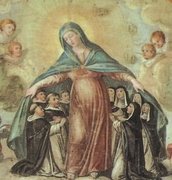
This is just one of many traditional depictions of the maternal protection of the Order of Preachers provided by our Lady. A similar motif, is it not? In St. Louis-Marie de Montfort's book, True Devotion to Mary, he makes the observation that due to the fact that Mary is now united to her Son, devotion to Mary is devotion to the Son. This helps unite these two themes.
God bless,
Mark
Dominus Flavit - The Lord wept
How many times am I to forgive my neighbor? Seven times seventy was the response. We must always be prepared to forgive our neighbor, if we wish to be forgiven. The one who plays God is not the one who takes life, no, he plays the devil. To play God is to extend mercy, for God glories in His mercy. Forgive us our trespasses as we forgive those who trespass against us.
Is there ever a situation where we may not forgive? No, as long as there is repentance, we are obliged to forgive, to act towards our neighbor as God does. This is the work of mercy incumbent on us, to be prepared to forgive from the heart, to rejoice with the angels over the conversion of a sinner.
Is there ever a situation where we can not forgive? This is different. For there is a sin which never can be forgiven, the sin against the Holy Spirit. This is the sin of refusing to repent and ask for mercy. One who does not ask cannot receive. Final impenitence for mortal sin brings one to hell, which is the exercise of God’s justice.
Who among us has not experienced the hurt from one who should love us, even who owes us their love and devotion, such as a child or a spouse? Is this not a shadow of what God receives from us, who in justice owe love to our creator, and gratitude to our redeemer? What parent is not quick to forgive a truly repentant child, and carries a deep hurt when they refuse our love and turn away?
So you see, repentance brings forth a response of mercy, which is the cause of joy in heaven and on earth. In stark contrast, impenitence brings forth justice, whose bitter fruit is sorrow, even the tears of God.
Jerusalem, Jerusalem, thou that killest the prophets
and stonest them that are sent unto thee, how often would I
have gathered together thy children, as the hen doth gather
her chickens under her wings, and thou wouldst not? [Mt 23:37]
Is there ever a situation where we may not forgive? No, as long as there is repentance, we are obliged to forgive, to act towards our neighbor as God does. This is the work of mercy incumbent on us, to be prepared to forgive from the heart, to rejoice with the angels over the conversion of a sinner.
Is there ever a situation where we can not forgive? This is different. For there is a sin which never can be forgiven, the sin against the Holy Spirit. This is the sin of refusing to repent and ask for mercy. One who does not ask cannot receive. Final impenitence for mortal sin brings one to hell, which is the exercise of God’s justice.
Who among us has not experienced the hurt from one who should love us, even who owes us their love and devotion, such as a child or a spouse? Is this not a shadow of what God receives from us, who in justice owe love to our creator, and gratitude to our redeemer? What parent is not quick to forgive a truly repentant child, and carries a deep hurt when they refuse our love and turn away?
So you see, repentance brings forth a response of mercy, which is the cause of joy in heaven and on earth. In stark contrast, impenitence brings forth justice, whose bitter fruit is sorrow, even the tears of God.
Jerusalem, Jerusalem, thou that killest the prophets
and stonest them that are sent unto thee, how often would I
have gathered together thy children, as the hen doth gather
her chickens under her wings, and thou wouldst not? [Mt 23:37]
Holy Land trip
Over the next few days, I hope to post some pictures and reflections from the trip to the holy land. Mark Gross, John Keenan, and Fr. Bart de la Torre joined Steve Ray's trip for a delicious buffet of the holy sites. This was Gwen's gift, and it has been received with love.
Deo Gratia
Deo Gratia
Tuesday, September 20, 2005
July Retreat
Finally thought to get Bonnie's pictures of the July retreat, which ran from Friday, the Feast of Mary Magdalene, through the rest of the weekend.

Yours truly introduced Mary Magdalene from a chapter in Louis of Granada's Summa of the Christian Life.

Our guest, Jayne Teske, gave a delightful presentation on Opus Dei

Sandra Ferguson followed with a presentation on the Holy Grail,

and Gayle and Stepanie by flashlight closed with more on Mary Madalene.

In the morning, our first Holy Mass at the Chapter House was celebrated!

A hearty thanks to Fr. Flores of Our Lady of the Valley for celebrating mass for us!

Holy Communion

Jim's urn

Procession with Jim's cremains to the cemetery.

The chapter gathers

for the final blessing for the interment. May God grant Jim Schuck TOP, and all the faithful departed, eternal rest.

Then, as good Dominican Tertiaries, it's back to the table to eat together,

and to study together,

and to pray together,

and then eat some more together,

to study the signs of the times,

and to praise the Lord in hymns and songs of praise.

Yours truly introduced Mary Magdalene from a chapter in Louis of Granada's Summa of the Christian Life.

Our guest, Jayne Teske, gave a delightful presentation on Opus Dei

Sandra Ferguson followed with a presentation on the Holy Grail,

and Gayle and Stepanie by flashlight closed with more on Mary Madalene.

In the morning, our first Holy Mass at the Chapter House was celebrated!

A hearty thanks to Fr. Flores of Our Lady of the Valley for celebrating mass for us!

Holy Communion

Jim's urn

Procession with Jim's cremains to the cemetery.

The chapter gathers

for the final blessing for the interment. May God grant Jim Schuck TOP, and all the faithful departed, eternal rest.

Then, as good Dominican Tertiaries, it's back to the table to eat together,

and to study together,

and to pray together,

and then eat some more together,

to study the signs of the times,

and to praise the Lord in hymns and songs of praise.
Friday, September 16, 2005
Preaching charism & Katrina
There is much noise from both ends of the spectrum; from divine punishment of sin to random events in a Godless universe. I thought it good to consider what today is in the Liturgy of the Hours, Office of Readings. St. Augustine wrote about the duties of the pastor, which includes preaching, which is the charism of the Dominicans in which we participate within our own circumstances.
As the media enjoys a macabre festival of finger-pointing, remember that God wants us to examine our own conscience, and to know and love Him that we may through our efforts help bring others to do so as well; and by so doing, offer the sacrifice of a soul that is so pleasing to God. This is what the sacrifices of the old testament prefigured; the death of the sinner reborn through baptism to a new life, offered to God.
As the media enjoys a macabre festival of finger-pointing, remember that God wants us to examine our own conscience, and to know and love Him that we may through our efforts help bring others to do so as well; and by so doing, offer the sacrifice of a soul that is so pleasing to God. This is what the sacrifices of the old testament prefigured; the death of the sinner reborn through baptism to a new life, offered to God.
Friday of the 24th Week of Ordinary Time
Liturgy of the Hours, Office of Readings
From a sermon On Pastors by St. Augustine
But what sort of shepherds are they who for fear of giving offense not only fail to prepare the sheep for the temptations that threaten, but even promise them worldly happiness? God himself made no such promise to this world. On the contrary, God foretold hardship upon hardship in this world until the end of time. And you want the Christian to be exempt from these troubles? Precisely because he is a Christian, he is destined to suffer more in this world.
For the Apostle says: All who desire to live a holy life in Christ will suffer persecution. But you, shepherd, seek what is yours and not what is Christ’s, you disregard what the Apostle says: All who want to live a holy live in Christ will suffer persecution. You say instead: “If you live a holy life in Christ, all good things will be yours in abundance…” Is this the way you build up the believer? Take note of what you are doing and where you are placing him. You have built him on sand. The rains will come, the river will overflow and rush in, the winds will blow, and the elements will dash against that house of yours. It will fall, and its ruin will be great.
Lift him up from the sand and put him on the rock. Let him be in Christ, if you wish him to be a Christian. Let him turn his thoughts to sufferings, however unworthy they may be in comparison to Christ’s. Let him center his attention on Christ, who was without sin, and consider Scripture which says to him: He chastises every son whom he acknowledges. Let him prepare to be chastised, or else not seek to be acknowledged as a son.
Venerable Louis of Granada
The Sinners Guide
Chapter 28, Of those who refuse to practice Virtue because they love the World
To understand this more fully, remember that true happiness does not consist in sensible or corporal pleasures, as the disciples of Epicurus and Mahomet assume. In the sane class we may place bad Christians whose lips deny the doctrines of these men, but whose lives are entirely in accordance with them. For do not he majority of the rich, who spend their lives in the mad pursuit of pleasure, tacitly acknowledge with Epicureans that pleasure is their last end, and with the Mahometans that sensual delight is their paradise? O disciples worthy of such masters! Why do you not abhor the lives of those whose teachings you profess to condemn? If you will have the paradise of Mahomet, you must expect to lose that of Christ.
Tuesday, August 30, 2005
Monday, August 29, 2005
Peace
There are three types of peace.
The first is the peace between God and man. God holds out the offer from the cross and awaits our acceptance. In other words, God waits for us to end the war against Him. He triumphed by surrendering to sinners. Why do we wait to surrender to the source of our being and of all Good?
The second peace is that peace where man is a peace with himself. The world covets this peace but does not know how to achieve it. This peace is a mirror of the first peace. In the first, peace is achieved when the lower serves the higher; thus when the lower faculties of the soul and the flesh serve the higher faculties of the soul (memory, understanding, and will), man is at peace with himself. The will is moved by the reason. Without grace, which comes from the first peace, the higher serves the lower, and man is not a peace, for he is serving his base appetites. The lower faculties incline towards vice, the higher towards virtue. With grace, the lower serves the higher, and man is at peace with himself.
The third peace is between neighbors. This peace is not possible between men who are not in possession of the first two. At best, men not at peace with themselves or God can be compelled into a facsimile of peace, but true peace occurs only when man is not at war with God and himself.
It is the world contents that the third peace can be had without the first, or even without reference to the second. The Lord, as our source and summit, who came to bring the blessing of peace on earth to men of good will, gave us the only Way, in Truth, and Life.
Thanks to Ven Louis of Granada, The Sinners Guide.
The first is the peace between God and man. God holds out the offer from the cross and awaits our acceptance. In other words, God waits for us to end the war against Him. He triumphed by surrendering to sinners. Why do we wait to surrender to the source of our being and of all Good?
The second peace is that peace where man is a peace with himself. The world covets this peace but does not know how to achieve it. This peace is a mirror of the first peace. In the first, peace is achieved when the lower serves the higher; thus when the lower faculties of the soul and the flesh serve the higher faculties of the soul (memory, understanding, and will), man is at peace with himself. The will is moved by the reason. Without grace, which comes from the first peace, the higher serves the lower, and man is not a peace, for he is serving his base appetites. The lower faculties incline towards vice, the higher towards virtue. With grace, the lower serves the higher, and man is at peace with himself.
The third peace is between neighbors. This peace is not possible between men who are not in possession of the first two. At best, men not at peace with themselves or God can be compelled into a facsimile of peace, but true peace occurs only when man is not at war with God and himself.
It is the world contents that the third peace can be had without the first, or even without reference to the second. The Lord, as our source and summit, who came to bring the blessing of peace on earth to men of good will, gave us the only Way, in Truth, and Life.
Thanks to Ven Louis of Granada, The Sinners Guide.
Tuesday, August 23, 2005
St. Rose of Lima
Today is the feast day of the first American saint, Rose of Lima. Next Sunday you will hear our Lord in the Gospel tell us to "pick up our cross daily and follow Him." Rose had this to say (LOH: Office of Readings, Aug 32):
Our Lord said to Rose: "Let all men know that grace comes after tribulation. Let them know that without the burden of afflictions it is impossible to reach the height of grace. Let them know that the gifts of grace increase as the struggles increase. Let men take care not to stray and be deceived. This is the only true stairway to paradise, and without the cross they can find no road to climb to heaven"
Rose answers: "If only mortals would learn how great it is to possess divine grace, how beautiful, how noble, how precious. How many riches it hides within itself, how many joys and delights! Without doubt they would devote all their care and concern to winning for themselves pains and afflictions. All men throughout the world would seek trouble, infirmities and torments, instead of good fortune, in order to attain the unfathomable treasures of grace. This is the reward and the final gain of patience. No one would complain about his cross or about troubles that may happen to him, if he would come to know the scales on which they are weighted when they are distributed to men."
From the New Advent site:
In her twentieth year she received the habit of St. Dominic. Thereafter she redoubled the severity and variety of her penances to a heroic degree, wearing constantly a metal spiked crown, concealed by roses, and an iron chain about her waist. Days passed without food, save a draught of gall mixed with bitter herbs. When she could no longer stand, she sought repose on a bed constructed by herself, of broken glass, stone, potsherds, and thorns. She admitted that the thought of lying down on it made her tremble with dread. Fourteen years this martyrdom of her body continued without relaxation, but not without consolation. Our Lord revealed Himself to her frequently, flooding her soul with such inexpressible peace and joy as to leave her in ecstasy four hours. At these times she offered to Him all her mortifications and penances in expiation for offences against His Divine Majesty, for the idolatry of her country, for the conversion of sinners, and for the souls in Purgatory.
Our Lord said to Rose: "Let all men know that grace comes after tribulation. Let them know that without the burden of afflictions it is impossible to reach the height of grace. Let them know that the gifts of grace increase as the struggles increase. Let men take care not to stray and be deceived. This is the only true stairway to paradise, and without the cross they can find no road to climb to heaven"
Rose answers: "If only mortals would learn how great it is to possess divine grace, how beautiful, how noble, how precious. How many riches it hides within itself, how many joys and delights! Without doubt they would devote all their care and concern to winning for themselves pains and afflictions. All men throughout the world would seek trouble, infirmities and torments, instead of good fortune, in order to attain the unfathomable treasures of grace. This is the reward and the final gain of patience. No one would complain about his cross or about troubles that may happen to him, if he would come to know the scales on which they are weighted when they are distributed to men."
From the New Advent site:
In her twentieth year she received the habit of St. Dominic. Thereafter she redoubled the severity and variety of her penances to a heroic degree, wearing constantly a metal spiked crown, concealed by roses, and an iron chain about her waist. Days passed without food, save a draught of gall mixed with bitter herbs. When she could no longer stand, she sought repose on a bed constructed by herself, of broken glass, stone, potsherds, and thorns. She admitted that the thought of lying down on it made her tremble with dread. Fourteen years this martyrdom of her body continued without relaxation, but not without consolation. Our Lord revealed Himself to her frequently, flooding her soul with such inexpressible peace and joy as to leave her in ecstasy four hours. At these times she offered to Him all her mortifications and penances in expiation for offences against His Divine Majesty, for the idolatry of her country, for the conversion of sinners, and for the souls in Purgatory.
Wednesday, August 03, 2005
Subscribe to:
Posts (Atom)