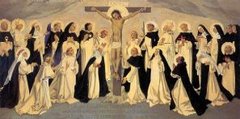
In this video series Fr. Dominic Legge, O.P. explains why Mary Magdalene was chosen as a patroness of the Dominican Order.
Part 1
Part 2
Part 3
Part 4
There's even some DaVinci Code (remember that?) thrown in!
July 26, 2011 - Archbishop Pietro Sambi, Apostolic Nuncio to the United States of America, has been placed on assisted ventilation after complications following a delicate surgery. The Apostolic Nunciature and the Nuncio's family kindly ask that Bishops, priests, religious, and lay faithful offer sacrifices and prayers for the health of the Apostolic Nuncio.
 The 17th issue of "Truth Be Told," the newsletter of the Laity of the Province of the Holy Name of Jesus has been posted to the web.


The Crucifix is a Book
I remember having read, under this title, a beautiful story in “Christian Perfection;” it relates to St Bonaventure. At the time when he was in great repute, teaching theology in Paris, and attraction general esteem and admiration by his works, St Thomas Aquinas went one day to see him, and requested him to show him what books he used for his studies. Then St Bonaventure, conducting him to his little chamber, showed him some very common books that were on his table. But St Thomas gave him to understand that he desired to see the other books from which he derived so many marvelous things. The Saint then showed him a small oratory, with nothing in it but a crucifix: “There, Father,” said he, “is all my other books; this is the principal one from which I draw all I teach, and all I write. Yes, it is by throwing myself at the foot of that crucifix, and begging of Him whose image it bears, the enlightenment of my doubts, and assisting at Mass, that I have made more progress in the sciences, and have gained more true fights than I should have done by the reading of any books whatsoever.” You did not expect this, that whilst men study much and know but little, the Saints content themselves with this crucifix, and attain to this most sublime genius.
Catholic Gems and Pearls, Rev J. Phelan, 1900

A proposal for the fiftieth anniversary of Vatican II
THE SUPERNATURAL WAY TO RESTORE PEACE BETWEEN
THE PRE- AND POST-COUNCIL
by Enrico Maria Radaelli
Third question: If we deny the infallibility of the doctrinal developments of the Council that depart from previous doctrines of the faith or close to the faith, won't we weaken the power of the continuist thesis?
Of course you weaken it, dear Fr. Cavalcoli, and even more: you annihilate it. And you strengthen the opposite thesis, as it should be, that there is no continuity.
No rupture, but also no continuity. So what then? The way out is suggested by Romano Amerio (1905-1997) with what the author of "Iota Unum" calls "the law of the historical preservation of the Church," revisited on page 41 of my book, according to which "the Church would not be lost in the case that it did not 'match' the truth, but in the case that it 'lost' the truth." And when does the Church not match the truth? When it forgets its teachings, or confuses them, muddies them, mixes them up, as has happened (not for the first time, and not for the last) from the Council until today. And when would it lose the truth? (In the conditional: it has been seen that it cannot in any way lose it.) Only if it struck it with anathema, or if vice versa it dogmatized a false doctrine, things that could be done by the pope and only by the pope, if (in the metaphysically impossible hypothesis that) his dogmatizing and anathematizing lips were not supernaturally bound by the two aforementioned oaths of Our Lord. I would insist on this point, which seems decisive to me.
the entire article may be read hereThe Psychopathology of “Sex Reassignment Surgery”: Assessing its Medical, Psychological and Ethical Appropriatenesspublished in The National Catholic Bioethics QuarterlyMoral Issues in Major SurgerySpring 2009Richard Fitzgibbons, Philip Sutton, and Dale O’Leary
AbstractIs it ethical to perform a surgery whose purpose is to make a male look like a female or a female to appear male? Is it medically appropriate? Sexual Reassignment Surgery (SRS) violates basic medical and ethical principles and is therefore not ethically or medically appropriate. (1) SRS mutilates a healthy, non-diseased body. To perform surgery on healthy body involves unnecessary risks; therefore, SRS violates the principle “primum non nocere (first, do no harm).” (2) Candidates for SRS may believe that they are trapped in the bodies of the wrong sex and therefore desire, or more accurately demand SRS; however, this belief is generated by a disordered perception of self. Such a fixed, irrational belief is appropriately described as a delusion. SRS, therefore, is a “category mistake”—it offers a surgical solution for psychological problems such as a failure to accept the goodness of one’s masculinity or femininity, lack of secure attachment relationships in childhood with same sex peers or a parent, self-rejection, untreated gender identity disorder, addiction to masturbation and fantasy, poor body image, excessive anger, severe psychopathology in a parent, etc. (3) SRS does not accomplish what it claims to accomplish. It does not change a person’s sex; therefore, it provides no true benefit. (4) SRS is a "permanent," effectively unchangeable, and often unsatisfying surgical attempt to change what may be only a temporary (i.e., psychothepeutically changeable) psychological/psychiatric condition.
But the surest method of arriving at a knowledge of God's eternal purposes about us is to be found in the right use of the present moment. We must esteem our present grace, and rest in it, and with tranquil assiduity correspond to it. Our present grace is the most infallible will of God. It is a revelation from God, which almost always brings its own authoritative interpretation along with it. What we want for our sanctification is not merely grace, but the right grace, the right grace at the right time and in the right place. God's will does not come to us in the whole, but in fragments, and generally in small fragments. It is our business to piece it together, and to live it into one orderly vocation. Like a lantern in the night, grace gives light around our feet, a circle of light just wide enough to prevent our stumbling. But then we must look at our feet. If we strain our eyes into the gloom ahead of us, we shall stumble in spite of the lantern: nay sometimes we shall even stumble because of it, its shadows move so suddenly, and with such unwieldy strides. Our present grace is also the one least beset with delusions, and we can act safely upon it, although perhaps not comfortably, even when we do not see how it matches with what has just gone before, or how it can fit into any conceivable future which our circumstances will allow. The hours are like slaves which follow each other, bringing fuel to the furnace. Each hour comes with some little (censored) of God's will fastened upon its back. If we thus esteem our present grace, we shall begin to understand God's purposes. It seems an easy thing to do, and yet it cannot really be easy because so few do it. One man is always pulling the past to pieces, while another man is marching with his head erect into the uncertain future, disdainful of the present. Strange to say, intentions are more exciting than actions, and therefore more attractive. For safety and for swiftness, for clear light and successful labour, there is nothing like the present. Practically speaking, the moment that is flying holds more eternity than all our past, and the future holds none at all, and only becomes capable of holding any, as it is manufactured piecemeal into the present. The spiritual direction of multitudes of men consists of nothing but keeping them to this; and it is one of those unlikely works which has the misfortune of being seldom successful, even though it is indispensable, and on the whole least successful, where most indispensable.
What is a Colloquium? The term “colloquium” is a conference or seminar in which a particular subject or topic is discussed. Unlike many a conference or seminar in which people simply listen to guest speakers, a colloquium invites dialog and discussion among many people. This Colloquium will focus on the social doctrine of the Catholic Church and its effect upon Idaho and the modern world.


Hungary: a governmental pro-life campaign
M. Viktor Orban’s government, just few weeks after the promulgation of the new Constitution protecting “the life of the foetus […] from the moment of conception”, started a consciousness-raising campaign in favor of adoption aimed at pregnant women in distress. Here is a poster. This picture was taken (by Sakari Huttunen for the Hu-lala website) at the beginning of May in a subway station in Budapest. This is a positive and comprehensible message, which invites to prefer adoption to abortion:
“I understand well that you are not ready to welcome me in your life, but give me to the adoption service, let me live”, entreats the unborn child.
[]
Article II of the new Hungarian Constitution protects a foetus’ right to life, which begins at conception:
“Human dignity shall be inviolable. Everyone shall have the right to life and human dignity; the life of the foetus shall be protected from the moment of conception."
At times I get the opportunity to leave my office for a break, which is located about three blocks from the St. John’s Cathedral in Boise, and either go to Holy Mass or take some time in prayer in the downstairs Chapel. I visited there today—not long after the Mass had been completed.
As I entered, it was quiet and the lights were dim and I knew it was a good time for silent prayer. After kneeling, it was apparent the sacristy door was wedged open slightly and a conversation could be heard.
The uneasy conversation occurred while others were praying in the Chapel including myself. While I could not attend Mass earlier, I was in the Chapel not long thereafter. From the wedged door, the people in the Chapel could hear the celebrant engaged in a lively discussion with a young woman.
From what could be discerned, she had knelt to receive Communion during Mass. The celebrant obviously objected to her posture. Having caught the end of a degrading dialog, I heard the young woman cite a recent statement by the Vatican encouraging receipt of Communion while kneeling. She also noted the fact she had received Communion while kneeling at another church without objection.
The celebrant voiced his objection again and—posing a question laced with cynicism—asked whether the “other” church celebrated the Latin Mass or had a communion rail. The young woman responded “no.” The woman recalled that the Mass celebrated at the “other” church was the ordinary form of the Holy Mass. After her response, the celebrant again objected to her kneeling and cited that she presented herself for communion “carrying Rosaries and a picture of Jesus.”
The celebrant asked the young woman to leave. As I had already finished my brief prayer and as I parted, the young woman appeared outside the Chapel in tears. From what I could discern during the last part of the dialog mentioned above, the woman’s motive was her object of devotion: Our Lord in the Holy Eucharist.
The celebrant is an elderly priest. His communication seemed intolerant of certain outward expressions of devotion as unsuitable in the modern Church. Yet, his generation and the 1960s mode of thinking are passing.
While I continue to pray for and am thankful for these elderly priests who celebrate Holy Mass and who sacrifice for others every day; why is it they get their knickers in a knot when it comes to the Faithful’s public expression of devotion to a Good God? Especially, when there is no harm done? If anything, public devotion is a good model for others to follow particularly children. Also, it appears that the celebrant’s objection to kneeling for Communion has more to do with form than substance.


I don’t see anything wrong with people being happy about a victory over an implacable and dangerous enemy that acted so despicably and mercilessly against unarmed, defenseless people ...
The 16th issue of "Truth Be Told," the newsletter of the Laity of the Province of the Holy Name of Jesus has been posted to the web.

Armed gunmen invade a Catholic church, shooting the faithful in prayer and murdering the priest. The Middle East today? Germany in the 1940s?From the Friars Blog of the Eastern Province (Link)
At America's back door in the 1920's the Mexican Government, headed by the atheist Plutarco Elías Calles, began an all-out assault on the Catholic Church, and especially the clergy of Mexico. In reponse, thousands rose up in armed revolt against the repressive Mexican government and in defense of the Church and religious freedom. The uprising became known as the Cristeros War, or Cristiada.
Now, Newland Films, a Mexican production company, is releasing a new film, Cristiada, about the Cristeros War. The movie stars Andy Garcia and Peter O'Toole, and is already garnering interest as a stirring tribute to those who risked their lives in defense of the faith in Mexico. The makers of the film describe it a: "A chronicle of the Cristeros War (1926-1929) which was touched off by a rebellion against the Mexican Government's attempt to secularize the country. The film follows the stories of ordinary people from across the country who choose to stand up for their freedom. Caught up in a full-fledged civil war, they must decide how far they are willing to go and what they're willing to risk."
Feeding Sheep or Amusing Goats?With good reason Leo XIII ordered the St Michael prayer be said at the end of mass.
attributed to Charles H. Spurgeon, 1834-1892 (edited)
________________________________________
An evil is in the professed camp of the Lord, so gross in its impudence, that the most shortsighted can hardly fail to notice it. During the past few years it has developed at an abnormal rate, even for evil. It has worked like leaven until the whole lump ferments. The devil has seldom done a cleverer thing, than hinting to the Church that part of their mission is to provide entertainment for the people, with a view to winning them. From speaking out as the Puritans did, the Church has gradually toned down her testimony, then winked at and excused the frivolities of the day. Then she tolerated them in her borders. Now she has adopted them under the plea of reaching the masses.
My first contention is that providing amusement for the people is nowhere spoken of in the Scriptures as a function of the Church - if it is a Christian work why did not Christ speak of it? 'Go ye into all the world and preach the gospel to every creature'. That is clear enough, so it would have been if He had added, 'and provide amusement for those who do not relish the gospel'. No such words, however, are to he found. It did not seem to occur to Him. Then again, 'He gave some apostles, some prophets, some pastors and teachers, for the work of the ministry'. Where do entertainers come in? The Holy Spirit is silent concerning them. Were the prophets persecuted because they amused the people or because they refused? The concert has no martyr roll.
Again, providing amusement is in direct antagonism to the teaching and life of Christ and all His apostles. What was the attitude of the Church to the world? 'Ye are the salt', not the sugar candy - something the world will spit out, not swallow. Short and sharp was the utterance 'Let the dead bury their dead'. He was in awful earnestness!
Had he introduced more of the bright and pleasant elements into His mission, He would have been more popular when they went back, because of the searching nature of His teaching. I do not hear Him say, 'Run after these people, Peter, and tell them we will have a different style of service tomorrow - something short and attractive with little preaching - we will have a pleasant evening for the people. Tell them they will be sure to enjoy it. Be quick, Peter, we must get the people somehow!' Jesus pitied sinners, sighed and wept over them, but never sought to amuse them. In vain will the epistles be searched to find any trace of the gospel of amusement. Their message is. 'Come out, keep out, keep clean out' - anything approaching fooling is conspicuous by its absence. They had boundless confidence in the gospel and employed no other weapon.
After Peter and John were locked up for preaching, the Church had a prayer meeting, but they did not pray, 'Lord, grant unto thy servants that by a wise and discriminating use of innocent recreation we may show these people how happy we are'. If they ceased not for preaching Christ, they had not time for arranging entertainments - scattered by persecution they went everywhere preaching the gospel. They turned the world upside down, that is the only difference! Lord, clear the Church of all the rot and rubbish the devil has imposed on her and bring us back to apostolic methods.
Lastly, the mission of amusement fails to effect the end desired. It works among young converts. Let the careless and scoffers, who thank God because the Church met them half way, speak and testify. Let the heavy laden who found peace through the concert not keep silent! Let the drunkard to whom the dramatic entertainment had been God's link in the chain of their conversion, stand up! There are none to answer! The mission of amusement produces no converts.
The need of the hour for today's ministry is believing scholarship, joined with earnest spirituality, the one springing from the other as fruit from the root. The need is Biblical doctrine, so understood and felt, that it sets men on fire.